Chronic Fatigue: Activity and Rest Planning
A planning worksheet for people living with chronic fatigue or ME/CFS: mapping the boom-and-bust pattern, finding a sustainable baseline for activity, scheduling rest deliberately, and making only small, stable changes.
About this resource
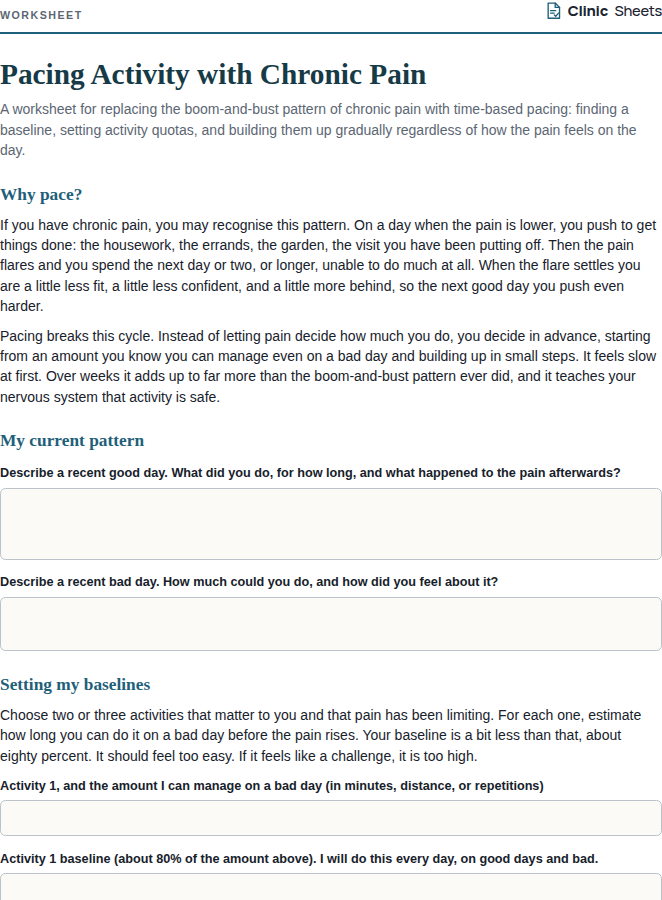
People living with persistent fatigue, whether diagnosed with ME/CFS or with fatigue secondary to another condition, very commonly fall into a boom-and-bust pattern. On a better day they do everything that has been waiting, then crash for days afterwards; during the crash they do almost nothing, lose fitness and confidence, and the next good day brings the same over-reach. Over time the average level of activity falls, and the unpredictability is exhausting in itself. Avoidance of activity out of fear of the crash, and a sense of guilt that drives over-activity when energy allows, are both part of the cycle.
Energy management, often called pacing, aims to replace this pattern with a steadier one: finding a level of activity and rest that can be sustained on most days, holding it there until it is stable, and making any increases small and only from a stable base. The NICE guideline for ME/CFS (2021) recommends energy management as a core approach and advises against fixed incremental increases in activity that do not take account of the person's response, which is why this worksheet emphasises stability and the person's own symptom signals rather than a schedule of increases. For post-exertional malaise, the worsening of symptoms after exertion that is characteristic of ME/CFS, the priority is to stay within limits rather than to push through.
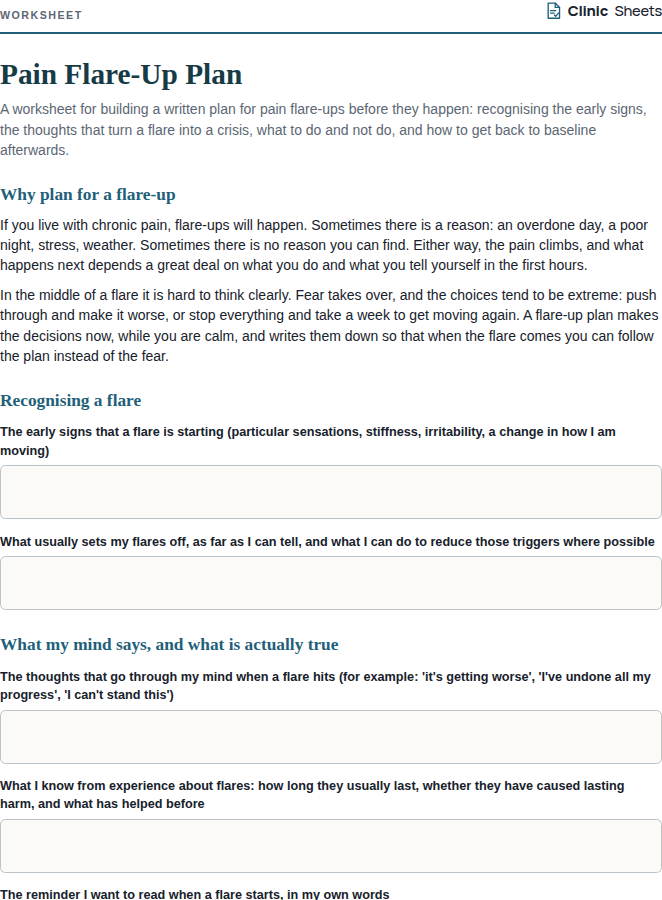
This worksheet takes the client through their current pattern, identifies a realistic baseline for the main daily activities, schedules rest as a planned part of the day rather than a consequence of collapse, and sets up a way of tracking how the plan is going. The professional version notes that the approach should be collaborative and led by the client's experience, that any medical causes of fatigue should have been assessed, and that low mood and sleep problems commonly co-occur and need attention in their own right.
How to use it
- Ensure the client has had medical assessment for their fatigue. This worksheet supports self-management; it does not replace investigation or treatment of underlying causes.
- Ask the client to keep a simple activity and symptom diary for one to two weeks before completing the baseline section, so the plan is based on data rather than memory of best or worst days.
- Set the baseline conservatively, at a level the client can manage on a poor day, not an average day. A baseline that is too high produces another crash and undermines confidence in the approach.
- Treat rest as scheduled and deliberate. Many clients only rest when they have no choice; help them plan short rests before they are needed.
- Do not impose a schedule of increases. Review the diary together, and only when the client has been stable for a sustained period consider a small change, agreed with them, and hold it there again. If symptoms worsen, return to the previous level without framing this as failure.
References
- National Institute for Health and Care Excellence. (2021). Myalgic encephalomyelitis (or encephalopathy)/chronic fatigue syndrome: Diagnosis and management (NICE guideline NG206). NICE.
- Burgess, M., & Chalder, T. (2005). Overcoming Chronic Fatigue: A Self-Help Guide Using Cognitive Behavioral Techniques. Robinson.
- Otis, J. D. (2007). Managing Chronic Pain: A Cognitive-Behavioral Therapy Approach, Therapist Guide. Oxford University Press.