Coping with a Cancer Diagnosis
A handout for adults recently diagnosed with cancer: what is normal in the emotional response, how the mind tries to cope, and ways to steady yourself through uncertainty, treatment and the questions that have no answers yet.
About this resource
A cancer diagnosis is one of the most disorienting experiences a person can have. In the weeks after diagnosis, shock, fear, numbness, anger and disbelief are all common, and the mind swings between the practical (appointments, decisions, telling people) and the existential. Anxiety and depression are more common in people with cancer than in the general population, and a substantial minority meet criteria for a disorder, but most of the distress is an understandable reaction to a real threat rather than a sign of psychopathology. Clinicians need to normalise without minimising, and to distinguish adjustment from a disorder that needs treatment in its own right.
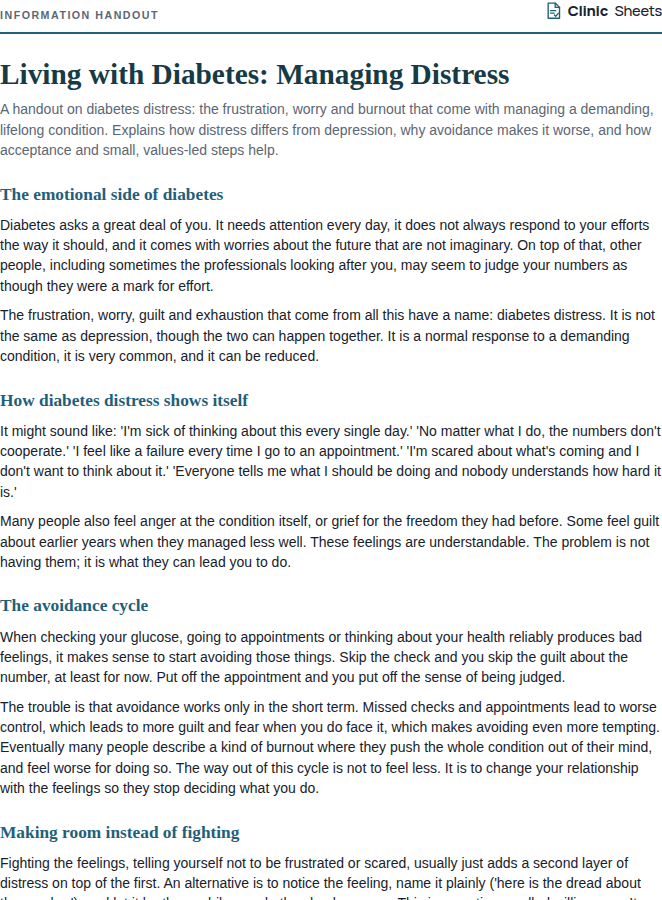
This handout draws on Moorey and Greer's adjuvant psychological therapy, a CBT approach developed specifically for people with cancer, and on acceptance and commitment therapy, which has been applied in oncology settings with an emphasis on psychological flexibility: making room for fear and uncertainty rather than being consumed by attempts to eliminate them, and staying connected to what matters in the life that is still being lived. It explains the common emotional responses, describes the difference between worry that leads to action and worry that goes round in circles, and offers concrete steps: managing information, staying in the present when the future is unknowable, keeping contact and routine, and asking for help.
The professional version notes the importance of screening for depression and anxiety at points of transition (diagnosis, start and end of treatment, recurrence), the value of coordinating with the oncology team and psychosocial oncology services, and a caution against framing coping in terms of 'fighting' or 'positive attitude', which can leave clients feeling responsible for their own prognosis. Nothing in the handout offers medical information; questions about treatment and prognosis belong with the medical team.
How to use it
- Use in the early weeks after diagnosis or at the start of treatment. Read it with the client and ask which of the described responses fit their experience.
- Screen for depression and anxiety and ask about hopelessness. Distress that is intense, persistent and interfering warrants treatment in its own right, not only support.
- Help the client distinguish worries they can act on (questions for the oncologist, practical arrangements) from worries that cannot be resolved yet, and build skills for the second kind: present-focused attention, willingness, and scheduled worry time if useful.
- Avoid language about fighting, winning or staying positive. Emphasise that emotional responses do not affect prognosis and that feeling frightened or low is not a failure of coping.
- Signpost to the oncology team's psychosocial services, peer support and practical support, and coordinate care where the client consents.
References
- Moorey, S., & Greer, S. (2012). Oxford Guide to CBT for People with Cancer (2nd ed.). Oxford University Press.
- Mitchell, A. J., Chan, M., Bhatti, H., Halton, M., Grassi, L., Johansen, C., & Meader, N. (2011). Prevalence of depression, anxiety, and adjustment disorder in oncological, haematological, and palliative-care settings: A meta-analysis of 94 interview-based studies. The Lancet Oncology, 12(2), 160-174.
- Hayes, S. C., Strosahl, K. D., & Wilson, K. G. (2012). Acceptance and Commitment Therapy: The Process and Practice of Mindful Change (2nd ed.). Guilford Press.