Intrusive Thoughts in New Parents
A reassuring, accurate handout explaining why unwanted thoughts and images about harm coming to the baby are common in new parents, why they are not a sign of danger, and how responding to them differently stops them from taking over.
About this resource
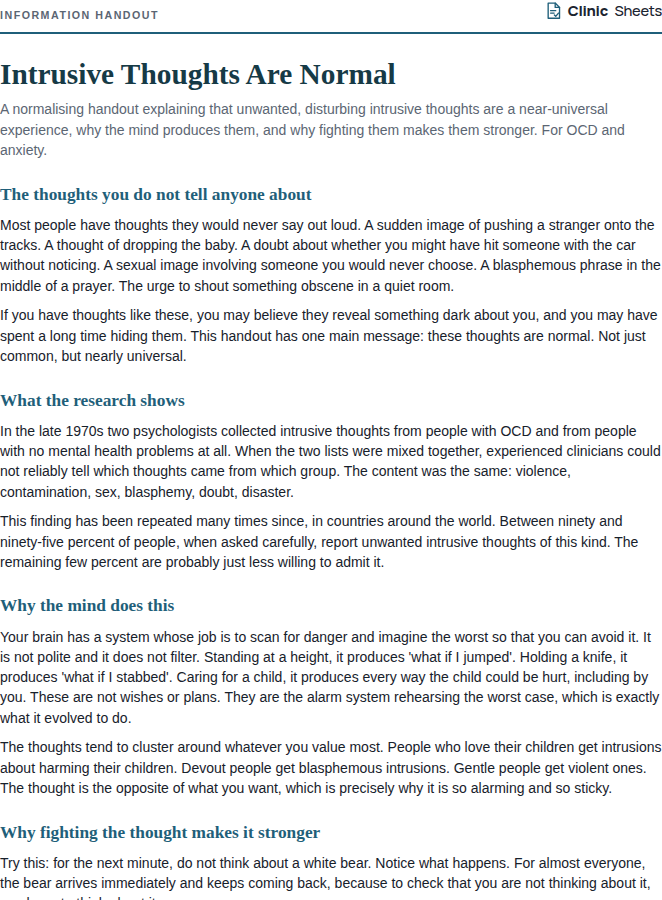
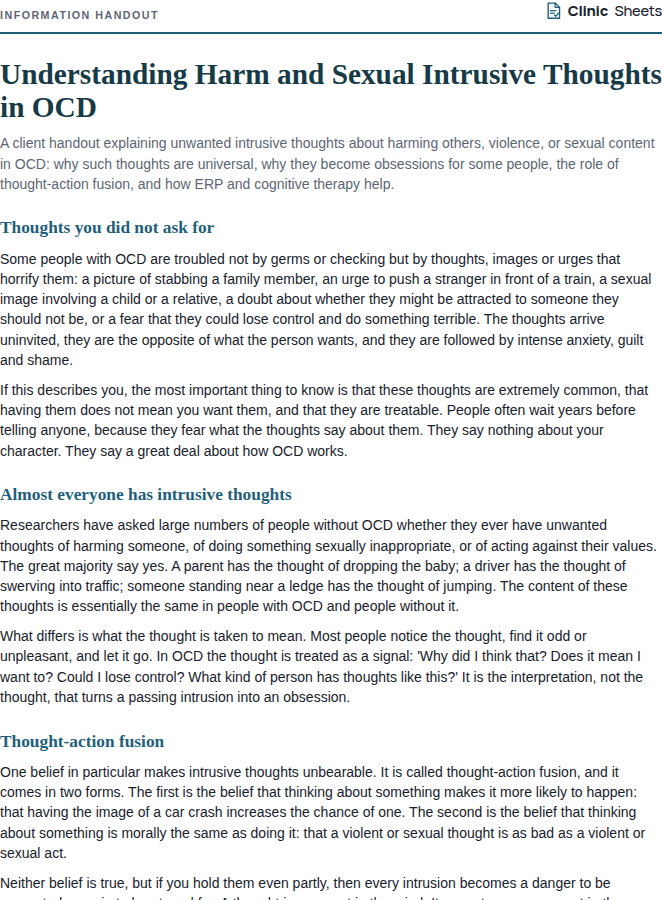
Unwanted, intrusive thoughts and images of harm coming to the infant, including thoughts of accidentally or deliberately hurting the baby, are reported by a large majority of new mothers and by many fathers. They are a normal feature of the postpartum period and appear to reflect a protective system on high alert. For most parents they pass quickly. For some they become a source of intense shame, secrecy and avoidance, and in a minority they develop into postpartum obsessive-compulsive symptoms.
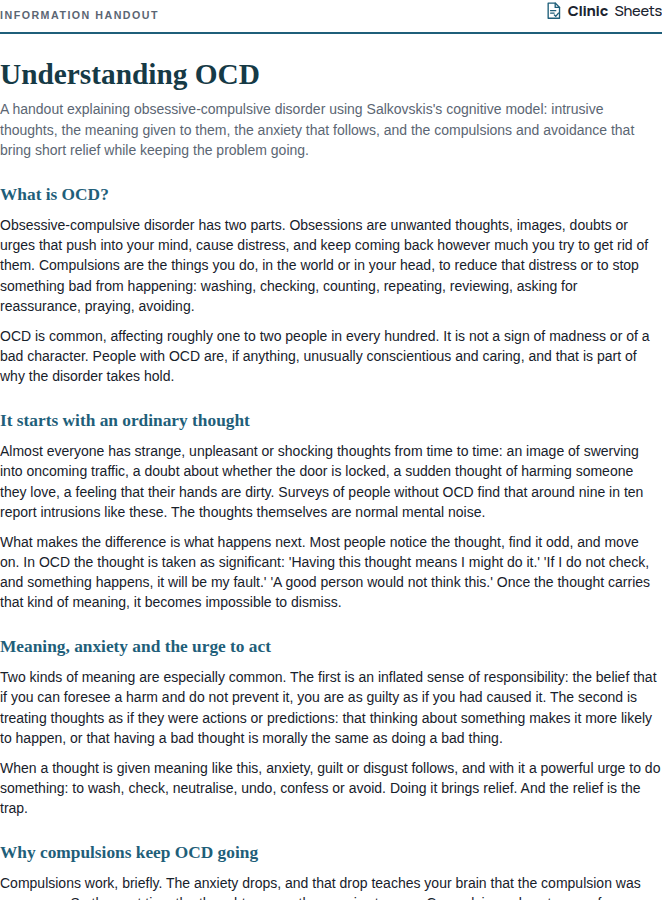
This handout draws on the cognitive model of obsessions: the thought itself is not the problem; the meaning attached to it ('having this thought means I might do it' or 'a good parent would never think this') and the responses that follow (checking, avoiding the baby, seeking reassurance, mental arguing) are what turn an ordinary intrusion into a persistent problem. It normalises the experience, explains the difference between an intrusive thought and an intention, and describes responses that keep the thought from growing.
The professional version adds guidance on distinguishing ego-dystonic intrusive thoughts from the delusional beliefs and disorganisation of postpartum psychosis, which requires urgent psychiatric assessment, and notes on how to ask about these thoughts directly and calmly, since parents rarely volunteer them.
How to use it
- Ask directly. Many parents will not raise these thoughts unless invited. A normalising question such as 'Lots of new parents get sudden unwanted thoughts or pictures of something bad happening to the baby. Has anything like that happened to you?' opens the door.
- Assess before reassuring. Establish that the thoughts are unwanted and distressing, that the parent has no wish to act on them, and that there are no features of psychosis or of depression with active suicidal or infanticidal intent. Where any of these are present, follow local risk and referral procedures.
- Read the handout together, pausing at the section on thoughts versus intentions. Ask the parent what they had made the thoughts mean and what they have been doing in response.
- Identify the parent's specific safety behaviours (avoiding bathing the baby, never being alone with the baby, hiding knives, repeated checking) and explain how these maintain the fear. Where symptoms are frequent and impairing, move to a CBT or exposure and response prevention plan for postpartum OCD.
- Where a partner is present and the parent consents, share the handout with them. Partners often respond to disclosure with alarm, and their understanding reduces secrecy.
References
- Abramowitz, J. S., Schwartz, S. A., Moore, K. M., & Luenzmann, K. R. (2003). Obsessive-compulsive symptoms in pregnancy and the puerperium: A review of the literature. Journal of Anxiety Disorders, 17(4), 461-478.
- Fairbrother, N., & Woody, S. R. (2008). New mothers' thoughts of harm related to the newborn. Archives of Women's Mental Health, 11(3), 221-229.
- Rachman, S., & de Silva, P. (1978). Abnormal and normal obsessions. Behaviour Research and Therapy, 16(4), 233-248.
- Salkovskis, P. M. (1985). Obsessional-compulsive problems: A cognitive-behavioural analysis. Behaviour Research and Therapy, 23(5), 571-583.