Understanding OCD
A handout explaining obsessive-compulsive disorder using Salkovskis's cognitive model: intrusive thoughts, the meaning given to them, the anxiety that follows, and the compulsions and avoidance that bring short relief while keeping the problem going.
About this resource
The cognitive-behavioural model of OCD, developed by Salkovskis and extended by Rachman and the Obsessive Compulsive Cognitions Working Group, holds that obsessions begin as ordinary intrusive thoughts, images or urges that almost everyone experiences. What distinguishes OCD is the appraisal: the intrusion is interpreted as meaning something important about the person (that they are dangerous, immoral or responsible for preventing harm), and this interpretation generates anxiety, guilt or disgust. Compulsions, mental rituals, reassurance seeking and avoidance are attempts to reduce that distress or prevent the feared outcome. They provide brief relief, which reinforces them, and they block the person from learning that the intrusion was harmless and the feared outcome would not have occurred.
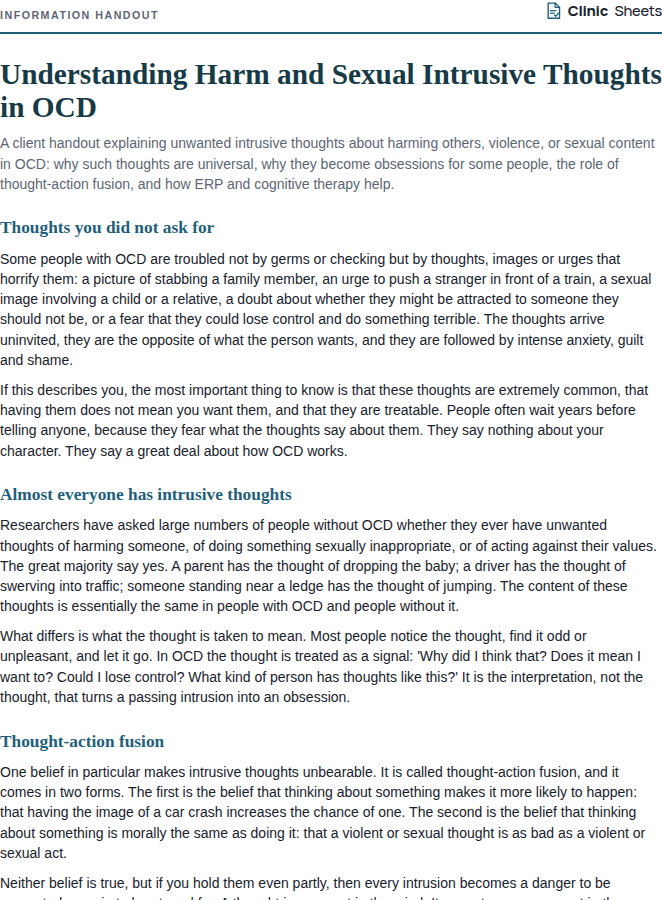
This handout walks the client through that sequence with two worked examples covering different OCD presentations (contamination and harm obsessions), explains the concepts of inflated responsibility and thought-action fusion in everyday terms, and prepares the client for exposure and response prevention by explaining why compulsions are the target of treatment rather than the thoughts themselves. A closing reflection section asks the client to identify their own intrusions, appraisals and compulsions.
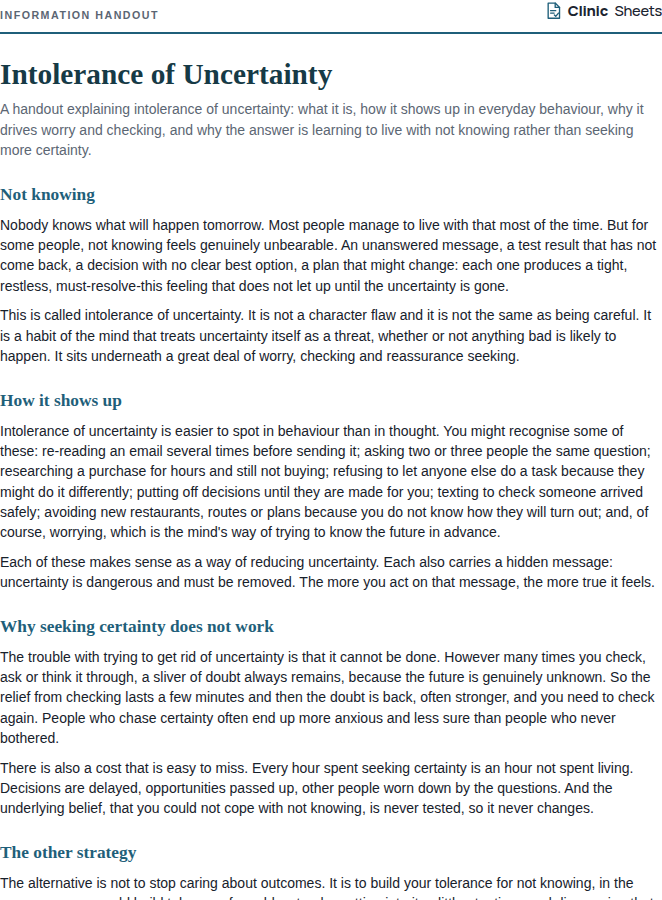
Use in the first or second session of CBT or ERP for OCD, before building a hierarchy. The professional version adds a table of the common OCD belief domains (responsibility, overestimation of threat, importance and control of thoughts, perfectionism, intolerance of uncertainty), guidance on identifying covert mental compulsions, and notes on presenting the model to clients whose obsessions are ego-dystonic and shameful (harm, sexual, religious themes) without either reassuring them or reinforcing the fear.
How to use it
- Use after assessment, once you know the client's main obsessional themes and compulsions, including mental ones.
- Read the model together and stop at each of the two worked examples. Ask which one is closer to the client's experience, then rebuild the sequence with one of their own recent episodes.
- Take care with the appraisal step. Ask: When that thought came, what did it mean to you that you had it? What did you think it said about you or about what might happen? Do not offer reassurance about the content.
- List all compulsions, including reviewing, mentally checking, praying, seeking reassurance, and avoidance. Ask what each is meant to prevent and how long the relief lasts.
- Complete the reflection section and preview exposure and response prevention: facing the trigger, letting the intrusion be there, and not doing the compulsion, so that the client can discover what actually happens.
References
- Salkovskis, P. M. (1985). Obsessional-compulsive problems: A cognitive-behavioural analysis. Behaviour Research and Therapy, 23(5), 571-583.
- Rachman, S. (1997). A cognitive theory of obsessions. Behaviour Research and Therapy, 35(9), 793-802.
- Obsessive Compulsive Cognitions Working Group. (1997). Cognitive assessment of obsessive-compulsive disorder. Behaviour Research and Therapy, 35(7), 667-681.
- Abramowitz, J. S., Taylor, S., & McKay, D. (2009). Obsessive-compulsive disorder. The Lancet, 374(9688), 491-499.