Understanding Harm and Sexual Intrusive Thoughts in OCD
A client handout explaining unwanted intrusive thoughts about harming others, violence, or sexual content in OCD: why such thoughts are universal, why they become obsessions for some people, the role of thought-action fusion, and how ERP and cognitive therapy help.
About this resource
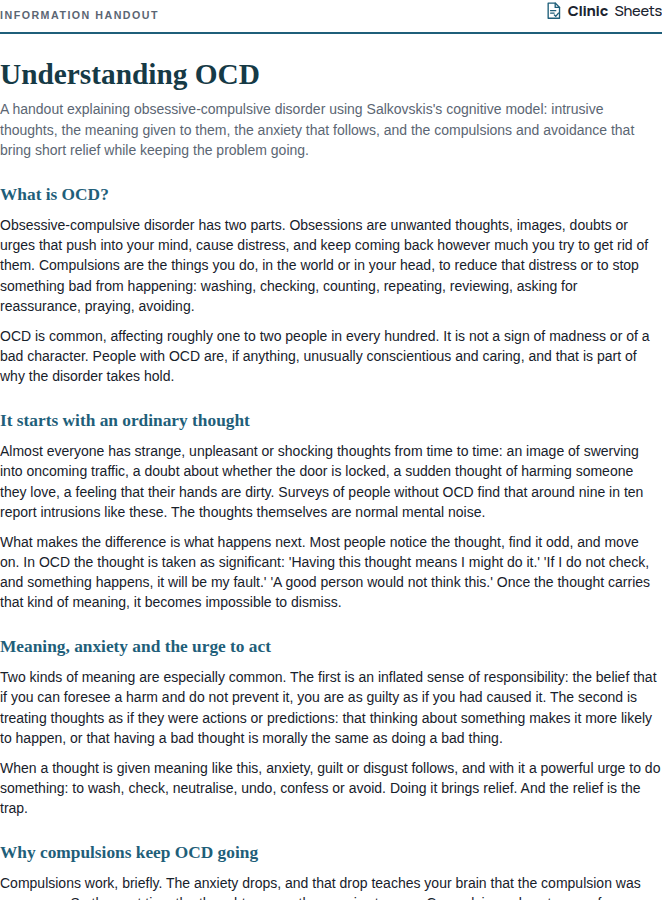
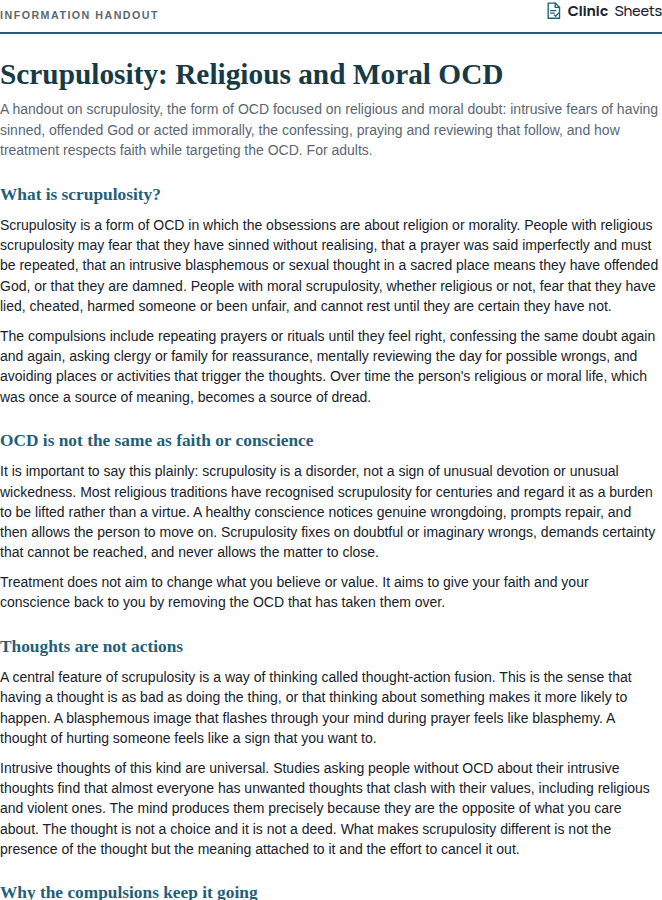
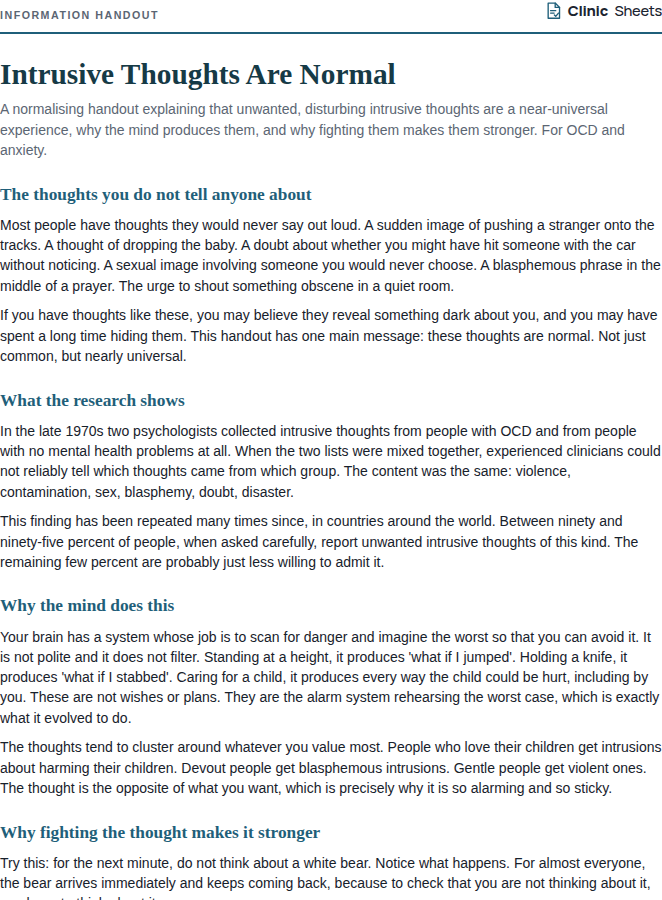
Intrusive thoughts about harm and sex are among the most distressing OCD presentations and among the most likely to go unreported, because the person is ashamed of the content and afraid of what disclosing it will mean. Rachman and de Silva showed that the content of clinical obsessions is essentially the same as the intrusive thoughts reported by the general population; what differs is the appraisal. In Rachman's cognitive theory, obsessions persist when the person interprets an intrusion as revealing something important about their character, intentions or future behaviour. Thought-action fusion, the belief that having a thought makes the event more likely or is morally equivalent to acting on it, is central to this appraisal.
This handout normalises intrusive thoughts, explains why they are not a sign of hidden desire or danger, describes the cycle of appraisal, anxiety, neutralising and avoidance that turns them into obsessions, and introduces exposure and response prevention and cognitive work as the treatment. It is careful to make the point that the person's distress is itself evidence that the thought runs against their values, and that the compulsions (checking, reviewing, seeking reassurance, avoiding knives or children) are what keep the thoughts prominent.
The professional version notes the importance of a careful but unambiguous risk assessment that distinguishes ego-dystonic obsessions from intent, the harm done by well-meaning but misinformed advice to avoid triggers, and the way in which mental compulsions such as reviewing, testing for arousal and mentally arguing with the thought maintain the problem and must be included in response prevention.
How to use it
- Give the handout once the client has been able to describe the content of their intrusions, even in general terms. Read the section on how common intrusive thoughts are together; many clients have never heard that such thoughts are universal.
- Use the thought-action fusion section to draw out the client's own beliefs about what the thoughts mean, and rate their belief in each.
- Ask the client to identify their mental compulsions as well as the visible ones using the reflection fields; reviewing, checking their feelings and seeking reassurance are frequently missed.
- Follow with the ERP rationale. Be explicit that avoiding triggers is not the treatment, since the client may have been advised otherwise.
References
- Rachman, S., & de Silva, P. (1978). Abnormal and normal obsessions. Behaviour Research and Therapy, 16(4), 233-248.
- Rachman, S. (1997). A cognitive theory of obsessions. Behaviour Research and Therapy, 35(9), 793-802.
- Shafran, R., Thordarson, D. S., & Rachman, S. (1996). Thought-action fusion in obsessive compulsive disorder. Journal of Anxiety Disorders, 10(5), 379-391.
- Salkovskis, P. M. (1985). Obsessional-compulsive problems: A cognitive-behavioural analysis. Behaviour Research and Therapy, 23(5), 571-583.