Maintenance Cycle Formulation (Generic)
A transdiagnostic formulation worksheet for mapping the vicious cycle that keeps a problem going: trigger, thoughts, feelings, body, behaviour, and the consequences that feed back to the start. Usable for any anxiety or mood problem.
About this resource
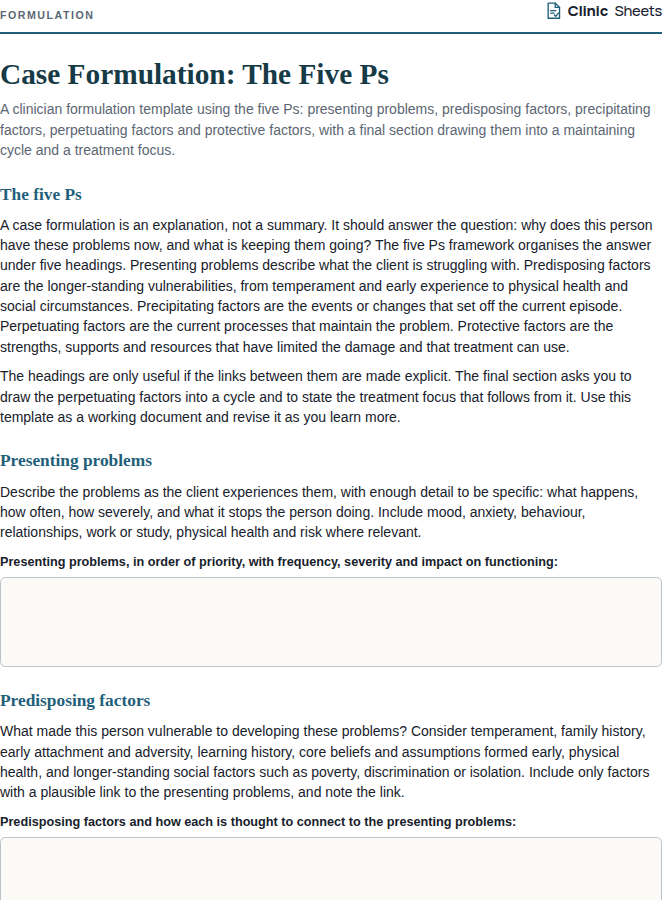
The maintenance cycle is the basic unit of CBT formulation. Whatever the diagnosis, the clinical question is the same: what is happening now that stops this problem from resolving on its own? The answer almost always involves an interaction between an interpretation of a situation, the emotion and physical arousal that follow, a behavioural response (most often avoidance, escape, a safety behaviour or withdrawal), and a consequence of that response that confirms the interpretation or removes the chance to disconfirm it. Salkovskis's account of the role of behaviour in maintaining anxiety, and the transdiagnostic work of Harvey and colleagues, both make the case that these processes cut across diagnostic categories.
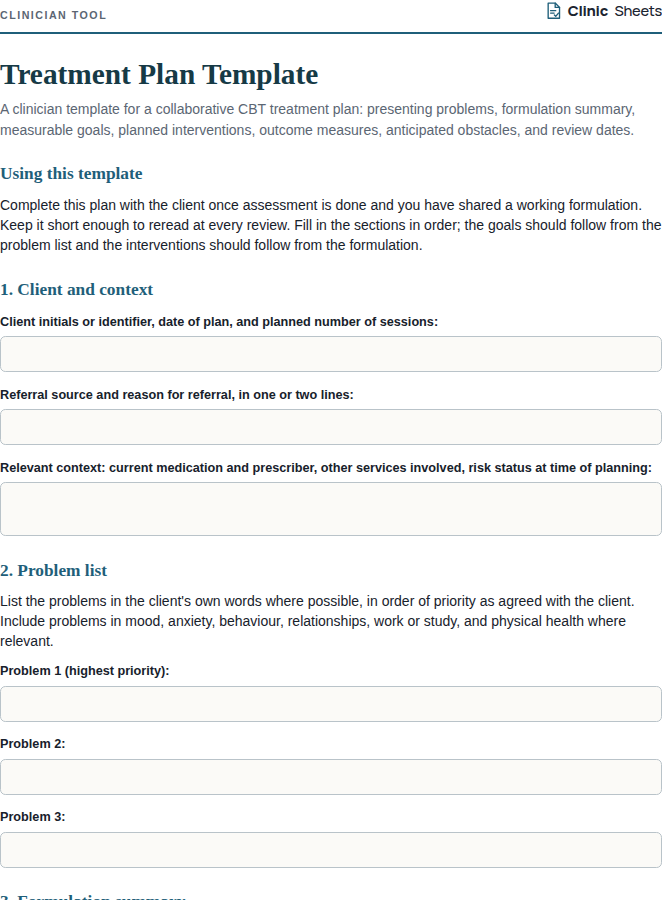
This worksheet is a generic version of that cycle, for use when a disorder-specific model is not needed or not yet clear, when the client has several overlapping problems, or as a first formulation in the earliest sessions. It walks the client through one specific recent episode, component by component, and then asks them to describe the loop in their own words. It is suitable for adults and for clinicians to use as a shared drawing in session.
The professional version includes guidance on choosing the episode, on eliciting the consequence of behaviour (the box clients most often leave empty), on distinguishing this generic cycle from the disorder-specific models it can lead into, and on using the completed cycle to explain the rationale for the interventions that follow.
How to use it
- Choose one specific, recent episode with the client. Ask for a time in the last week or two when the problem was present, and get the details: when, where, who, what was happening.
- Fill the boxes in whatever order comes naturally. Feelings and body sensations are usually easiest; the interpretation often needs the question 'What did that mean to you at the time?' or 'What did you think was going to happen?'
- Give particular attention to the behaviour and its consequences. Ask what the client did to cope, what happened immediately afterwards, and what they concluded. The short-term relief and the long-term cost are both part of the formulation.
- Draw the cycle on paper or a whiteboard as you go, with arrows, so the client sees it as a loop rather than a list.
- Ask the client to describe the cycle in their own words in the final section. If they can explain how it keeps itself going, the formulation has landed.
- Use the completed cycle to introduce treatment: each intervention should be linked to the part of the cycle it aims to change.
References
- Salkovskis, P. M. (1991). The importance of behaviour in the maintenance of anxiety and panic: A cognitive account. Behavioural Psychotherapy, 19(1), 6-19.
- Harvey, A. G., Watkins, E., Mansell, W., & Shafran, R. (2004). Cognitive Behavioural Processes Across Psychological Disorders: A Transdiagnostic Approach to Research and Treatment. Oxford University Press.
- Kennerley, H., Kirk, J., & Westbrook, D. (2016). An Introduction to Cognitive Behaviour Therapy: Skills and Applications (3rd ed.). SAGE.