Treatment Plan Template
A clinician template for a collaborative CBT treatment plan: presenting problems, formulation summary, measurable goals, planned interventions, outcome measures, anticipated obstacles, and review dates.
About this resource
A written treatment plan turns a formulation into a course of action. It states what the client wants to be different, how the formulation explains the problems, which interventions will be used in which order, how progress will be measured, and when the plan will be reviewed. Plans that are written collaboratively and revisited regularly are associated with clearer sessions, better homework completion and fewer drifting courses of therapy.
This template follows the structure recommended in the standard CBT texts: problem list, formulation summary, goals stated in observable terms with a baseline and target, a sequence of interventions matched to each goal, measures and their review frequency, and a section for obstacles and the plan to address them. It is deliberately brief. A plan that runs to several pages is rarely read again; one that fits on two sides can be brought out at each review.
The professional version includes guidance on writing goals that are specific enough to be measured, on matching intervention sequence to the formulation rather than to a fixed protocol, and on how to handle plans for clients with several problems or unclear priorities.
How to use it
- Complete the plan in the second or third session, once assessment is finished and a preliminary formulation has been shared with the client. Draft it together, or draft it yourself and review it with the client before finalising.
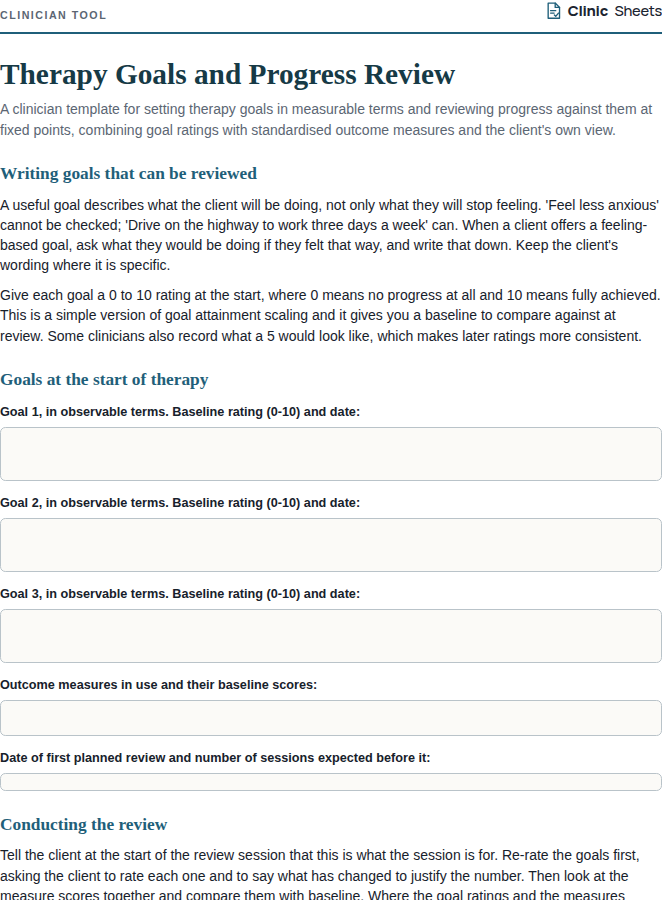
- Write each goal in terms the client could observe: what they would be doing, how often, in what situations. Record a baseline (current frequency or score) and a target. Avoid goals that only describe the absence of a symptom.
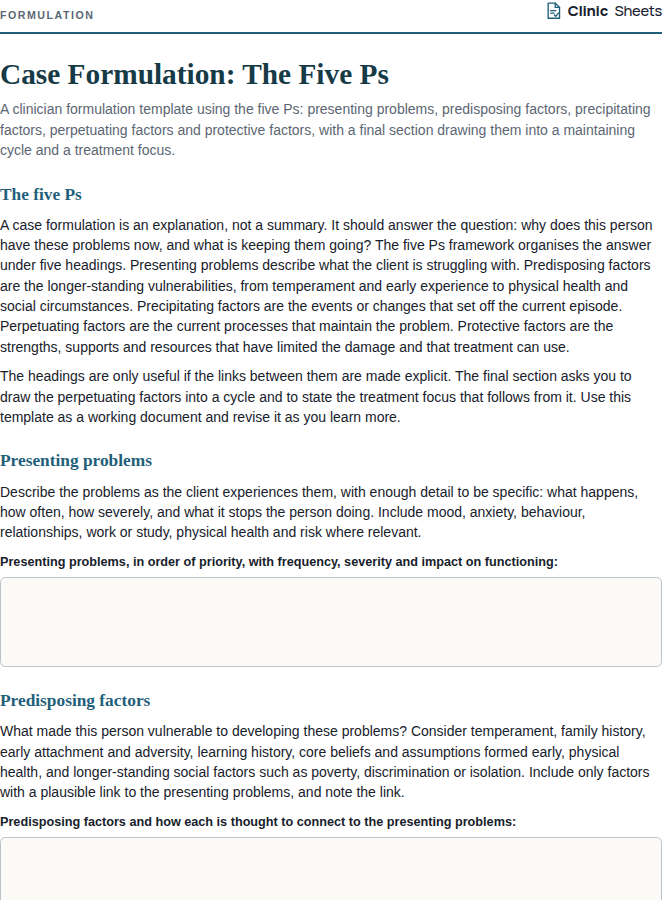
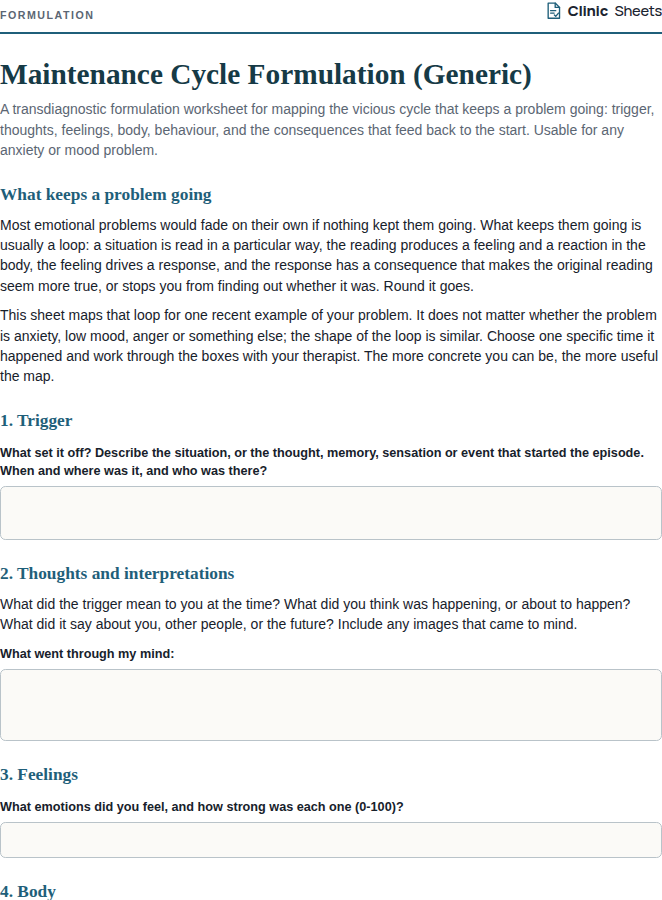
- Link each intervention to the part of the formulation it targets. If you cannot say which maintaining process an intervention addresses, reconsider whether it belongs in the plan.
- Choose one or two outcome measures appropriate to the problem and set the review frequency. Session-by-session measurement is ideal for depression and anxiety; some measures are better suited to review every few sessions.
- Set a review date, usually after four to six sessions. At review, re-rate goals, look at the measure scores, and revise the plan. Note any changes and the reasons.
- Give the client a copy. The plan is a shared document, and clients who hold it are more likely to remember and pursue the goals between sessions.
References
- Beck, J. S. (2020). Cognitive Behavior Therapy: Basics and Beyond (3rd ed.). Guilford Press.
- Persons, J. B. (2008). The Case Formulation Approach to Cognitive-Behavior Therapy. Guilford Press.
- Kuyken, W., Padesky, C. A., & Dudley, R. (2009). Collaborative Case Conceptualization: Working Effectively with Clients in Cognitive-Behavioral Therapy. Guilford Press.