What Is CBT?
A plain-language introduction to cognitive behavioural therapy: what it is, what happens in sessions, and what the client is expected to do between them. For the first session or as pre-therapy reading.
About this resource
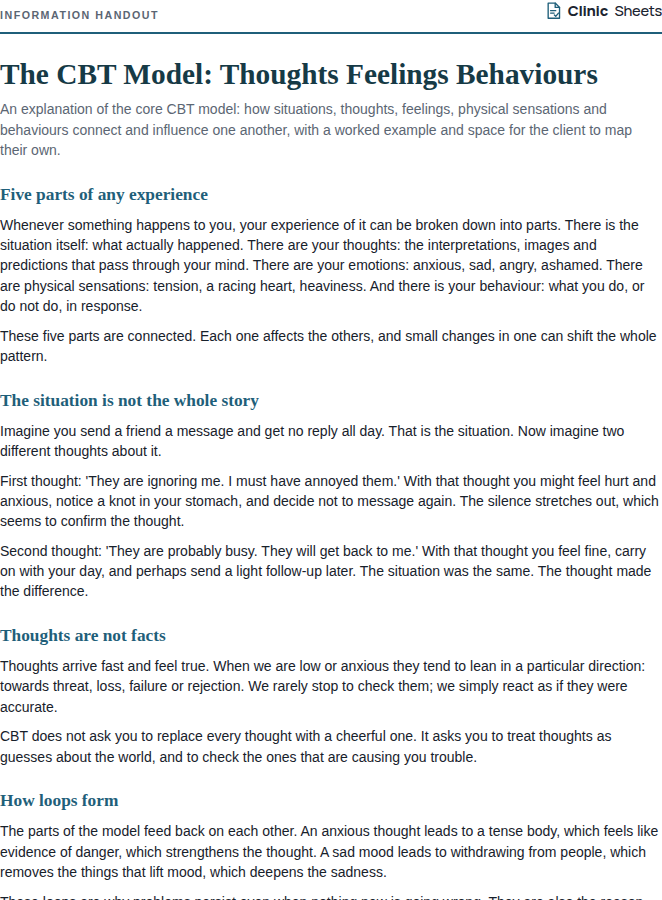
Cognitive behavioural therapy (CBT) is a structured, time-limited, present-focused psychotherapy built on the observation that the way we interpret events shapes how we feel and what we do. It has the largest evidence base of any psychological treatment for anxiety and depression, and its core ideas are simple enough to explain in a single session. Clients who understand the rationale early tend to engage more fully with between-session tasks, which in turn predicts outcome.
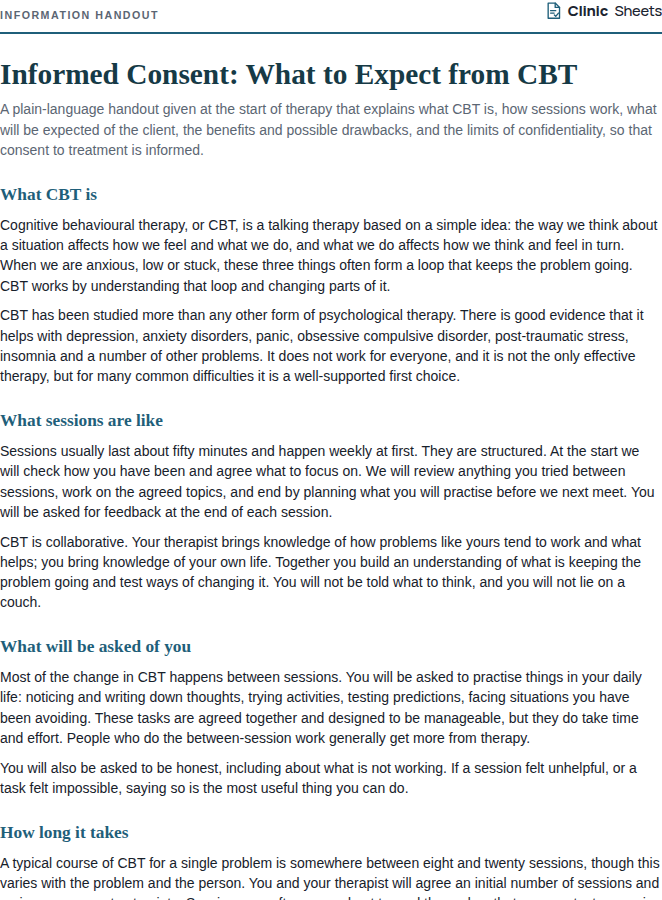
This handout covers the basics a new client needs: the link between thoughts, feelings and behaviour; the collaborative and active style of the work; what a typical session looks like; the role of homework; and the goal of the client becoming their own therapist. It deliberately avoids jargon and does not assume any prior knowledge of therapy.
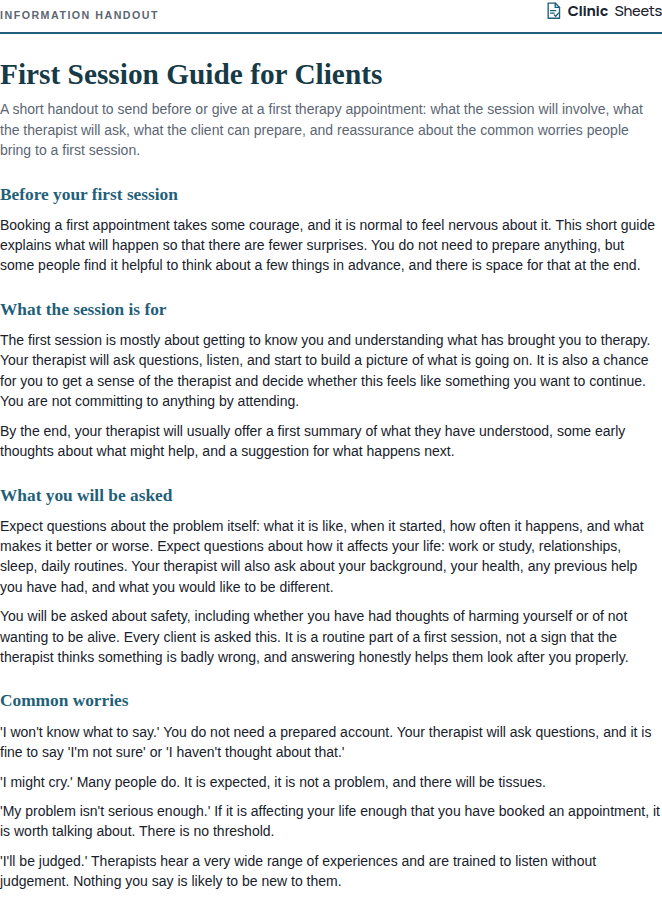
Use it as orientation reading before or after the first session, or as a leave-behind for clients who are deciding whether CBT is right for them. It pairs with The CBT Model: Thoughts, Feelings, Behaviours, which goes into the model itself in more detail.
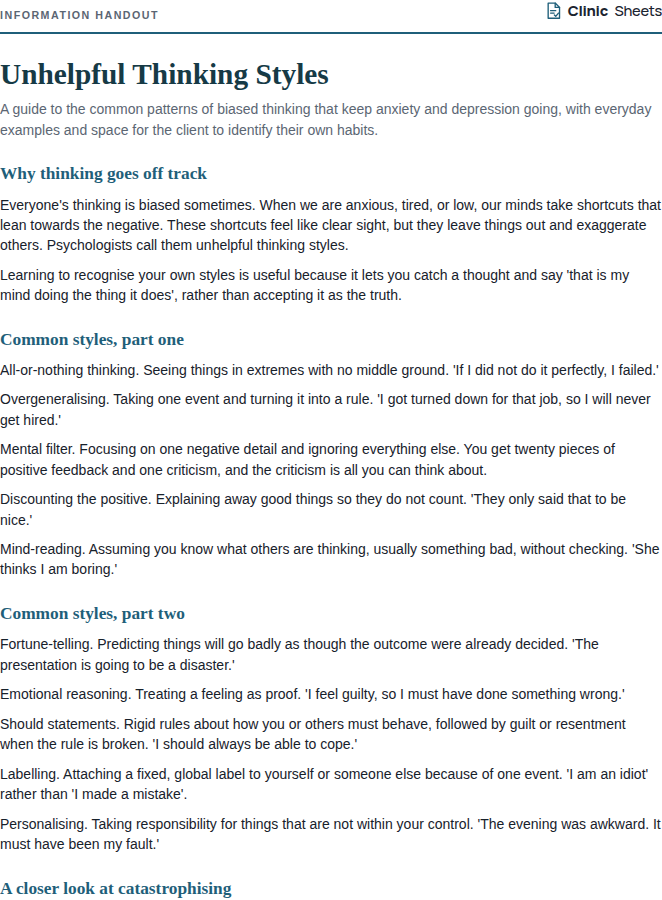
The professional version adds notes on socialising clients to the model, common misconceptions (that CBT is about positive thinking, or that it ignores the past), and how to introduce homework so that it lands as collaboration rather than instruction.
How to use it
- Give the handout at the end of the assessment or first session, or send it ahead of time as pre-reading.
- In session, ask what the client already knows or has heard about CBT. Correct misconceptions gently, using the handout as a reference.
- Walk through the section on what happens in a session and agree the practical frame: number of sessions, agenda setting, and between-session tasks.
- Ask the client to note one question or concern in the reflection field and bring it to the next session.
- Return to the handout if engagement dips later in treatment, particularly the section on why practice between sessions matters.
References
- Beck, J. S. (2020). Cognitive Behavior Therapy: Basics and Beyond (3rd ed.). Guilford Press.
- Hofmann, S. G., Asnaani, A., Vonk, I. J. J., Sawyer, A. T., & Fang, A. (2012). The efficacy of cognitive behavioral therapy: A review of meta-analyses. Cognitive Therapy and Research, 36(5), 427-440.
- Westbrook, D., Kennerley, H., & Kirk, J. (2011). An Introduction to Cognitive Behaviour Therapy: Skills and Applications (2nd ed.). SAGE.