The CBT Model: Thoughts Feelings Behaviours
An explanation of the core CBT model: how situations, thoughts, feelings, physical sensations and behaviours connect and influence one another, with a worked example and space for the client to map their own.
About this resource
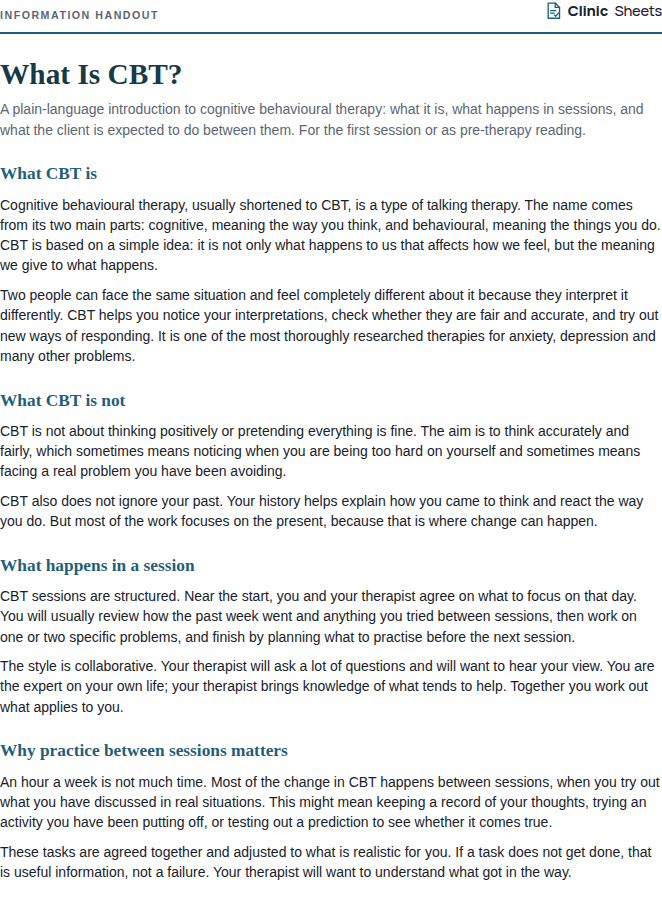
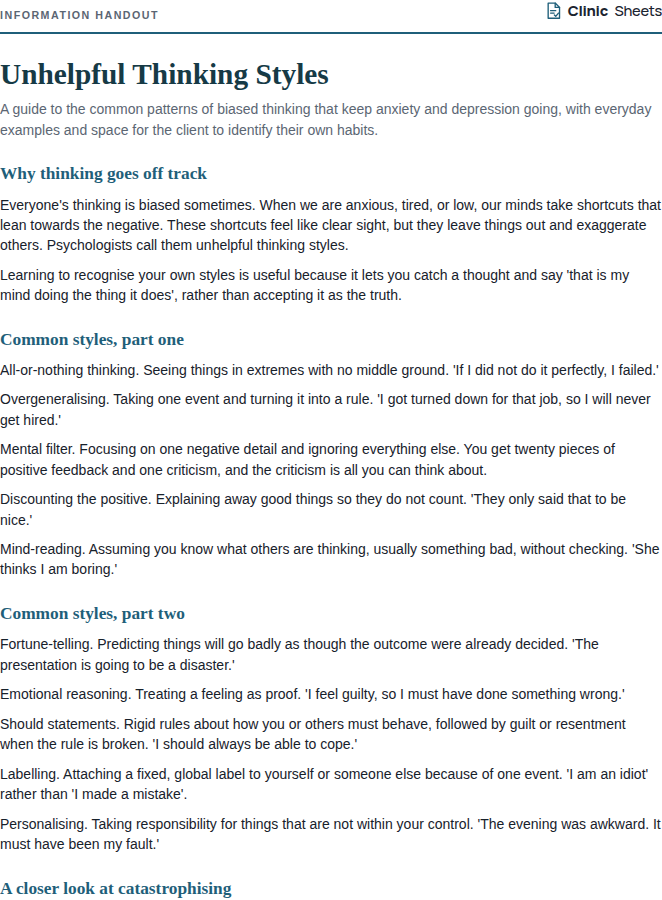
The cognitive model proposes that our emotional and behavioural responses to events are mediated by our appraisals of those events. A situation on its own does not produce a feeling; the meaning we attach to it does. This handout presents the model as a set of linked components, situation, thoughts, emotions, physical sensations and behaviour, and shows how they feed back into one another to create loops that maintain distress.
Socialising the client to this model is a standard early task in CBT, and the quality of that socialisation influences everything that follows. Clients who grasp that thoughts are interpretations rather than facts are better placed to make use of thought records, behavioural experiments and other change methods. The handout uses a single everyday example, a friend who does not reply to a message, to show how two different appraisals lead to two different outcomes.
The final section invites the client to map a recent situation of their own onto the model. This is best done together in session and is an early step towards an individual formulation.
The professional version includes guidance on distinguishing thoughts from feelings when clients conflate them, prompts for eliciting hot thoughts, and suggestions for moving from this generic model to a problem-specific one.
How to use it
- Introduce the model in the first or second session, after the assessment and before any thought-based or behavioural work.
- Read through the worked example together. Ask the client which of the two responses feels more familiar to them.
- Complete the mapping section using a recent, specific situation the client has raised. Keep the thought concrete and in the client's own words.
- Draw the links between the components on paper or a whiteboard so the client sees the loop, not just a list.
- Refer back to the model whenever introducing a new technique, so the client understands which part of the cycle it targets.
References
- Beck, A. T., Rush, A. J., Shaw, B. F., & Emery, G. (1979). Cognitive Therapy of Depression. Guilford Press.
- Padesky, C. A., & Mooney, K. A. (1990). Clinical tip: Presenting the cognitive model to clients. International Cognitive Therapy Newsletter, 6, 13-14.
- Greenberger, D., & Padesky, C. A. (2015). Mind Over Mood (2nd ed.). Guilford Press.