AUDIT Alcohol Use Questionnaire
The World Health Organization's ten-item Alcohol Use Disorders Identification Test (AUDIT), reproduced in full with scoring and the WHO risk zones. A brief screen for hazardous drinking, harmful drinking and possible alcohol dependence.
About this resource
The AUDIT was developed by the World Health Organization as a screening tool for use in primary care and other non-specialist settings. Its ten questions cover three areas: the amount and frequency of drinking (items 1 to 3), signs of dependence (items 4 to 6), and harm related to drinking (items 7 to 10). It asks about the last year rather than lifetime use, so it is sensitive to current risk rather than history. It was validated across six countries and has been translated widely, which makes it one of the most robust brief screens in the field.
The instrument is reproduced here in full because the WHO makes it freely available for reproduction and clinical use without permission. The wording follows the self-report version in the WHO guidelines for use in primary care (second edition). Each item is scored from 0 to 4, giving a total between 0 and 40. The WHO groups scores into four risk zones, each linked to a level of intervention, from simple advice through brief counselling to referral for specialist assessment.
In a counselling setting the AUDIT is most useful as a conversation opener rather than a verdict. The first three items on their own (the AUDIT-C) are a reasonable quick screen when time is short. This professional version adds notes on interpreting the zones, on the cautions that apply to women, older adults and people from cultures with different drink sizes, and on how to feed the score back in a motivational interviewing style.
How to use it
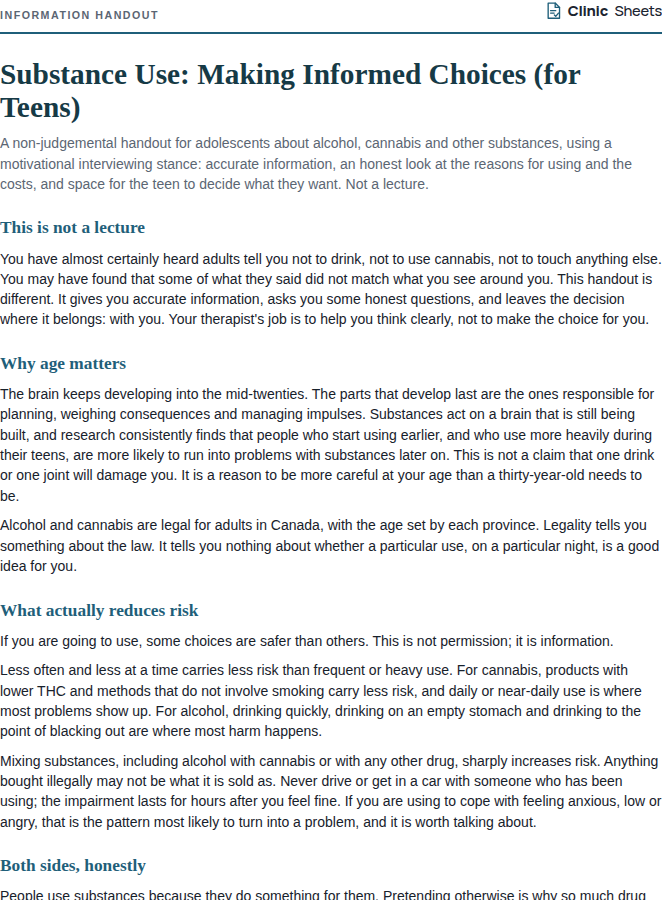
- Give the questionnaire to the client to complete on paper, or read the questions aloud. Before starting, explain that a 'drink' means a standard drink, and give a local example (in Canada, roughly a 341 ml bottle of 5% beer, a 142 ml glass of 12% wine or a 43 ml shot of 40% spirits).
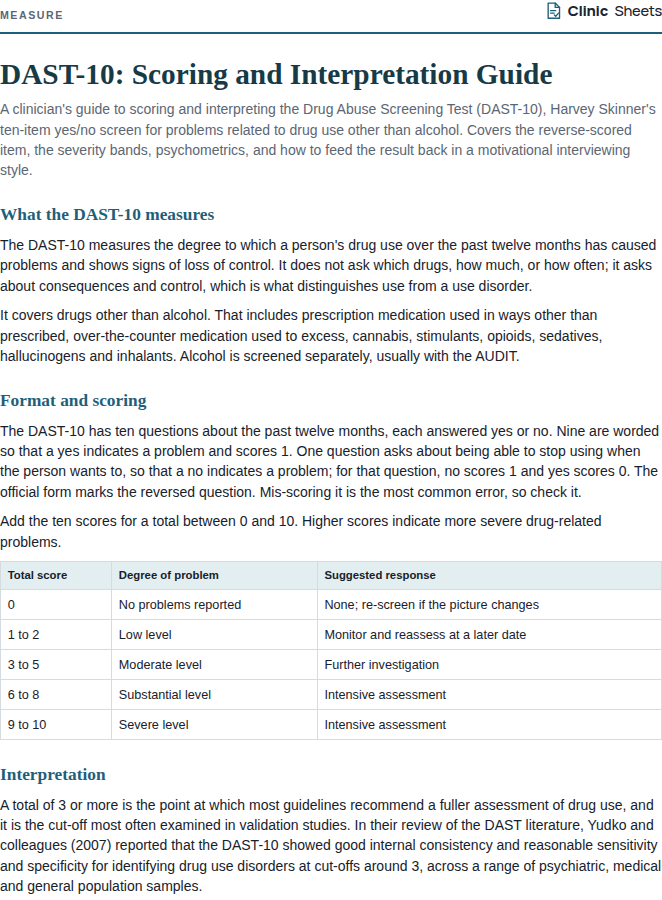
- Add the scores for the ten items. Items 1 to 8 are scored 0 to 4 across the five answer choices. Items 9 and 10 have three answer choices scored 0, 2 and 4.
- Find the total in the scoring table and note the risk zone. Look separately at items 4 to 6 (dependence) and items 7 to 10 (harm), since a high score in either group changes the picture even when the total is moderate.
- Feed the result back neutrally, then ask for the client's reaction: 'This puts you in the zone where the WHO suggests cutting down would protect your health. What do you make of that?' Let the client's own concern, not the number, carry the weight.
- Repeat the measure at review points. Because the timeframe is the last year, it is slower to change than a weekly drinking diary, so pair it with a diary when tracking treatment.
References
- Babor, T. F., Higgins-Biddle, J. C., Saunders, J. B., & Monteiro, M. G. (2001). AUDIT: The Alcohol Use Disorders Identification Test. Guidelines for use in primary care (2nd ed.). World Health Organization.
- Saunders, J. B., Aasland, O. G., Babor, T. F., de la Fuente, J. R., & Grant, M. (1993). Development of the Alcohol Use Disorders Identification Test (AUDIT): WHO collaborative project on early detection of persons with harmful alcohol consumption. II. Addiction, 88(6), 791-804.
- Bush, K., Kivlahan, D. R., McDonell, M. B., Fihn, S. D., & Bradley, K. A. (1998). The AUDIT alcohol consumption questions (AUDIT-C): An effective brief screening test for problem drinking. Archives of Internal Medicine, 158(16), 1789-1795.