CAGE Questionnaire
The CAGE questionnaire, Ewing's four-item public domain screen for problem drinking, reproduced in full with its scoring, the conventional threshold of two, interpretation notes and guidance on when a fuller alcohol assessment is needed.
About this resource
The CAGE questionnaire was developed by John Ewing and published in 1984. It is a four-question screen for lifetime problem drinking, and its name is a mnemonic for the four questions: Cut down, Annoyed, Guilty and Eye-opener. Each question is answered yes or no, and each 'yes' scores one point. The questions can be asked conversationally in a clinical interview or given on paper, and the whole screen takes under a minute.
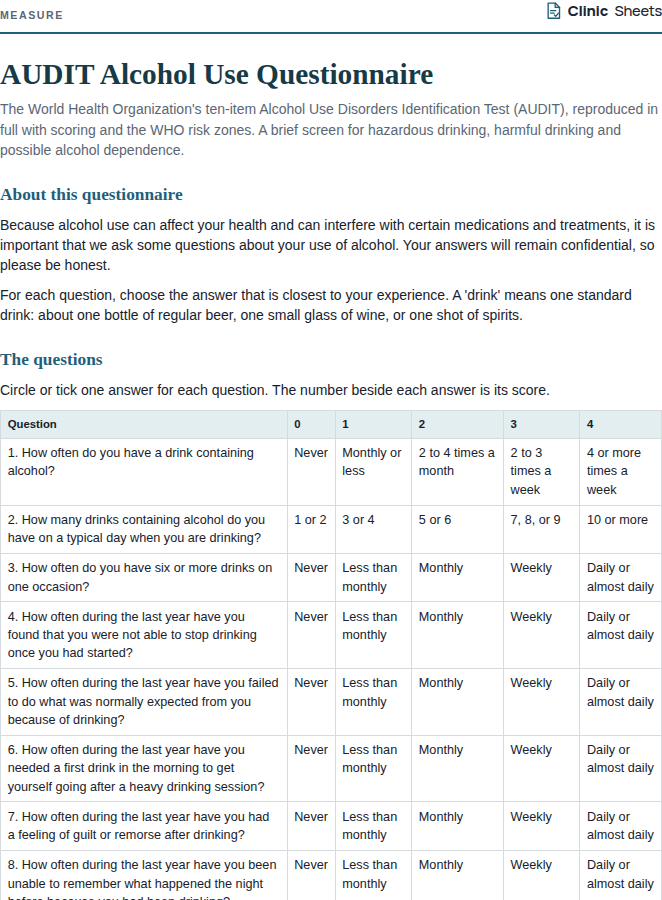
The CAGE is a screen for alcohol dependence and problem drinking rather than for hazardous consumption. It asks about the consequences and experience of drinking, not about quantity or frequency, so it will miss people who drink at risky levels but have not yet felt a need to cut down or experienced guilt or criticism. For that reason the AUDIT is usually preferred where the aim is to identify hazardous and harmful drinking across the whole range. The CAGE remains useful as a quick conversational opener, particularly where a client is unlikely to complete a longer questionnaire.
Two or more 'yes' answers is the conventional threshold for a clinically significant result and should prompt a fuller assessment of drinking pattern, dependence and related harms. The professional version adds the scoring, interpretation guidance, limitations and suggestions for how to follow up a positive screen in a motivational interviewing style.
The instrument is reproduced here because the CAGE questionnaire is in the public domain and may be used freely. Item wording follows Ewing's 1984 publication.
How to use it
- Ask the four questions as part of a routine history, in a matter-of-fact tone, or give them on paper. Because they ask about 'ever', clarify the time frame afterwards if the answers refer to a period in the past.
- Score one point for each 'yes'. A total of 2 or more is the usual threshold for a positive screen; some clinicians follow up on a single 'yes'.
- Follow a positive screen with a fuller assessment: current quantity and frequency, pattern of use, features of dependence, withdrawal history, related harms, and the client's own view of their drinking. The AUDIT is a suitable next step.
- Respond in a motivational interviewing style: reflect what the client has said, ask permission before giving information, and explore their own concerns and reasons for change rather than confronting.
- Refer for medical assessment where there is daily heavy drinking or a history of withdrawal symptoms, because stopping suddenly can be medically risky and should be supervised.
References
- Ewing, J. A. (1984). Detecting alcoholism: The CAGE questionnaire. JAMA, 252(14), 1905-1907.
- Miller, W. R., & Rollnick, S. (2013). Motivational Interviewing: Helping People Change (3rd ed.). Guilford Press.