Performance Anxiety in Sport Music and Stage
A handout for performers, athletes and musicians on performance anxiety: why arousal is not the enemy, how self-focused attention and monitoring of technique disrupt skilled performance, and how CBT and acceptance-based approaches help you perform with nerves rather than without them. For adults and adolescents.
About this resource
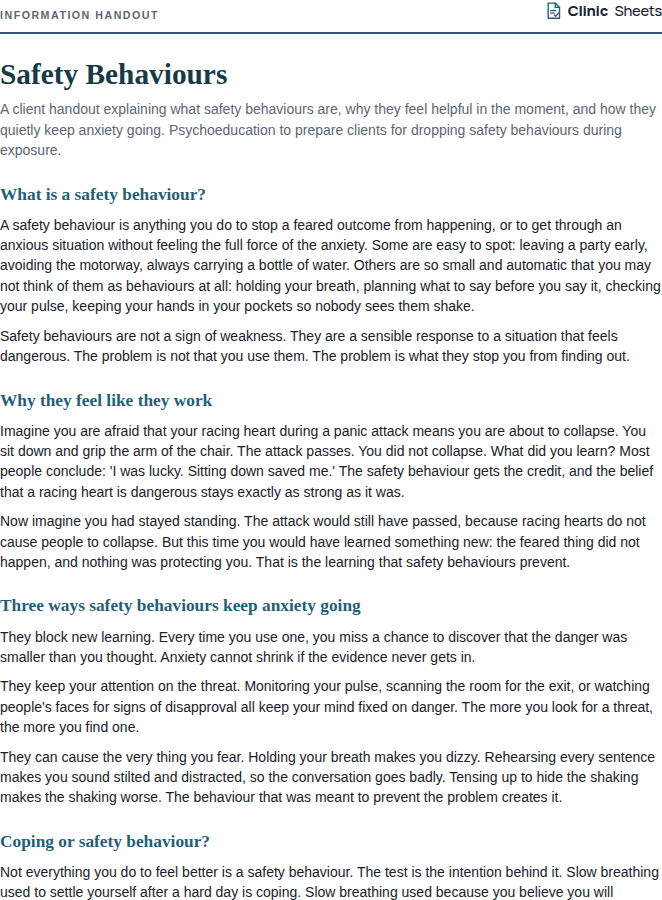
Performance anxiety affects musicians, actors, dancers, athletes, public performers and students taking exams or auditions. It ranges from useful pre-performance arousal to a disabling fear that leads to avoidance, withdrawal from opportunities, or reliance on alcohol and beta-blockers. Its cognitive structure resembles social anxiety as described by Clark and Wells: a feared image of visible failure, self-focused attention that pulls resources away from the task, and safety behaviours (over-practising, avoiding eye contact with the audience, rushing) that impair performance. A second mechanism is specific to skilled performance: under pressure, performers start consciously monitoring movements that are normally automatic, which fragments a well-learned skill.
This handout explains both mechanisms in plain language, distinguishes performance anxiety from lack of preparation, and introduces two complementary approaches. The CBT approach tests catastrophic predictions and shifts attention outward to the music, the play or the game. The acceptance and commitment approach, developed for performers in models such as the Mindfulness-Acceptance-Commitment approach, teaches the performer to make room for anxious sensations and thoughts without fighting them, and to commit attention to the task and to what they value about performing. Clients are encouraged to expect nerves, drop the struggle against them, and direct attention to the task.
The professional version adds guidance on assessing for substance use or medication as safety behaviours, on graded performance exposures (recording, small audiences, mock auditions), and on adapting the material to a specific discipline.
How to use it
- Ask the client to describe their last difficult performance in detail: what they predicted, where their attention went, what they did to cope, and what they concluded afterwards. Map this onto the model in the handout.
- Distinguish anxiety from preparation. If the client is genuinely under-prepared, the work is practice; if they are well prepared and still fail under pressure, the work is attention and acceptance.
- Introduce the idea that the aim is not to remove nerves but to change the relationship with them. Many performers find the phrase performing with nerves, not without them, useful.
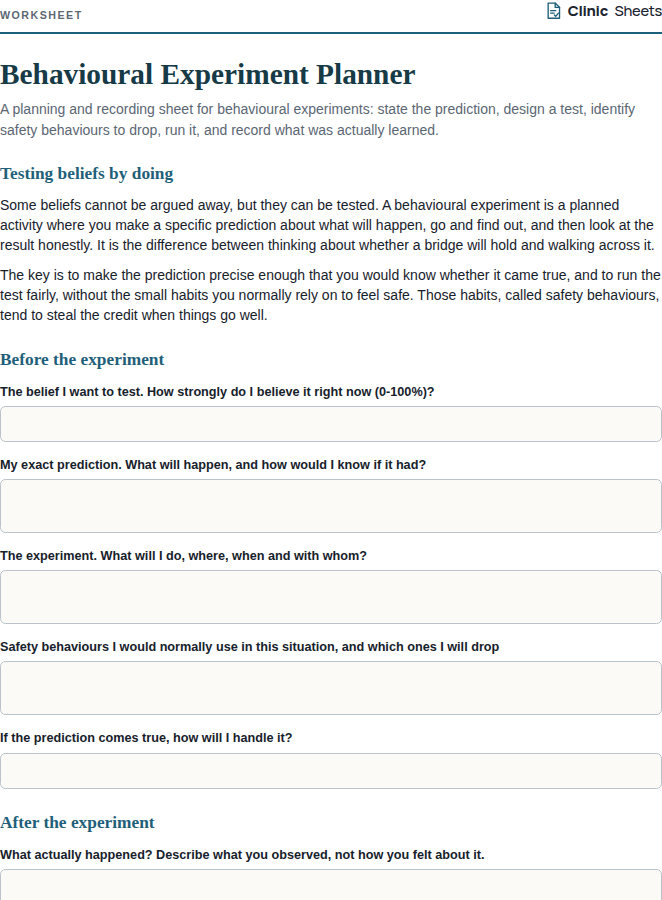
- Plan graded performance experiments: playing for a recording, for one person, for a small group, in a mock audition, in a low-stakes public setting. In each, agree an external focus of attention and a safety behaviour to drop.
- Use the reflection fields to identify the client's values in performing. Reconnecting with why they perform is a strong counterweight to threat-focused thinking.
References
- Kenny, D. T. (2011). The Psychology of Music Performance Anxiety. Oxford University Press.
- Gardner, F. L., & Moore, Z. E. (2007). The Psychology of Enhancing Human Performance: The Mindfulness-Acceptance-Commitment (MAC) Approach. Springer.
- Clark, D. M., & Wells, A. (1995). A cognitive model of social phobia. In R. G. Heimberg, M. R. Liebowitz, D. A. Hope, & F. R. Schneier (Eds.), Social Phobia: Diagnosis, Assessment, and Treatment (pp. 69-93). Guilford Press.
- Beilock, S. L., & Carr, T. H. (2001). On the fragility of skilled performance: What governs choking under pressure? Journal of Experimental Psychology: General, 130(4), 701-725.