Emotion Regulation: Check the Facts
A DBT emotion regulation worksheet that walks the client through checking whether an emotion, or its intensity, fits the facts of the situation, by separating what happened from interpretations and testing the feared outcome.
About this resource
Check the Facts is a core skill in the DBT emotion regulation module. It rests on the observation that emotions are often set off not by events themselves but by interpretations of them, and that when an interpretation is inaccurate, the emotion that follows does not fit the situation. An emotion can also fit the facts in kind but not in intensity: sadness at a friend cancelling is reasonable, but despair may not be. When an emotion does not fit the facts, the person can work on changing the interpretation. When it does fit, the appropriate skill is problem solving or opposite action.
The skill has a set sequence. Name the emotion and rate its intensity. Describe the prompting event in factual terms, without judgements. Identify the interpretations, assumptions and thoughts about the event. Consider whether a threat is being assumed, and how likely the feared outcome really is. Imagine the catastrophe actually happening and assess whether it could be coped with. Then ask whether the emotion, and its intensity, fit the facts. Unlike a CBT thought record, the focus is on the emotion rather than the thought, and the end point is a decision about which skill to use next.
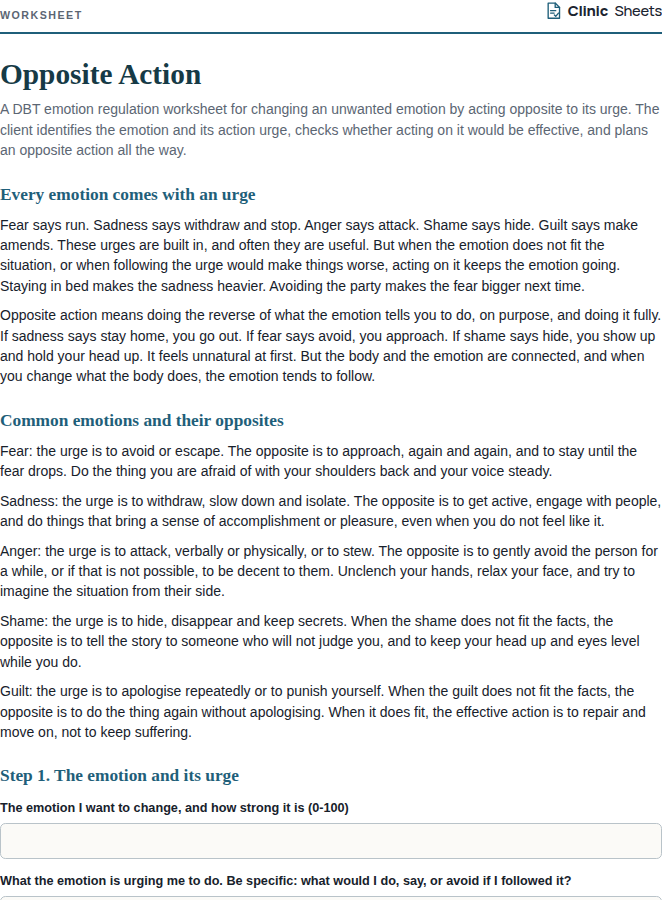
This worksheet takes the client through each step with full-sentence prompts, includes a short intro on why emotions can misfire, and ends with the decision point. It is suitable for adults who have learned the basics of the emotion regulation module, and it pairs with the Opposite Action worksheet, which is the next step when an emotion does not fit the facts or is not effective.
The professional version includes a table of the common emotions and the facts that typically justify each (fear when there is a threat to life, health or wellbeing; anger when a goal is blocked or one is attacked; guilt when one's own values have been violated), guidance on clients who cannot separate facts from interpretations, and notes on the difference between checking facts and invalidating emotion.
How to use it
- Introduce the idea that emotions are usually triggered by interpretations, and that an emotion can fit or not fit the facts in both kind and intensity. Give examples of each from the client's own experience.
- Complete the first sheet together in session with a recent, moderately intense emotion. Spend the most time on separating the factual description from the interpretations; this step carries the skill.
- For the feared outcome, ask the client to estimate the probability honestly and then imagine the outcome actually happening. Explore how they would cope. This step reduces emotion more often than the probability estimate does.
- Reach a conclusion together: does the emotion fit the facts, does its intensity fit, and what skill follows? Make the decision explicit and write it down.
- Be careful not to use the sheet to argue the client out of an emotion that does fit. When an emotion is justified, validate it and move to problem solving.
References
- Linehan, M. M. (2015). DBT Skills Training Manual (2nd ed.). Guilford Press.
- Neacsiu, A. D., Eberle, J. W., Kramer, R., Wiesmann, T., & Linehan, M. M. (2014). Dialectical behavior therapy skills for transdiagnostic emotion dysregulation: A pilot randomized controlled trial. Behaviour Research and Therapy, 59, 40-51.
- Gross, J. J. (2015). Emotion regulation: Current status and future prospects. Psychological Inquiry, 26(1), 1-26.