Opposite Action
A DBT emotion regulation worksheet for changing an unwanted emotion by acting opposite to its urge. The client identifies the emotion and its action urge, checks whether acting on it would be effective, and plans an opposite action all the way.
About this resource
Opposite action is one of the most powerful skills in the DBT emotion regulation module and one of the most widely applicable. Every emotion carries an action urge: fear urges escape, sadness urges withdrawal, anger urges attack, shame urges hiding. Acting on the urge tends to strengthen and prolong the emotion, and in depression and anxiety these urges maintain the disorder: withdrawal deepens low mood, avoidance confirms threat. Opposite action reverses this. When an emotion does not fit the facts, or when acting on it would not be effective, the person deliberately does the opposite of what the emotion demands, and the emotion changes as a consequence.
The skill draws directly on exposure principles and on behavioural activation, but it is framed in a way that generalises across emotions. Linehan emphasises acting opposite 'all the way': not just approaching the feared situation but approaching it with an open posture and steady voice; not just getting out of bed but getting up, dressing and engaging with something. Half-hearted opposite action, in which the body approaches while the face and mind retreat, tends not to work.
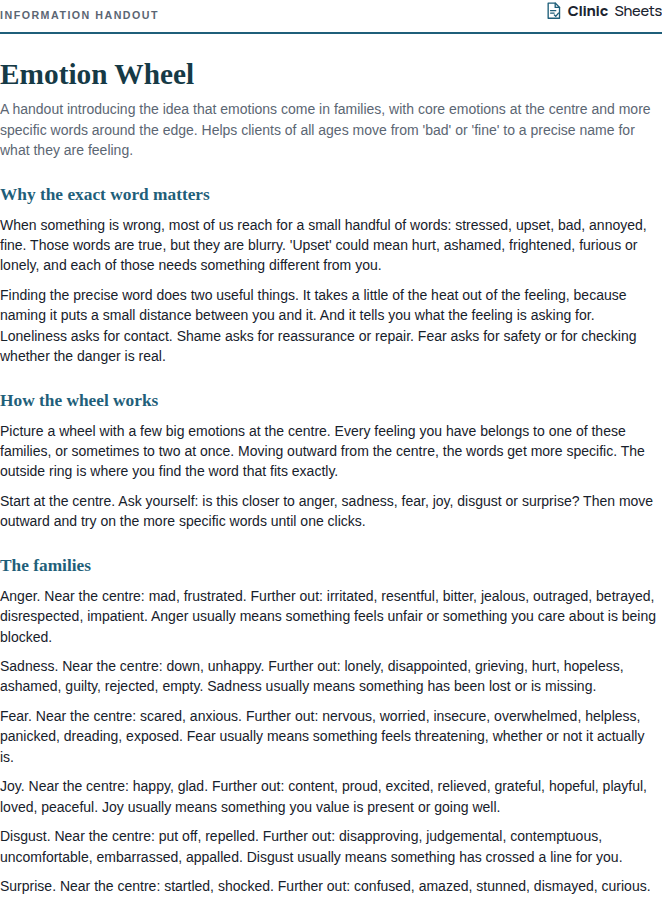
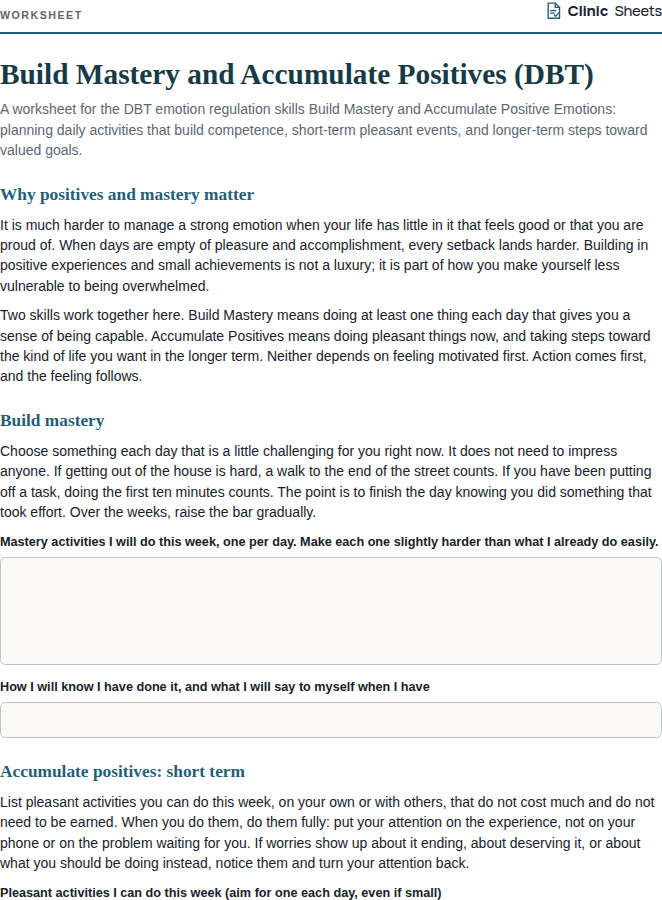
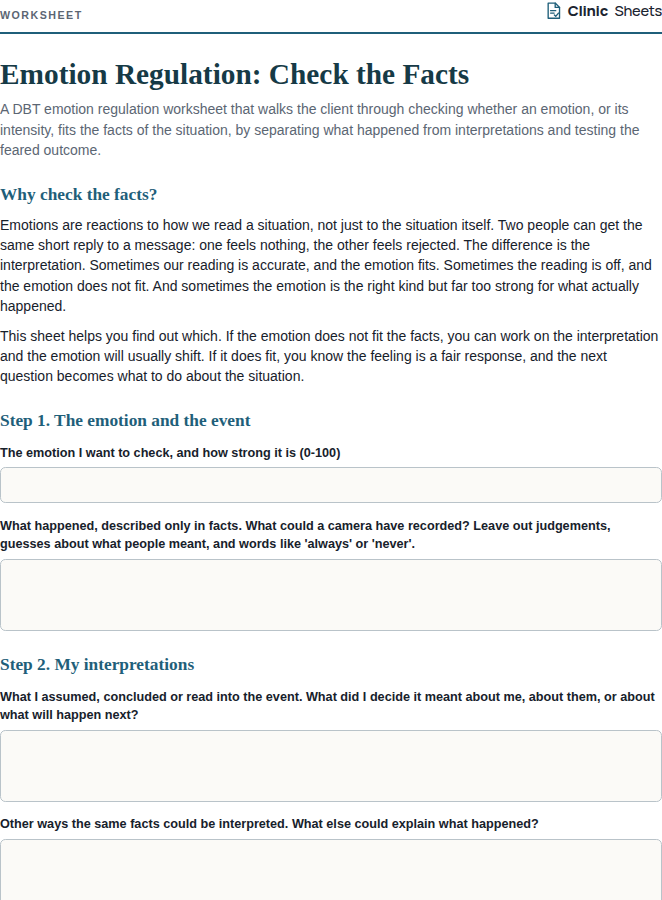
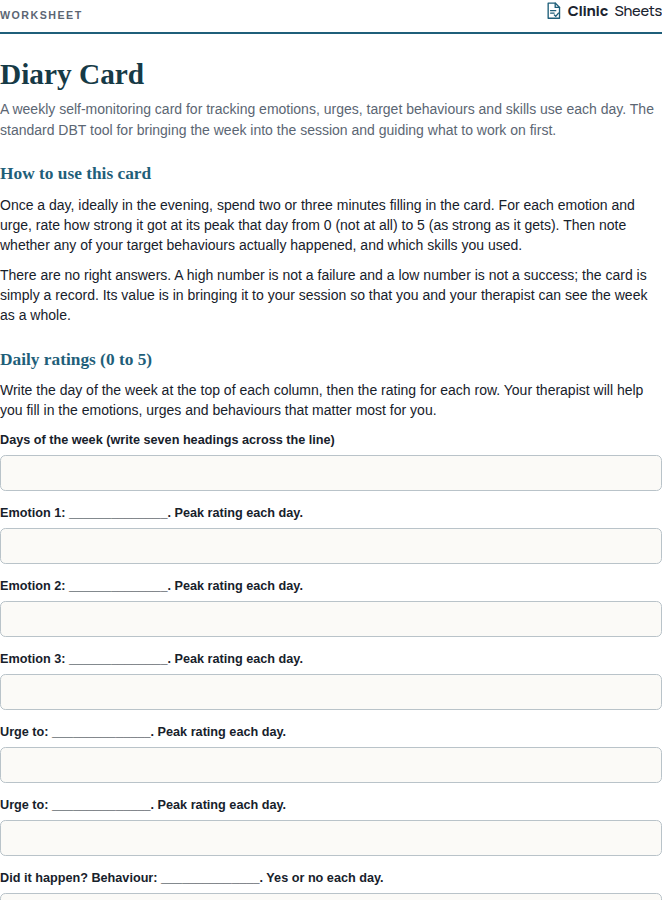
This worksheet follows the DBT sequence: identify the emotion and its urge, check whether the emotion fits the facts and whether acting on it would be effective, and if not, plan and carry out the opposite action fully. It includes a reference list of common emotions and their opposite actions. It is suitable for adults and works best after the client has been introduced to Check the Facts.
The professional version includes the full emotion-by-emotion table with typical urges and opposite actions, guidance on the two prerequisites (the emotion must not fit the facts, or acting on it must be ineffective), and notes on the most common failure, which is opposite action done with a clenched jaw and a plan to leave early.
How to use it
- Begin with a clear example of how an action urge maintains an emotion, using the client's own pattern. Withdrawal and low mood is usually the easiest to see.
- Establish the two conditions. Opposite action is used when the emotion does not fit the facts, or when it does fit but acting on it would make things worse. If the emotion fits and acting on it is effective, the skill is problem solving instead.
- Help the client identify the specific action urge, then the specific opposite. Push for behavioural detail: what would your body, face, voice and words be doing?
- Plan opposite action all the way. Ask the client to rehearse in session, including posture and tone, and to notice any part of them that is still doing the original action.
- Review the outcome at the next session with attention to whether the emotion changed. Opposite action usually needs to be repeated several times before the emotion shifts reliably; frame this as expected.
References
- Linehan, M. M. (2015). DBT Skills Training Manual (2nd ed.). Guilford Press.
- Rizvi, S. L., & Linehan, M. M. (2005). The treatment of maladaptive shame in borderline personality disorder: A pilot study of 'opposite action'. Cognitive and Behavioral Practice, 12(4), 437-447.
- Martell, C. R., Dimidjian, S., & Herman-Dunn, R. (2010). Behavioral Activation for Depression: A Clinician's Guide. Guilford Press.