Leaves on a Stream (Audio Script)
A read-aloud script for the classic ACT defusion exercise in which each thought is placed on a leaf and allowed to drift past on a stream. Teaches the client to observe thoughts without arguing with them, following them or pushing them away.
About this resource
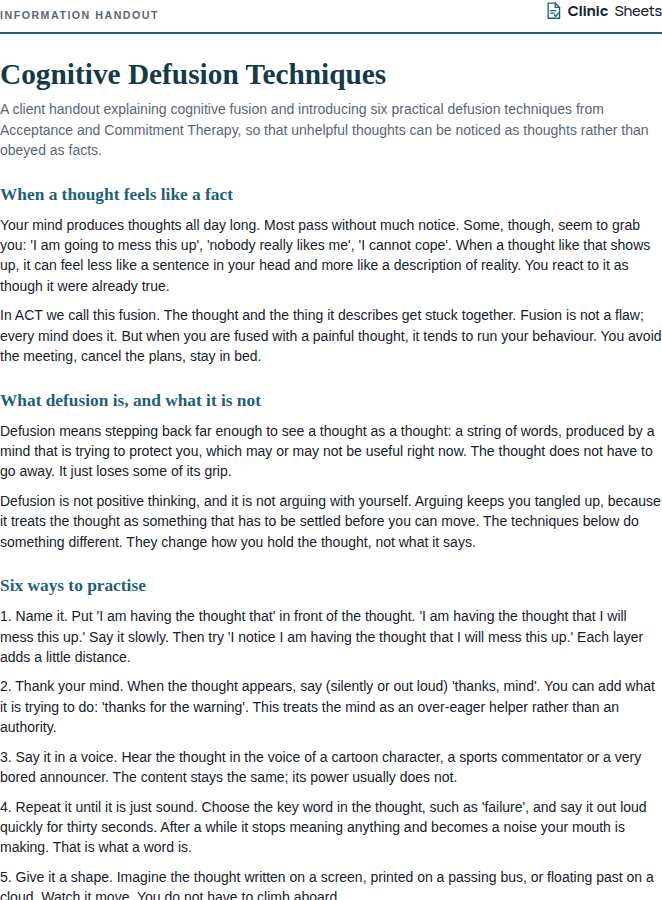
Leaves on a Stream is one of the best-known cognitive defusion exercises in Acceptance and Commitment Therapy. In ACT, the problem is not the content of thoughts but fusion with them: being so caught up in a thought that it is experienced as literal truth and directs behaviour. Defusion exercises change the client's relationship with thinking, so that thoughts are seen as passing mental events rather than commands or facts. This exercise is described in Hayes, Strosahl and Wilson's foundational text and in most ACT clinical manuals.
The script asks the client to imagine a stream with leaves floating on it, to place each thought that arises onto a leaf, and to watch it float past. The key learning happens when the client notices that the stream has stopped, or that they have climbed onto a leaf and floated off with the thought, and then gently returns to watching. The exercise is not about getting rid of thoughts or achieving calm, and the script says so explicitly, because clients often turn it into a control strategy.
This script is written for recording by the clinician or reading in session, around ten minutes at a slow pace. The professional version adds guidance on debriefing (what did you notice, which thoughts were sticky, what happened when you got hooked), on adapting the image for clients who do not visualise easily (words on a conveyor belt, clouds passing, a train going by), and on linking the exercise to the workability of fused thinking in the client's own formulation.
How to use it
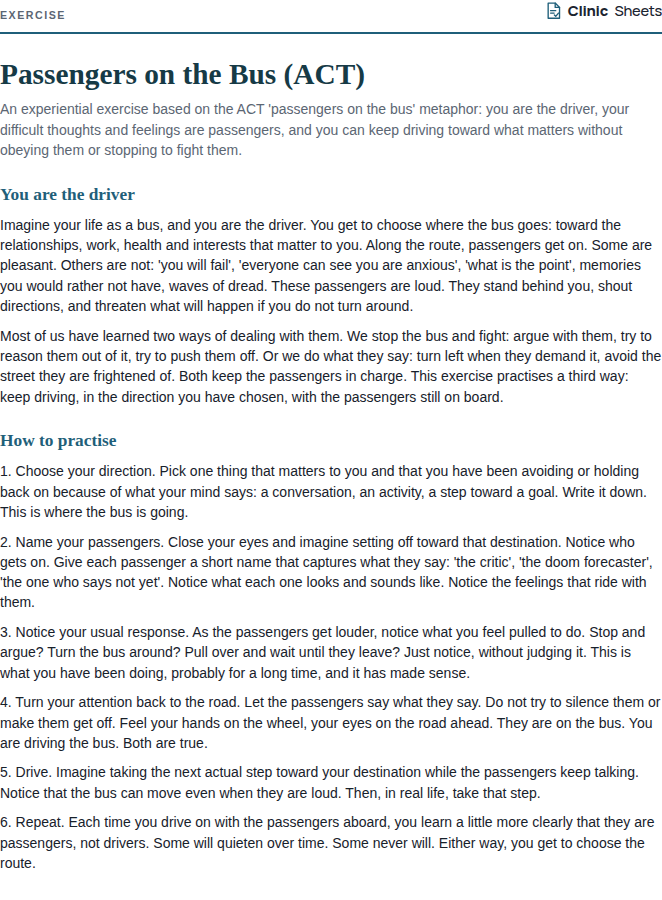
- Introduce defusion before the exercise, ideally after the client has experienced how struggling with thoughts tends to make them louder. A brief metaphor (passengers on the bus, or trying not to think of something) sets the frame.
- Explain that the aim is to notice thoughts, not to clear the mind or feel relaxed. Say plainly that getting hooked and drifting off is expected and is part of the practice.
- Read at a slow, even pace, honouring every pause. Ten minutes is about right; for clients new to mindfulness, five minutes is a reasonable first version.
- Debrief afterwards: which thoughts were easy to place on leaves, which were sticky, what it was like to notice the stream had stopped. Sticky thoughts are usually the ones worth further defusion work.
- Assign daily practice with the recording for one to two weeks, then encourage brief informal versions in daily life: noticing 'there is a thought' and letting it drift while carrying on with what matters.
References
- Hayes, S. C., Strosahl, K. D., & Wilson, K. G. (2012). Acceptance and Commitment Therapy: The Process and Practice of Mindful Change (2nd ed.). Guilford Press.
- Harris, R. (2019). ACT Made Simple: An Easy-to-Read Primer on Acceptance and Commitment Therapy (2nd ed.). New Harbinger.
- Levin, M. E., Hildebrandt, M. J., Lillis, J., & Hayes, S. C. (2012). The impact of treatment components suggested by the psychological flexibility model: A meta-analysis of laboratory-based component studies. Behavior Therapy, 43(4), 741-756.