Values Clarification
A worksheet for identifying what matters most to a person across the main domains of life, rating how fully they are currently living by each value, and choosing where to begin acting. A core ACT tool.
About this resource
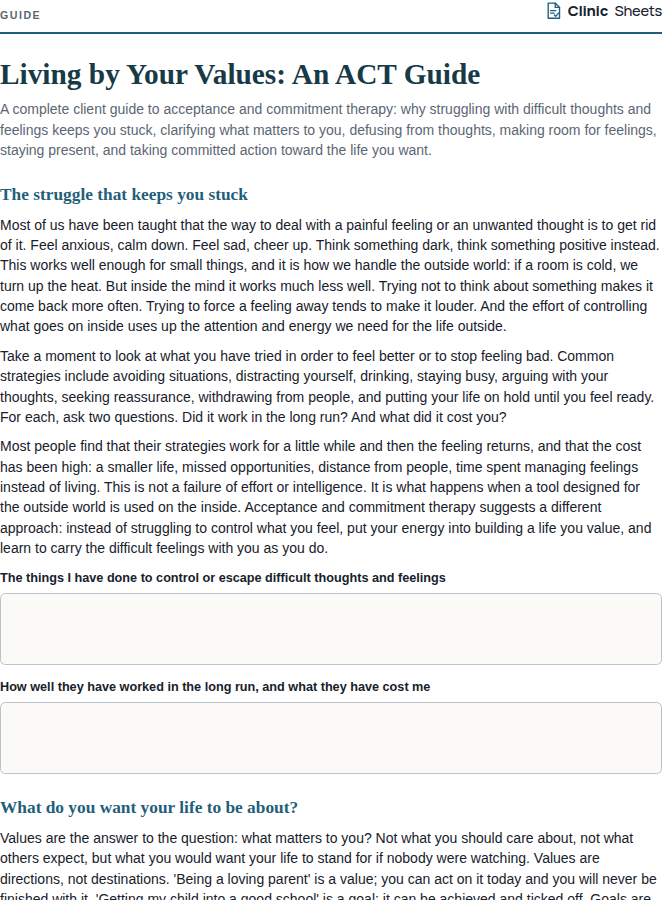
In Acceptance and Commitment Therapy, values are chosen life directions: ongoing qualities of action such as being caring, curious, honest or courageous, as distinct from goals, which are achievable outcomes. Values give acceptance its purpose. Clients are asked to make room for difficult thoughts and feelings not as an end in itself but so that they can move toward what matters, and values clarification is the process of working out what that is. Wilson's Valued Living Questionnaire and related measures showed that the gap between how important a domain is and how consistently a person is acting in it predicts distress, and that closing the gap is associated with improvement.
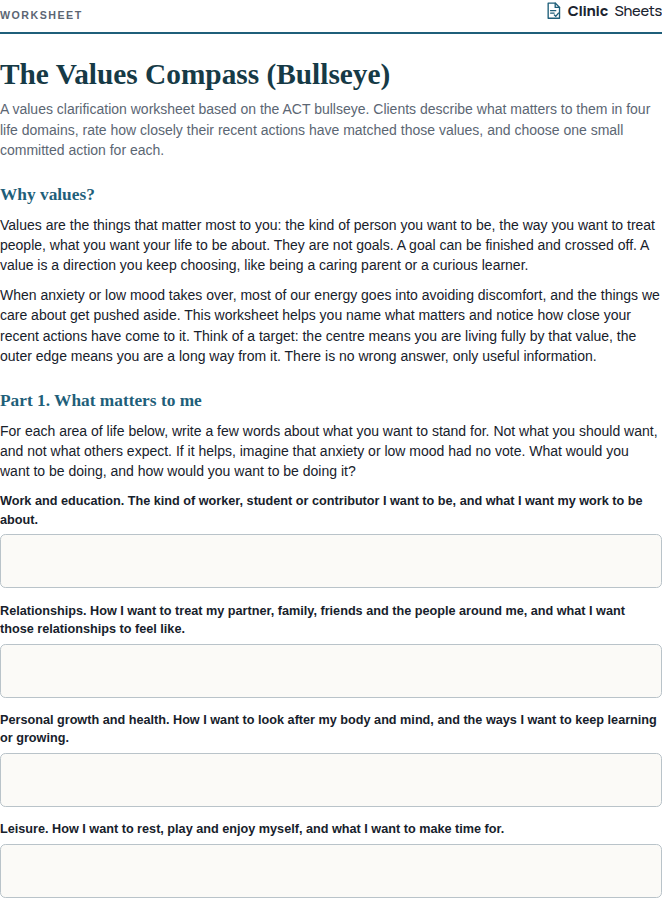
This worksheet takes the client through the major life domains (relationships, work or education, health, personal growth, leisure, community and spirituality where relevant), asking in each case what they want to stand for, how important the domain is, and how fully they are currently living by that value. The importance-consistency gaps then identify where committed action will have the most effect. The worksheet closes by asking the client to select one domain and one small, values-consistent step to take this week.
The professional version adds guidance on distinguishing values from goals and from socially expected answers, on working with clients who say they do not know what they value (often a sign of prolonged avoidance), and on the common pattern of clients scoring every domain as maximally important.
How to use it
- Introduce values after the client has some grasp of the ACT rationale (see Introduction to ACT), so that the work is framed as choosing directions rather than setting targets.
- Explain the difference between a value and a goal with an example. Getting married is a goal; being a loving partner is a value that continues after the wedding.
- Complete the domains together in session, at least the first three. Ask open questions: what kind of friend do you want to be? What would you want people to say about how you worked?
- Watch for values that are really rules ('I must be perfect') or that belong to someone else ('my parents want me to'). Ask whether the client would still choose this if no one ever knew.
- Use the gap between importance and current consistency to pick a starting domain. Choose one where the gap is large but a first step is feasible.
- Agree a concrete, small committed action for the coming week and review it next session. Return to the worksheet periodically as treatment progresses.
References
- Hayes, S. C., Strosahl, K. D., & Wilson, K. G. (2012). Acceptance and Commitment Therapy: The Process and Practice of Mindful Change (2nd ed.). Guilford Press.
- Wilson, K. G., Sandoz, E. K., Kitchens, J., & Roberts, M. (2010). The Valued Living Questionnaire: Defining and measuring valued action within a behavioral framework. The Psychological Record, 60(2), 249-272.
- Harris, R. (2019). ACT Made Simple (2nd ed.). New Harbinger.
- Wilson, K. G., & Murrell, A. R. (2004). Values work in Acceptance and Commitment Therapy. In S. C. Hayes, V. M. Follette, & M. M. Linehan (Eds.), Mindfulness and Acceptance: Expanding the Cognitive-Behavioral Tradition (pp. 120-151). Guilford Press.