OCD Formulation (Vicious Flower)
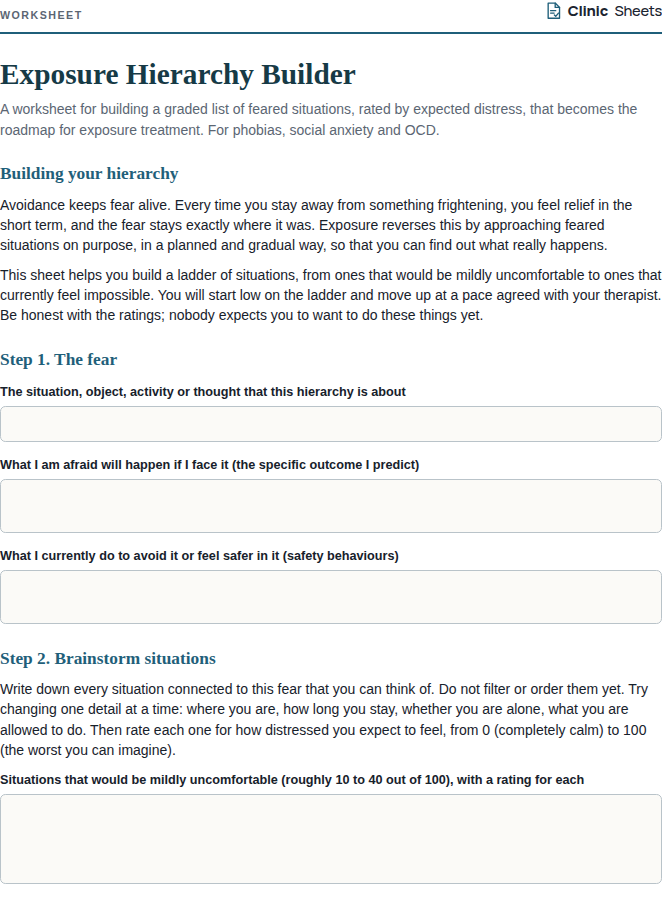
A collaborative formulation of obsessive-compulsive disorder built around the 'vicious flower': an intrusive thought at the centre, with the appraisals, emotions, compulsions, avoidance and attentional processes that keep it going arranged as petals feeding back into the centre.
About this resource
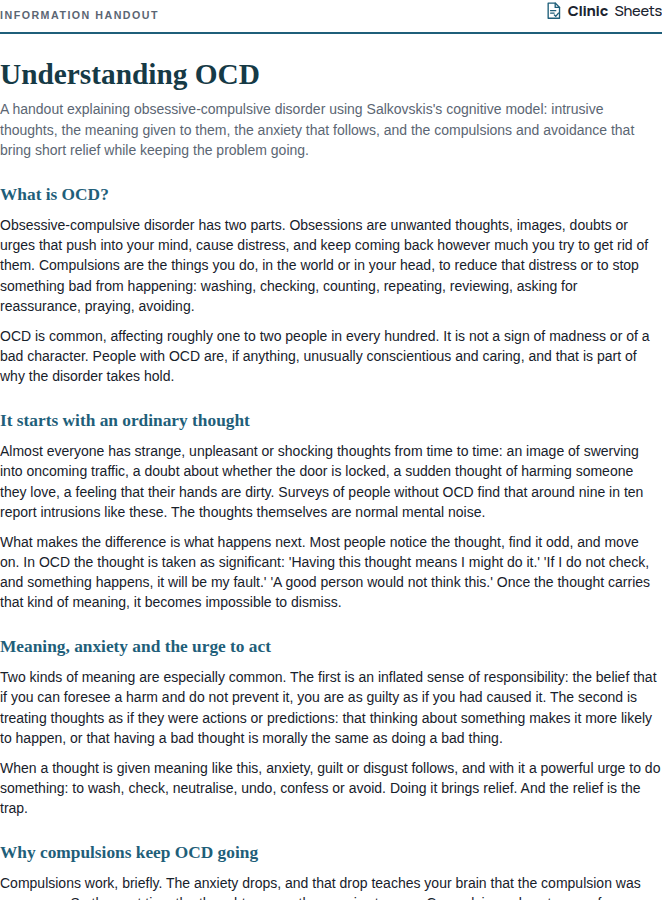
The cognitive model of OCD, developed principally by Paul Salkovskis, holds that intrusive thoughts, images and urges are a normal experience shared by almost everyone. What distinguishes OCD is not the intrusion itself but the meaning the person attaches to it: that having the thought makes harm more likely, that they are responsible for preventing it, or that the thought reveals something dangerous about who they are. This appraisal produces anxiety, guilt or disgust, which the person tries to reduce through compulsions, neutralising, reassurance seeking, avoidance and hypervigilance. Each of these responses brings short-term relief but confirms the appraisal, increases the salience of the intrusion, and prevents the person from discovering that the feared outcome would not have occurred.
The vicious flower diagram, popularised in the Oxford and Bath OCD clinics, lays this out visually. The intrusion and its appraisal sit at the centre. Each maintaining process is a petal that loops back to the centre, showing the client that everything they do to manage the problem is in fact part of the problem. Building the flower together is often the moment a client first sees OCD as a coherent, understandable trap rather than a sign of madness or badness.
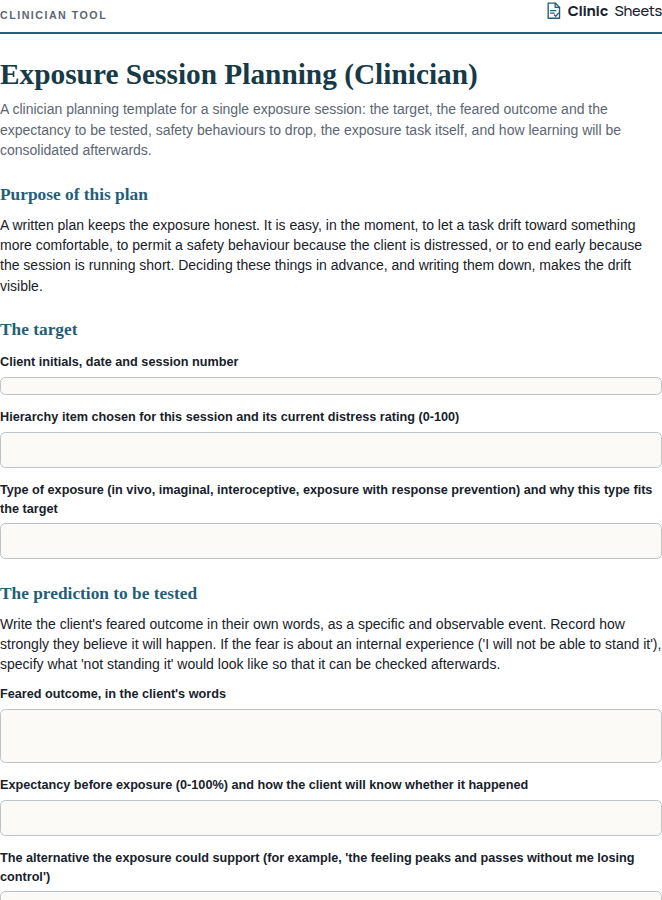
This resource uses written fields in place of the drawn diagram so it can be completed on paper or on screen and then transferred to a whiteboard. It is intended for the assessment and early treatment phase, before exposure and response prevention or behavioural experiments begin. The professional version adds guidance on eliciting the appraisal when the client can only describe the compulsion, and notes on the 'theory A versus theory B' framing that follows naturally from the completed flower.
How to use it
- Choose one recent, specific episode of obsessional distress rather than a general description of the problem. Ask the client to walk you through it moment by moment.
- Start at the centre. Identify the intrusion (thought, image, doubt or urge) and then the appraisal: 'When that thought came, what did it mean to you? What did you think might happen? Whose fault would it be?'
- Work through each petal in turn, using the client's own words. Compulsions and neutralising are usually easy to identify; avoidance, reassurance seeking, attentional bias and mood effects often need prompting.
- For every petal, ask the key question: 'What effect does doing this have on how much the thought bothers you, in the short term and in the long term?' Draw the arrow back to the centre only when the client can see the loop themselves.
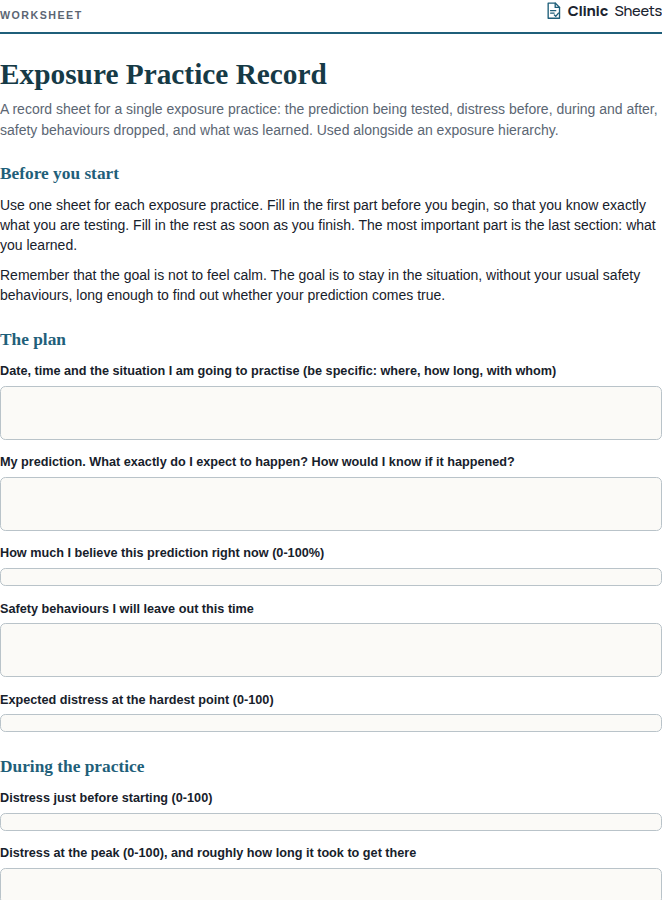
- Summarise the completed flower as a maintaining cycle and introduce the alternative explanation: the problem may not be danger, but worry about danger. This sets up ERP and behavioural experiments as ways to test the two explanations.
- Give the client the completed sheet and ask them to add any petals they notice over the following week.
References
- Salkovskis, P. M. (1985). Obsessional-compulsive problems: A cognitive-behavioural analysis. Behaviour Research and Therapy, 23(5), 571-583.
- Salkovskis, P. M. (1999). Understanding and treating obsessive-compulsive disorder. Behaviour Research and Therapy, 37, S29-S52.
- Rachman, S. (1997). A cognitive theory of obsessions. Behaviour Research and Therapy, 35(9), 793-802.
- Veale, D., & Willson, R. (2021). Overcoming Obsessive Compulsive Disorder (2nd ed.). Robinson.