Exposure Session Planning (Clinician)
A clinician planning template for a single exposure session: the target, the feared outcome and the expectancy to be tested, safety behaviours to drop, the exposure task itself, and how learning will be consolidated afterwards.
About this resource
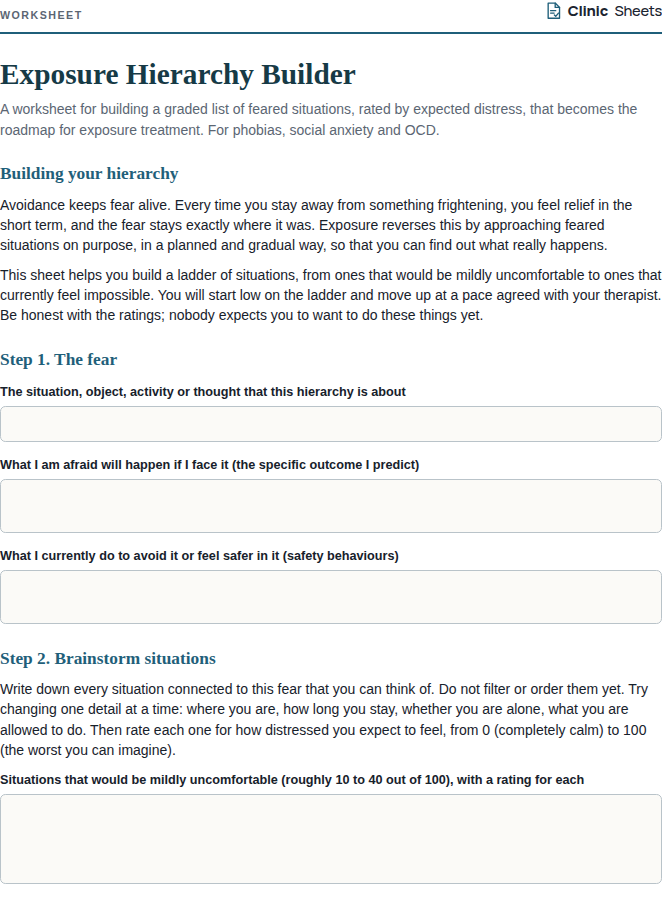
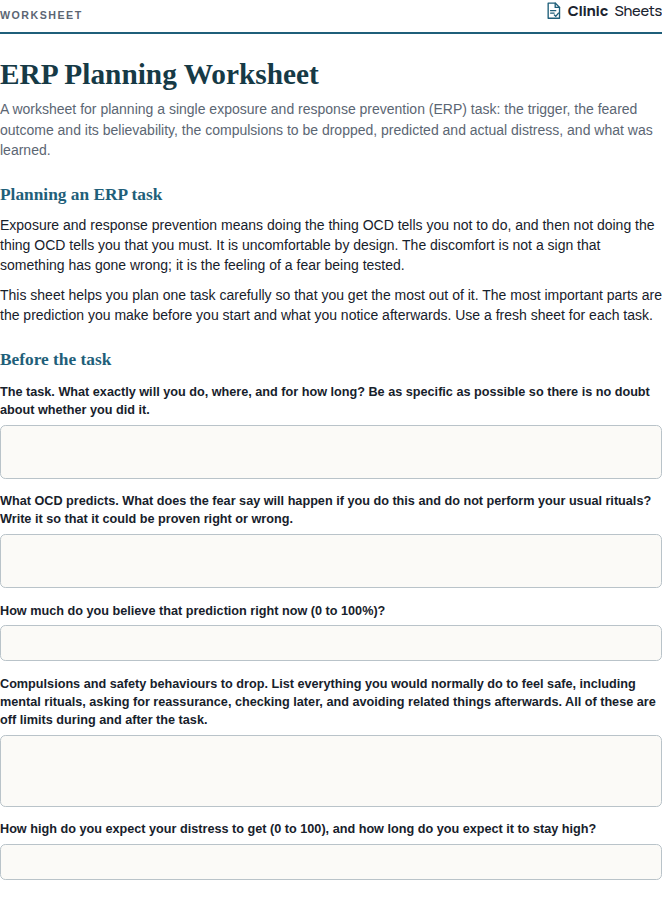
Exposure is the most reliably effective ingredient in the treatment of phobias, OCD, panic and PTSD, and it is also the ingredient most often delivered loosely. Sessions go better when they are planned. This template asks you to specify, before the session, what the client fears will happen, how strongly they expect it, what they would normally do to prevent it, and how the task will be set up so that the expectancy is genuinely tested.
The template draws on the inhibitory learning account of exposure, in which the aim is not primarily for fear to fall within the session but for the client to learn that the feared outcome does not occur, or is tolerable when it does. That framing shifts the planning questions: the key variables are expectancy violation, the removal of safety behaviours, variability across contexts and stimuli, and consolidation of what was learned. Habituation may still happen and can be recorded, but it is not the target.
The professional version adds notes on pacing the hierarchy, handling in-session avoidance, deciding when to end an exposure, and the specific adjustments for imaginal and interoceptive exposure and for exposure with response prevention in OCD.
How to use it
- Plan the session in the ten minutes before the client arrives, or at the end of the previous session with the client. Use the hierarchy you built together to choose a target that is challenging but that the client is willing to attempt.
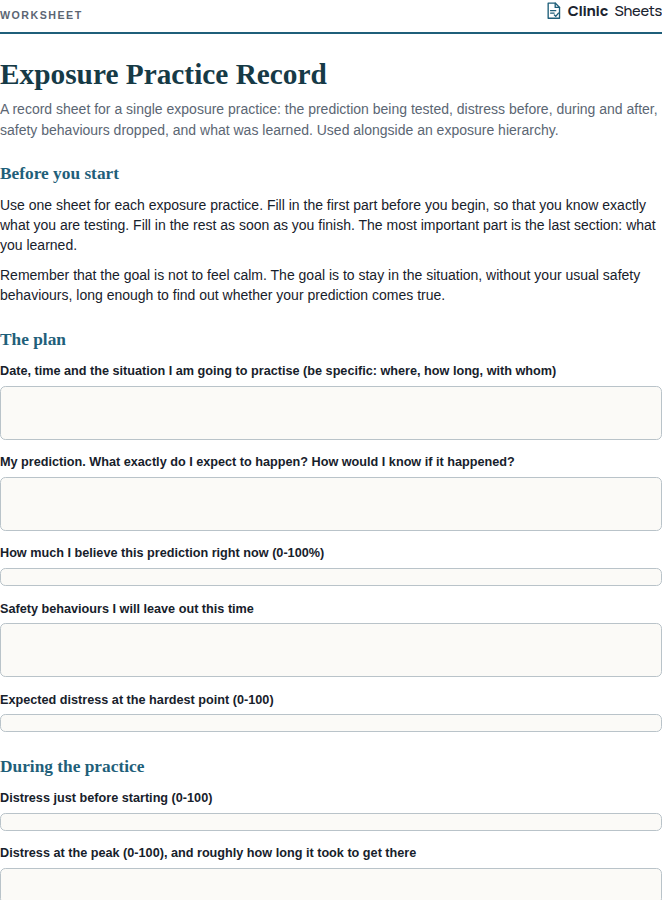
- Elicit the specific feared outcome and the client's expectancy as a percentage. 'I will feel anxious' is not a testable prediction; 'I will faint' or 'I will lose control and shout' is.
- List every safety behaviour the client would normally use, including subtle ones such as distraction, checking for exits, reassurance-seeking, or holding onto something. Agree which ones will be dropped for this exposure.
- Run the exposure long enough, or often enough, for the expectancy to be clearly tested. Record the outcome and the client's revised expectancy immediately afterwards.
- Spend the last part of the session consolidating: what did the client learn, what surprised them, and how does it fit with the feared belief? Then agree the between-session repetition, varying context where possible.
- Keep the completed plans. They document the treatment and make the next hierarchy step easier to choose.
References
- Craske, M. G., Treanor, M., Conway, C. C., Zbozinek, T., & Vervliet, B. (2014). Maximizing exposure therapy: An inhibitory learning approach. Behaviour Research and Therapy, 58, 10-23.
- Abramowitz, J. S., Deacon, B. J., & Whiteside, S. P. H. (2019). Exposure Therapy for Anxiety: Principles and Practice (2nd ed.). Guilford Press.
- Foa, E. B., & Kozak, M. J. (1986). Emotional processing of fear: Exposure to corrective information. Psychological Bulletin, 99(1), 20-35.