Exposure Hierarchy Builder
A worksheet for building a graded list of feared situations, rated by expected distress, that becomes the roadmap for exposure treatment. For phobias, social anxiety and OCD.
About this resource
Graded exposure remains the most reliably effective ingredient in the treatment of anxiety disorders. Its starting point is a hierarchy: an ordered list of feared situations, objects, activities or thoughts, each rated for the distress the client expects it to produce. The hierarchy makes an overwhelming problem concrete, gives the client a sense of control over pacing, and provides a visible record of progress as items are ticked off.
This worksheet guides the client through identifying the core fear, brainstorming relevant situations without filtering, rating each one on a 0-100 scale of expected distress, and then ordering them from least to most difficult. It also prompts the client to record which safety behaviours would need to be dropped for each item, since an exposure done with safety behaviours intact tends to teach very little. It is compatible with both the habituation rationale and the inhibitory learning approach; in the latter, the ratings serve as predictions to be tested rather than a strict order to be followed.
Use it after psychoeducation about avoidance and safety behaviours, once the client has agreed that exposure is the way forward. Revisit and re-rate the hierarchy every few sessions. The professional version adds guidance on generating enough variety in a hierarchy (varying context, duration, proximity and the presence of others), on what to do when everything is rated 100, and on building hierarchies for OCD where the items are often thoughts, uncertainties or omitted rituals rather than external situations.
How to use it
- Agree the target fear first. A hierarchy works best when it is organised around a single theme, such as driving, speaking in meetings, or touching contaminated surfaces. Build a separate hierarchy for each major fear.
- Brainstorm freely before rating. Ask the client to list every situation that comes to mind, including ones they think are impossible. Aim for 10 to 15 items. Prompt for variation: alone versus accompanied, short versus long, familiar versus unfamiliar places.
- Rate each item for expected distress, 0 to 100, as it is imagined now. Reassure the client that ratings are estimates, not commitments.
- Order the items from lowest to highest. Check for gaps: if the ratings jump from 30 to 80, generate intermediate steps by changing one variable at a time.
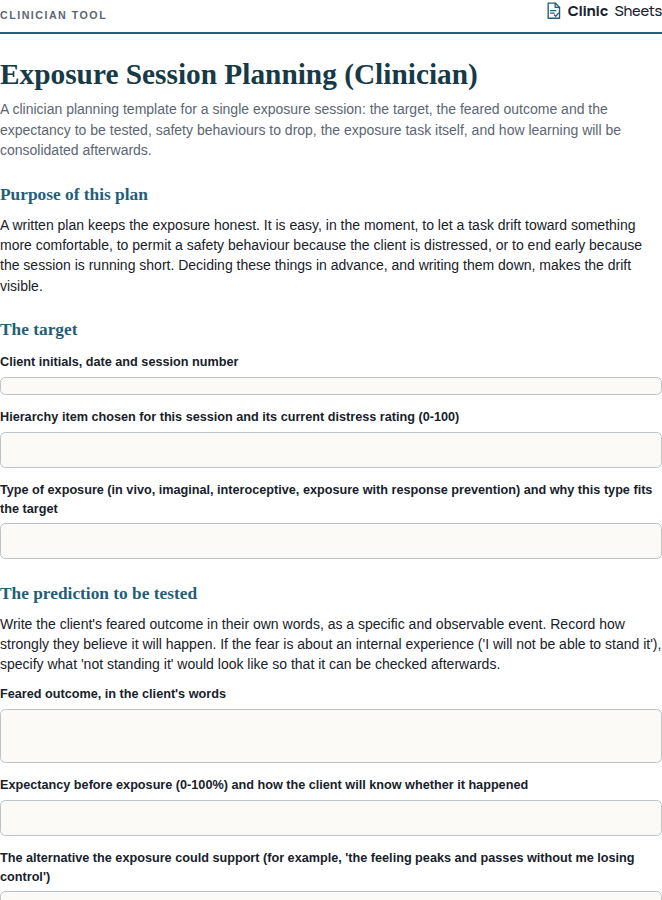
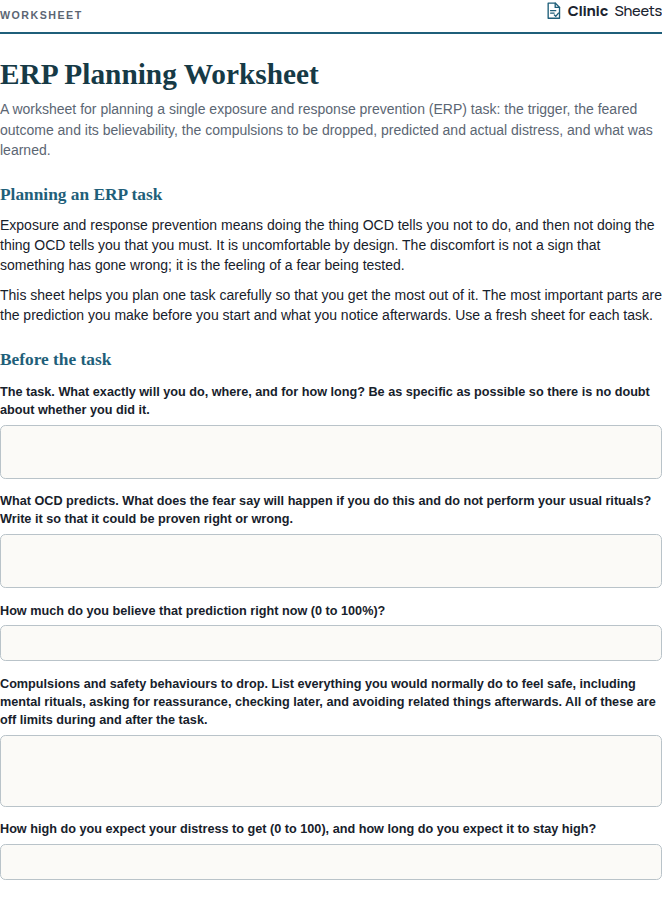
- For each item, identify the safety behaviours the client would be tempted to use and agree that exposures will be done without them. Note also the specific prediction being tested ('I will faint', 'people will laugh').
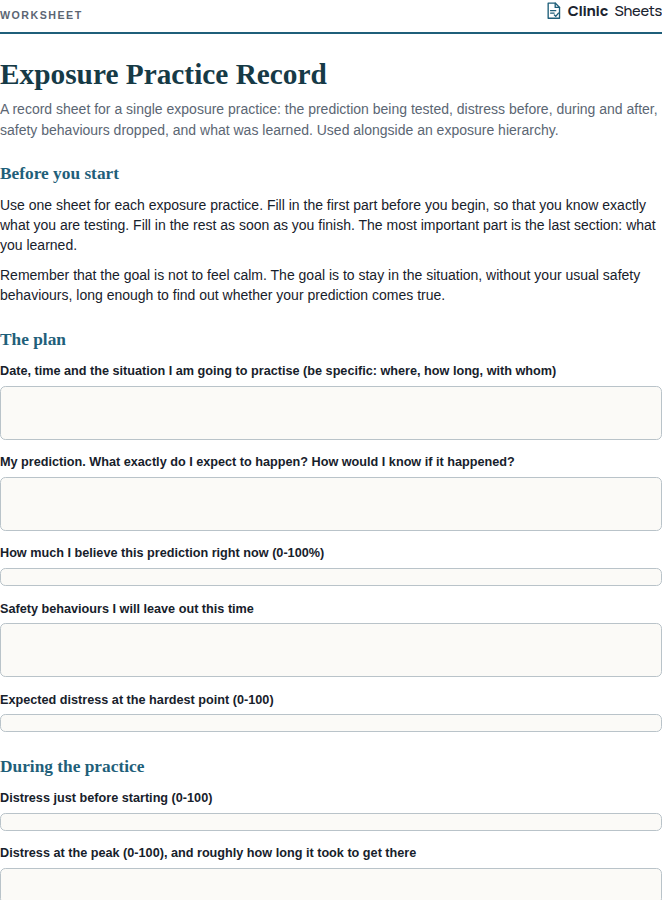
- Choose a starting item in the 30 to 50 range for the first exposure. Use the Exposure Practice Record to log each attempt, and return to this sheet to re-rate items as treatment proceeds.
References
- Abramowitz, J. S., Deacon, B. J., & Whiteside, S. P. H. (2019). Exposure Therapy for Anxiety: Principles and Practice (2nd ed.). Guilford Press.
- Craske, M. G., Treanor, M., Conway, C. C., Zbozinek, T., & Vervliet, B. (2014). Maximizing exposure therapy: An inhibitory learning approach. Behaviour Research and Therapy, 58, 10-23.
- Foa, E. B., & Kozak, M. J. (1986). Emotional processing of fear: Exposure to corrective information. Psychological Bulletin, 99(1), 20-35.