Exposure Practice Record
A record sheet for a single exposure practice: the prediction being tested, distress before, during and after, safety behaviours dropped, and what was learned. Used alongside an exposure hierarchy.
About this resource
Exposure produces change only when the client actually does it, does it repeatedly, and extracts the learning afterwards. A practice record supports all three. Writing down the plan in advance turns a vague intention into a commitment; rating distress at intervals shows the client that anxiety rises, plateaus and falls even when nothing is done about it; and the debrief questions convert a frightening experience into evidence about the feared prediction.
This record is built around the inhibitory learning model, so it foregrounds the client's specific prediction and asks, afterwards, how well the outcome matched it. It also captures peak distress and end-of-practice distress so that habituation can be tracked across repetitions, and it explicitly asks which safety behaviours were dropped, since a practice done with subtle safety behaviours in place will often produce a puzzling lack of progress. One sheet per practice; the client keeps them in a folder and brings them to session.
The professional version adds a troubleshooting guide for common patterns in the records: distress that never rises (the item is too easy or a safety behaviour is hidden), distress that never falls within the practice (the practice was too short or the client was distracting themselves), and repeated practices with no change in the prediction rating (the learning is not being consolidated, or the client is attributing the outcome to luck).
How to use it
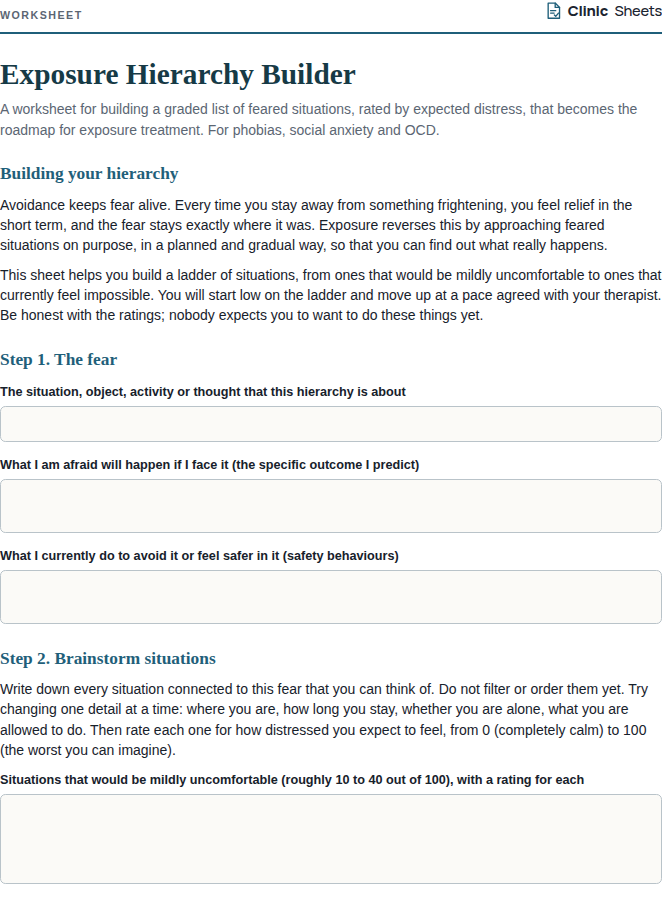
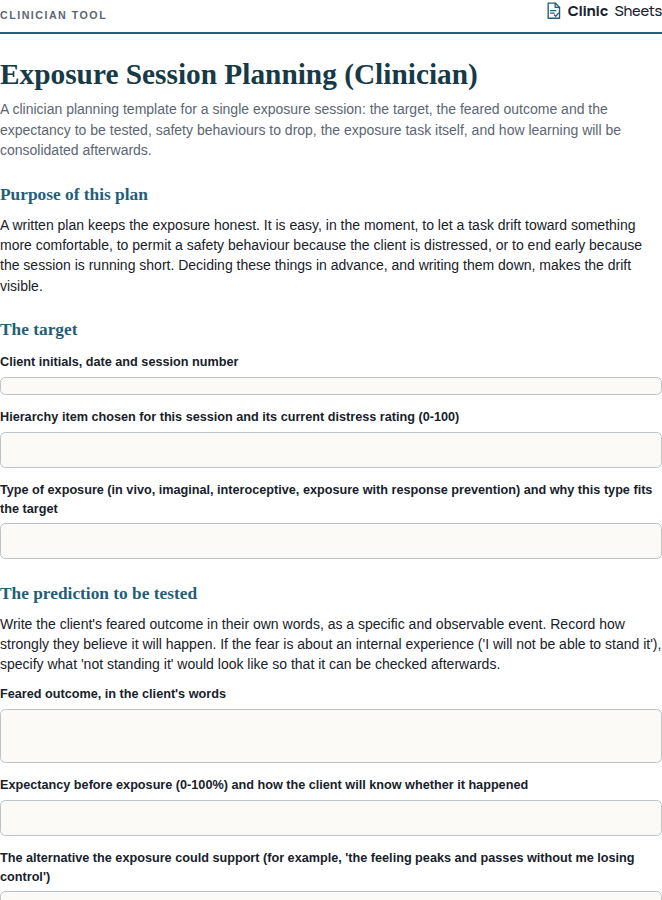
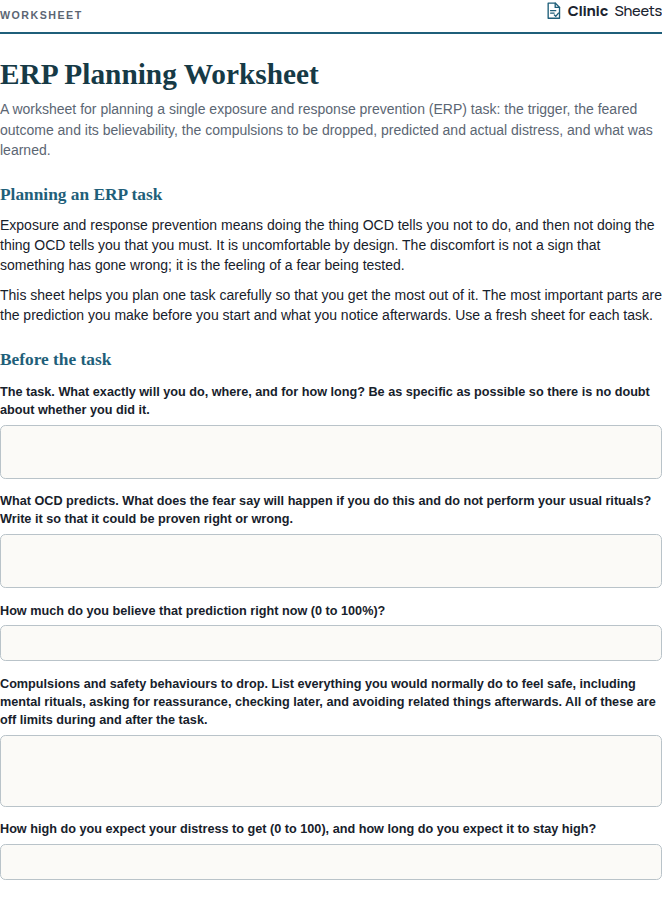
- Plan the practice in session using an item from the client's hierarchy. Complete the top half of the record together: the situation, the exact prediction, how much the client believes it, and the safety behaviours to be left out.
- Ask the client to rate distress just before starting, at the peak, and at the end. Explain that the aim is not to keep distress low but to stay in the situation until they have learned something about the prediction.
- Instruct the client to complete the debrief section as soon as possible after the practice, while the detail is fresh.
- Review the record at the next session. Compare the predicted outcome with what happened, and re-rate belief in the prediction. Ask what surprised them.
- Plan the next repetition. Repeat the same item until the client's belief in the prediction has dropped substantially, then move up the hierarchy. Vary the context where possible so the learning generalises.
References
- Craske, M. G., Treanor, M., Conway, C. C., Zbozinek, T., & Vervliet, B. (2014). Maximizing exposure therapy: An inhibitory learning approach. Behaviour Research and Therapy, 58, 10-23.
- Abramowitz, J. S., Deacon, B. J., & Whiteside, S. P. H. (2019). Exposure Therapy for Anxiety: Principles and Practice (2nd ed.). Guilford Press.
- Foa, E. B., Yadin, E., & Lichner, T. K. (2012). Exposure and Response (Ritual) Prevention for Obsessive-Compulsive Disorder: Therapist Guide (2nd ed.). Oxford University Press.