Perinatal Mood: Self-Care and Support Plan
A practical planning worksheet for pregnant and postpartum clients experiencing low mood or anxiety: sleep protection, small daily activities, people who can help, warning signs, and who to contact if things get worse.
About this resource
Depression and anxiety during pregnancy and the first year after birth are common, and they arrive at a time when the usual sources of recovery, such as sleep, exercise, social contact and time alone, are hardest to reach. Cognitive behavioural and interpersonal approaches to perinatal mood both emphasise the same practical levers: protecting rest where possible, restoring small amounts of valued and pleasant activity, reducing isolation, and making the client's support network specific rather than vague.
This worksheet turns those levers into a written plan. It asks the client to identify what a realistic amount of rest looks like right now and who can make it possible, to schedule two or three small activities for themselves each week, to name the people they will call for practical help and for emotional support, and to write down early warning signs alongside the steps they and their supports will take if mood deteriorates. The final section is a brief safety step modelled on the Stanley and Brown approach, adapted for the perinatal context.
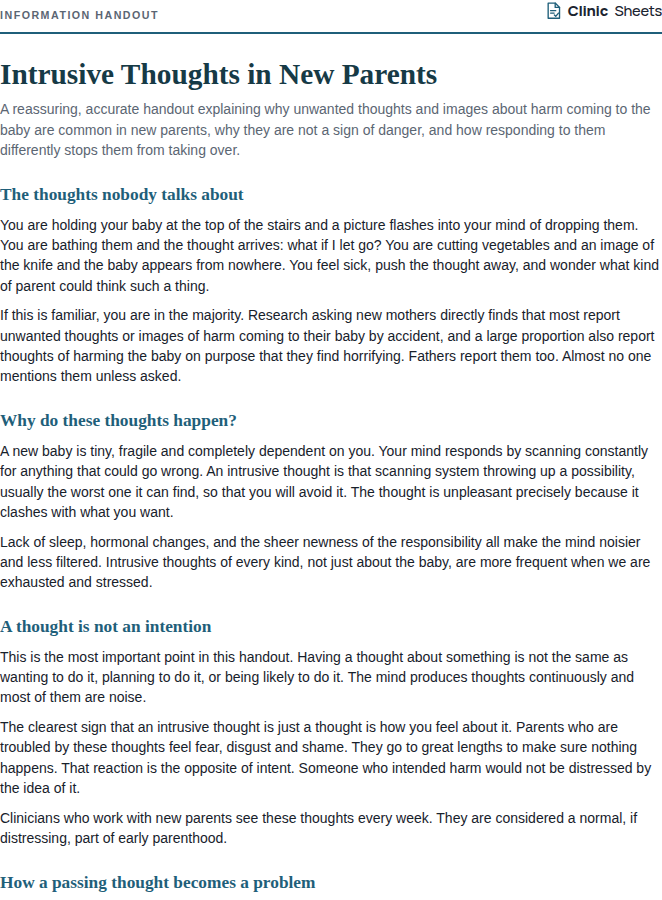
The professional version adds prompts for partners or family members to be included in the plan, notes on separating the client's needs from the baby's needs when the two have become blurred, and reminders about screening for intrusive thoughts, thoughts of self-harm and, where relevant, symptoms of postpartum psychosis, which requires urgent medical attention.
How to use it
- Use after an initial assessment of mood, anxiety and risk. Where scores or presentation raise concern about safety or psychosis, address those first and involve the perinatal care team.
- Complete the sleep section together and be realistic. The aim is one protected block of sleep, not a normal night. Identify who can take a feed or a settling shift, and what would need to change for that to happen.
- For activity scheduling, aim for two or three small, specific, achievable items per week. Ten minutes outside counts. Review what happened at the next session rather than whether it went perfectly.
- Invite the client to share the plan with a partner or family member. Many clients find it easier to accept help when it is written as part of a plan rather than requested in the moment.
- Review the warning signs and the 'if things get worse' section at each session and update contact details. Confirm the client knows how to reach 9-8-8 and when to use 911 or the emergency department.
References
- O'Hara, M. W., & McCabe, J. E. (2013). Postpartum depression: Current status and future directions. Annual Review of Clinical Psychology, 9, 379-407.
- Sockol, L. E. (2015). A systematic review of the efficacy of cognitive behavioral therapy for treating and preventing perinatal depression. Journal of Affective Disorders, 177, 7-21.
- Stanley, B., & Brown, G. K. (2012). Safety Planning Intervention: A brief intervention to mitigate suicide risk. Cognitive and Behavioral Practice, 19(2), 256-264.
- Weissman, M. M., Markowitz, J. C., & Klerman, G. L. (2018). The Guide to Interpersonal Psychotherapy (Updated and expanded ed.). Oxford University Press.