Daily Routine and Rhythm (Bipolar Disorder)
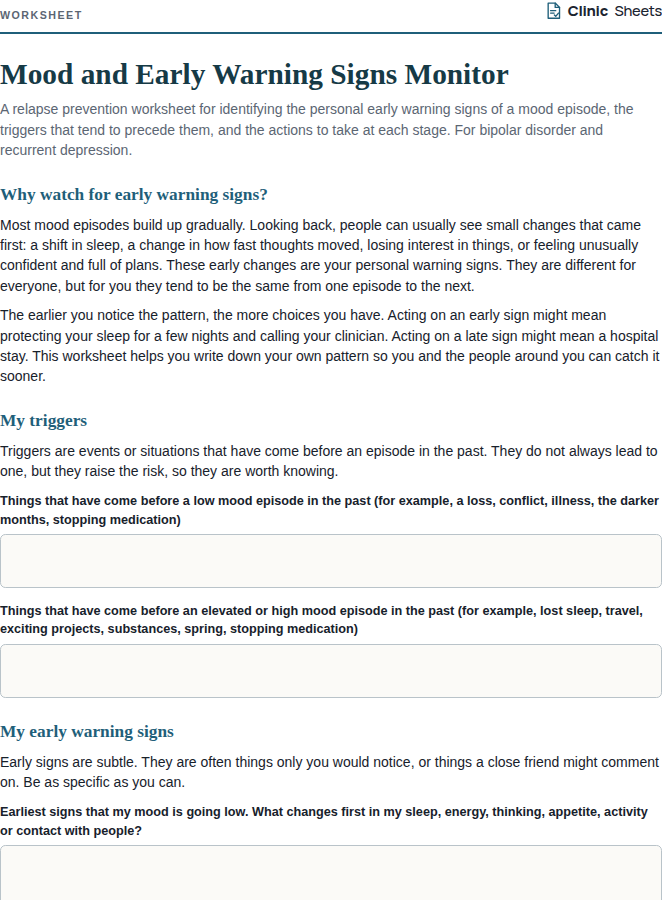
A social rhythm planning worksheet for people with bipolar disorder: setting target times for waking, first contact, meals, activity and bed, tracking how consistent they are, and identifying the events that disrupt them.
About this resource
Interpersonal and Social Rhythm Therapy (IPSRT), developed by Ellen Frank and colleagues, rests on the observation that disruption of daily routines and sleep-wake timing can precipitate mood episodes in people with bipolar disorder. Regular daily 'zeitgebers' (time cues such as waking, meals, social contact and bedtime) help stabilise circadian rhythms, and stabilising rhythms is associated with fewer relapses. The core tool of IPSRT is the Social Rhythm Metric, a daily record of when key activities happen.
This worksheet is a simplified planning and tracking tool in that tradition. The client sets a realistic target time for five anchor activities, records the actual time each day for a week, notes their mood and energy, and then reviews which anchors drifted and why. A final section helps the client identify predictable disruptors (shift work, travel, social events, weekends, conflict) and plan how to protect rhythm around them.
The professional version adds guidance on pacing changes (shifting an anchor by 15 to 30 minutes at a time), on the particular importance of protecting sleep timing during periods of elevated mood, and on integrating the routine review with relapse prevention and medication adherence discussions with the prescribing clinician.
How to use it
- Introduce the rationale: irregular routines and sleep loss are among the most reliable triggers of mood episodes, and regular time cues are something the client can control. Avoid framing it as rigidity; the aim is predictability with room for life.
- Set target times collaboratively. Start from the client's current pattern, not an ideal one. Prioritise a consistent wake time seven days a week, since this is the strongest anchor for the sleep-wake cycle.
- Ask the client to record actual times daily for at least a week, along with a brief mood and energy rating. Review the record together, looking for drift of more than an hour and for links between disrupted anchors and mood.
- Use the disruptors section to plan ahead for known events. For unavoidable disruptions such as travel or shift changes, plan how the client will return to the routine as quickly as possible.
- Revisit the worksheet at regular intervals and after any episode. Coordinate with the client's prescriber, since routine disruption, sleep changes and early symptoms should be shared across the care team.
References
- Ehlers, C. L., Frank, E., & Kupfer, D. J. (1988). Social zeitgebers and biological rhythms: A unified approach to understanding the etiology of depression. Archives of General Psychiatry, 45(10), 948-952.
- Frank, E. (2005). Treating Bipolar Disorder: A Clinician's Guide to Interpersonal and Social Rhythm Therapy. Guilford Press.
- Frank, E., Kupfer, D. J., Thase, M. E., Mallinger, A. G., Swartz, H. A., Fagiolini, A. M., Grochocinski, V., Houck, P., Scott, J., Thompson, W., & Monk, T. (2005). Two-year outcomes for interpersonal and social rhythm therapy in individuals with bipolar I disorder. Archives of General Psychiatry, 62(9), 996-1004.