PLEASE Skills
A DBT emotion regulation handout on the PLEASE skills: looking after physical health (treating illness, balanced eating, avoiding mood-altering substances, balanced sleep, and exercise) to reduce vulnerability to intense emotions.
About this resource
PLEASE is a set of skills from the DBT emotion regulation module aimed at reducing emotional vulnerability. The acronym stands for treating PhysicaL illness, balanced Eating, Avoiding mood-altering substances, balanced Sleep, and getting Exercise. The premise is that the body sets the baseline for emotional reactivity. A person who is unwell, hungry, hung over, sleep-deprived or sedentary starts each day closer to their emotional threshold, so that ordinary events push them over it. Attending to these basics does not make emotions disappear, but it raises the threshold and makes every other skill easier to use.
Clients frequently underestimate this module because it sounds like ordinary health advice. The clinical argument is worth making explicitly: sleep deprivation alone measurably increases emotional reactivity and reduces the capacity for regulation, and the same is true of hunger and substance use. For clients with emotion dysregulation, whose baseline reactivity is already high, these factors can be the difference between a difficult day and a crisis. PLEASE skills are also the easiest to track, which makes them a good early behavioural target.
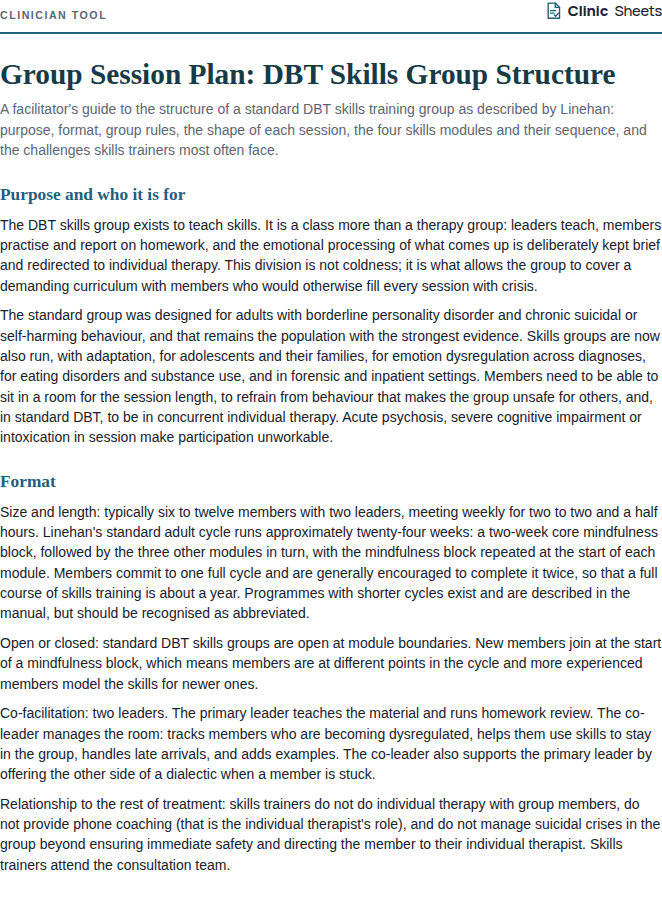
This handout explains the vulnerability principle, walks through each of the five areas with practical suggestions, and asks the client to identify their own weakest area and one change to make. It avoids prescriptive targets, medical advice and diet rules, and it frames each area as balance rather than perfection. It is suitable for adults and adolescents.
The professional version includes notes on when to refer to a physician (persistent sleep problems, suspected medical contributors to mood), guidance for clients with eating disorders (where the eating and exercise sections need careful adaptation and no numerical targets), and a simple weekly tracking format.
How to use it
- Introduce the vulnerability principle with a diagram: a threshold line, and a baseline that sits closer to it or further from it depending on the body's state. Ask the client where their baseline was on their last bad day.
- Go through each area and ask the client to rate honestly how they are doing. Resist the urge to lecture; the client has heard the health advice before. Focus on the link to emotion.
- Choose one area, not five. Ask the client which area is most out of balance and which change is most achievable. A single sustained change is worth more than a comprehensive plan that lasts a week.
- Adapt the eating and exercise sections for clients with eating disorders or a history of them. Balance is the frame; there are no targets.
- Track the chosen change on the diary card alongside emotion ratings, and review the relationship between the two over several weeks.
References
- Linehan, M. M. (2015). DBT Skills Training Manual (2nd ed.). Guilford Press.
- Rathus, J. H., & Miller, A. L. (2015). DBT Skills Manual for Adolescents. Guilford Press.
- Walker, M. P., & van der Helm, E. (2009). Overnight therapy? The role of sleep in emotional brain processing. Psychological Bulletin, 135(5), 731-748.
- Schuch, F. B., Vancampfort, D., Richards, J., Rosenbaum, S., Ward, P. B., & Stubbs, B. (2016). Exercise as a treatment for depression: A meta-analysis adjusting for publication bias. Journal of Psychiatric Research, 77, 42-51.