Rebuilding Trust After a Breach
A handout for couples recovering from a breach of trust such as an affair, a significant lie, or hidden spending. It explains why the injury runs so deep, what each partner tends to need, and the stages through which trust is rebuilt.
About this resource
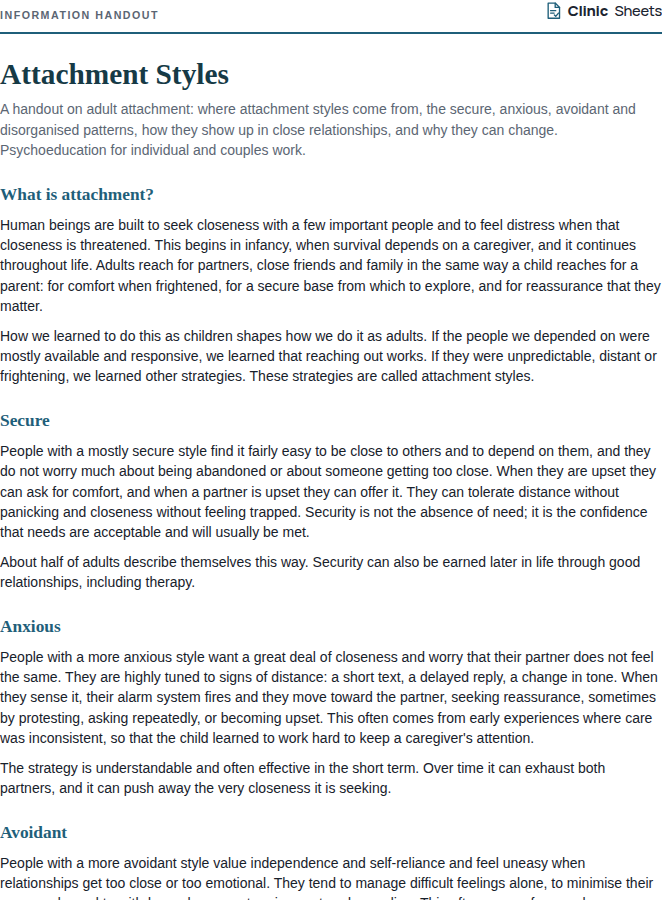
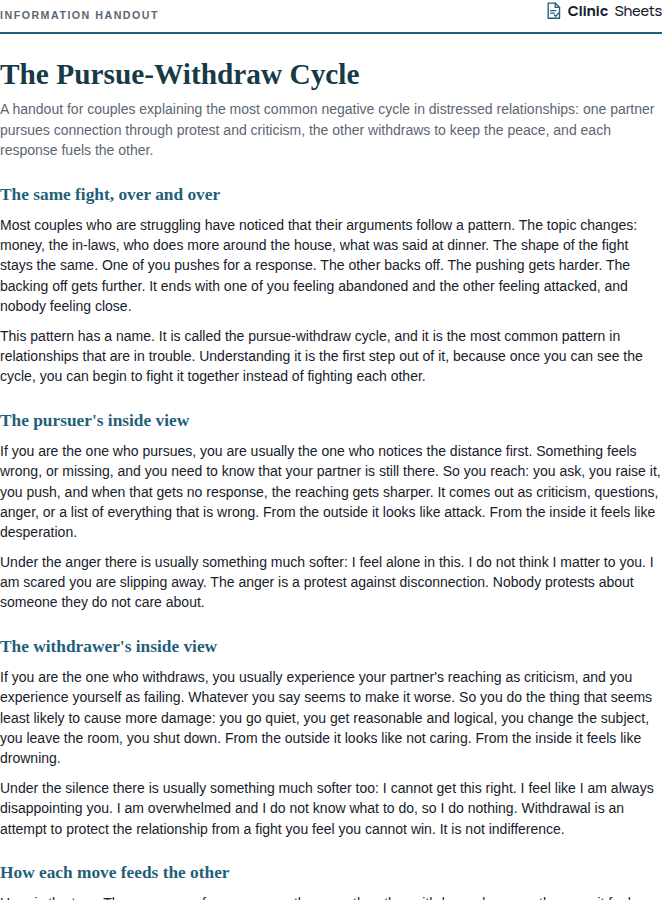
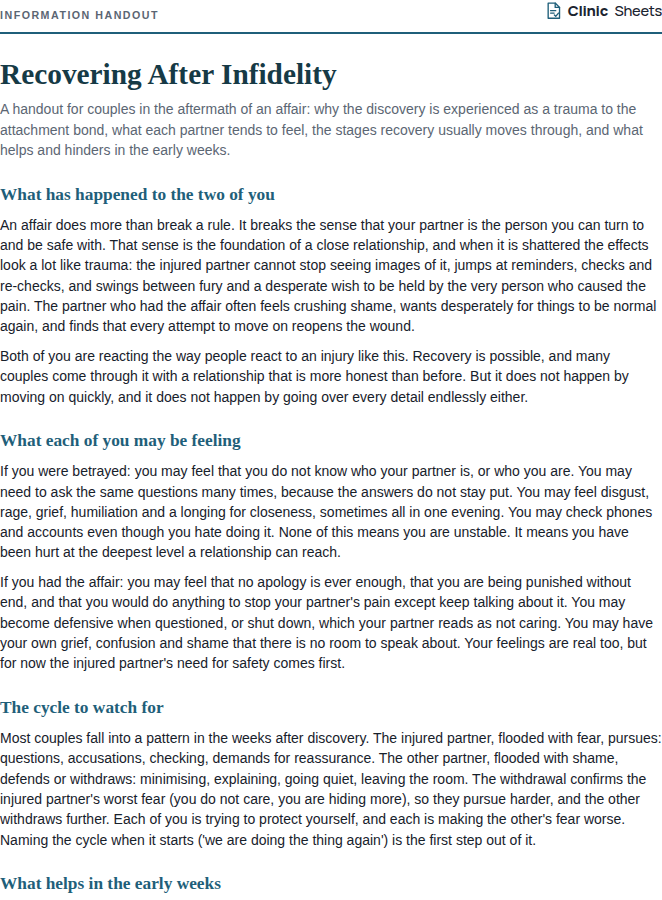
A serious breach of trust, whether sexual, emotional or financial, is experienced by the injured partner as an attachment injury: a moment when the person they most depended on became a source of danger. This is why the reaction often looks like trauma, with intrusive images, hypervigilance, emotional swings and a compulsion to seek information. The partner who committed the breach usually wants the relationship to move forward quickly and can experience the injured partner's continued questioning as punishment, which leads to defensiveness and a second injury: the sense of being alone with the pain.
This handout normalises both partners' reactions, explains why the injury does not resolve on a timetable, and lays out the broad stages described in the couples literature: absorbing the impact and establishing stability, making sense of what happened and why, and then moving forward on the basis of a repaired bond. It draws on the integrative affair-recovery model of Gordon, Baucom and Snyder and on the emotionally focused approach to attachment injury repair, in which the injuring partner's ability to stay present with the hurt, take responsibility and respond to the underlying attachment need is what allows forgiveness to become possible.
The professional version adds guidance on the disclosure phase (how much detail, and what kind), on managing the injured partner's interrogation and the injuring partner's minimisation, and on the difference between forgiveness and reconciliation, since the couple may achieve one without the other.
How to use it
- Use once the immediate crisis has settled enough that both partners can sit in a room together and the breach is no longer ongoing. It is not suitable while an affair continues or while the injuring partner is still concealing material facts.
- Read the sections on each partner's experience aloud in session and ask each partner how accurately it describes them. This often gives the injuring partner their first real picture of the injured partner's inner world, and vice versa.
- Use the stages to orient the couple: most couples in the first weeks are in stage one and are frustrated that they are not further along. Naming this reduces pressure.
- Help the injuring partner practise the responses described in 'What helps and what hurts': staying present, answering questions without defensiveness, and responding to the feeling rather than the accusation.
- Return to the reflection prompts over several sessions. The answers change as the couple moves through the stages.
References
- Gordon, K. C., Baucom, D. H., & Snyder, D. K. (2004). An integrative intervention for promoting recovery from extramarital affairs. Journal of Marital and Family Therapy, 30(2), 213-231.
- Baucom, D. H., Snyder, D. K., & Gordon, K. C. (2009). Helping Couples Get Past the Affair: A Clinician's Guide. Guilford Press.
- Johnson, S. M. (2004). The Practice of Emotionally Focused Couple Therapy: Creating Connection (2nd ed.). Brunner-Routledge.
- Glass, S. P., & Staeheli, J. C. (2003). Not "Just Friends": Rebuilding Trust and Recovering Your Sanity After Infidelity. Free Press.