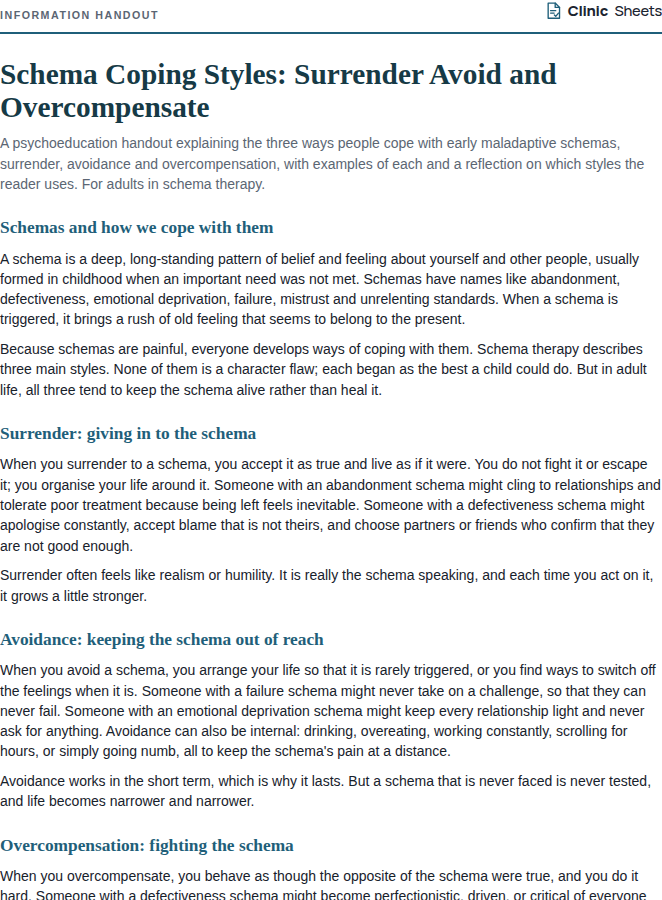
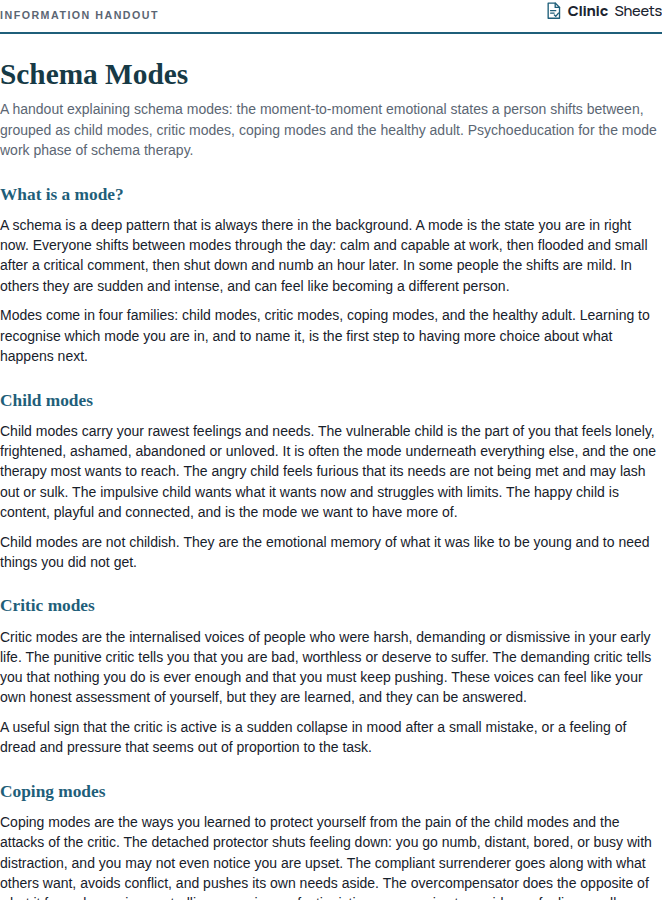
Attachment Styles
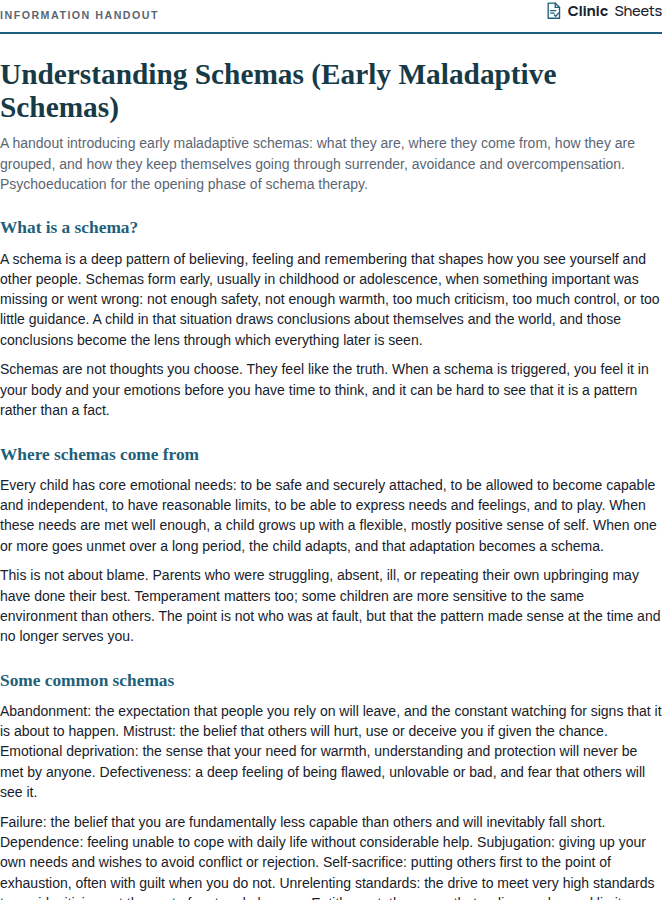
A handout on adult attachment: where attachment styles come from, the secure, anxious, avoidant and disorganised patterns, how they show up in close relationships, and why they can change. Psychoeducation for individual and couples work.
About this resource
Attachment theory, developed by John Bowlby and extended to adult romantic relationships by Hazan and Shaver, proposes that early experiences with caregivers shape an internal working model of whether others can be relied on and whether the self is worthy of care. In adulthood, these models organise how people seek closeness, respond to distance and conflict, and regulate emotion within relationships. Four broad patterns are usually described: secure, anxious (or preoccupied), avoidant (or dismissing), and disorganised (or fearful-avoidant). Most people show one dominant pattern with features of others, and the pattern can vary between relationships.
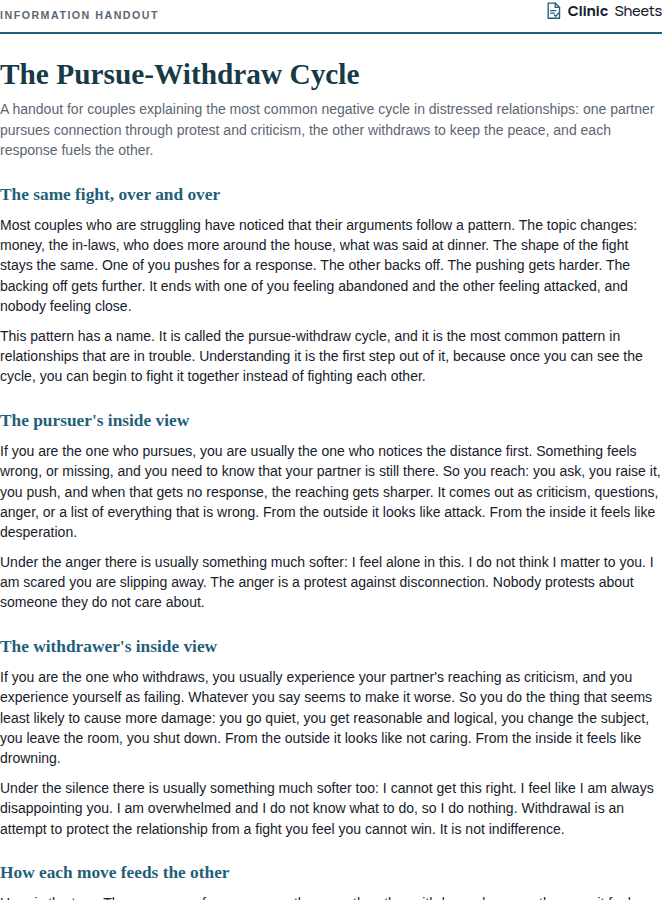
This handout presents the four styles without pathologising any of them, emphasising that each is an adaptation to what closeness was like early on. It describes what each style tends to feel, think and do when a partner is close or distant, and it introduces the way that styles interact, particularly the common anxious-avoidant pairing in which one partner pursues and the other withdraws, each intensifying the other. This is the pattern that Johnson's emotionally focused therapy targets as the negative cycle, and the handout is written to lead into that work. It closes with the idea of earned security: attachment patterns are not fixed and can shift through relationships, including the therapeutic one.
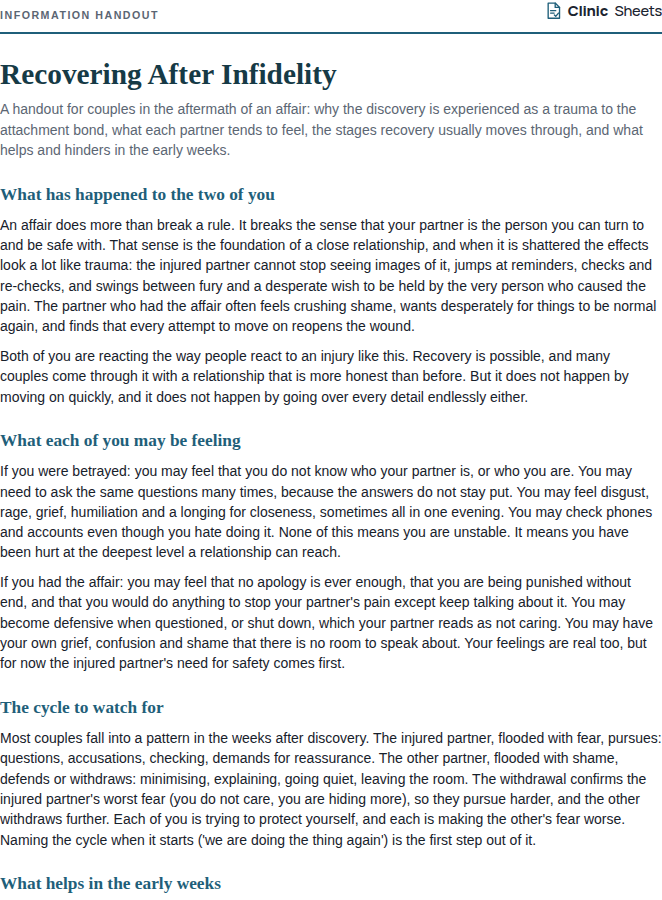
It suits adults with relationship difficulties or personality difficulties in individual therapy, and couples in the assessment phase of EFT. The professional version adds a summary of the research base, guidance on discussing styles with a couple without one partner being cast as the problem, and notes on how attachment relates to schemas such as abandonment, mistrust and emotional deprivation.
How to use it
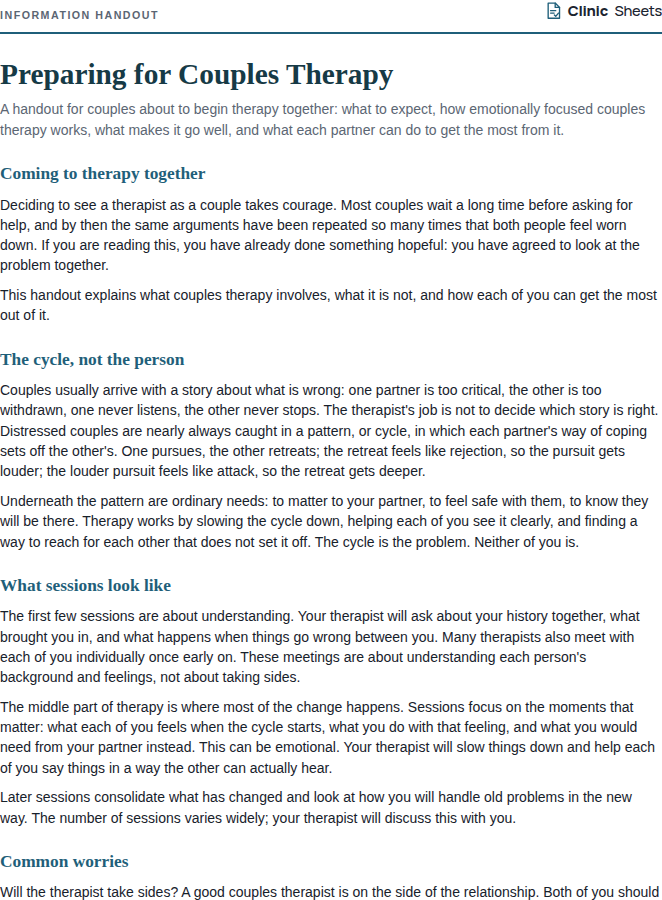
- Introduce the handout once you have heard enough relationship history to have a sense of the client's or couple's patterns. Read the four styles together and ask which feel familiar, for themselves and for partners past and present.
- Frame every style as an adaptation that made sense. Avoid letting anxious and avoidant become good and bad, or one partner's style become the explanation for the relationship's problems.
- With couples, use the section on how styles interact to introduce the idea of a cycle that neither partner chose and both are caught in. This is the bridge to The Negative Cycle (Couples).
- In individual work, link the style to early experience and, where schema therapy is being used, to the relevant schemas.
- Use the reflection questions as homework and revisit them. Clients often revise their self-assessment after a few weeks of noticing.
References
- Bowlby, J. (1988). A Secure Base: Parent-Child Attachment and Healthy Human Development. Basic Books.
- Hazan, C., & Shaver, P. (1987). Romantic love conceptualized as an attachment process. Journal of Personality and Social Psychology, 52(3), 511-524.
- Mikulincer, M., & Shaver, P. R. (2016). Attachment in Adulthood: Structure, Dynamics, and Change (2nd ed.). Guilford Press.
- Johnson, S. M. (2019). Attachment Theory in Practice: Emotionally Focused Therapy (EFT) with Individuals, Couples, and Families. Guilford Press.