Recovering After Infidelity
A handout for couples in the aftermath of an affair: why the discovery is experienced as a trauma to the attachment bond, what each partner tends to feel, the stages recovery usually moves through, and what helps and hinders in the early weeks.
About this resource
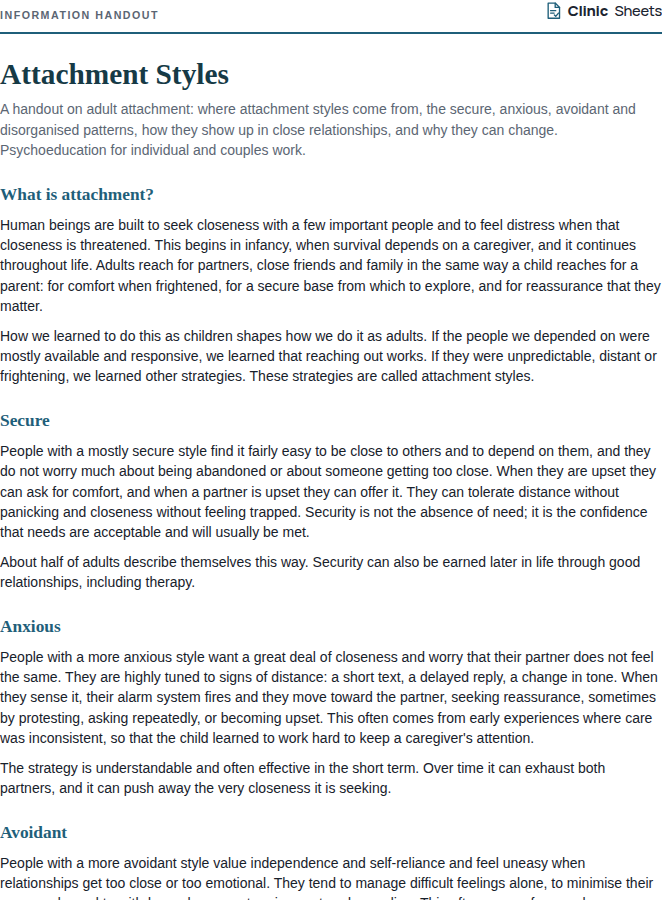
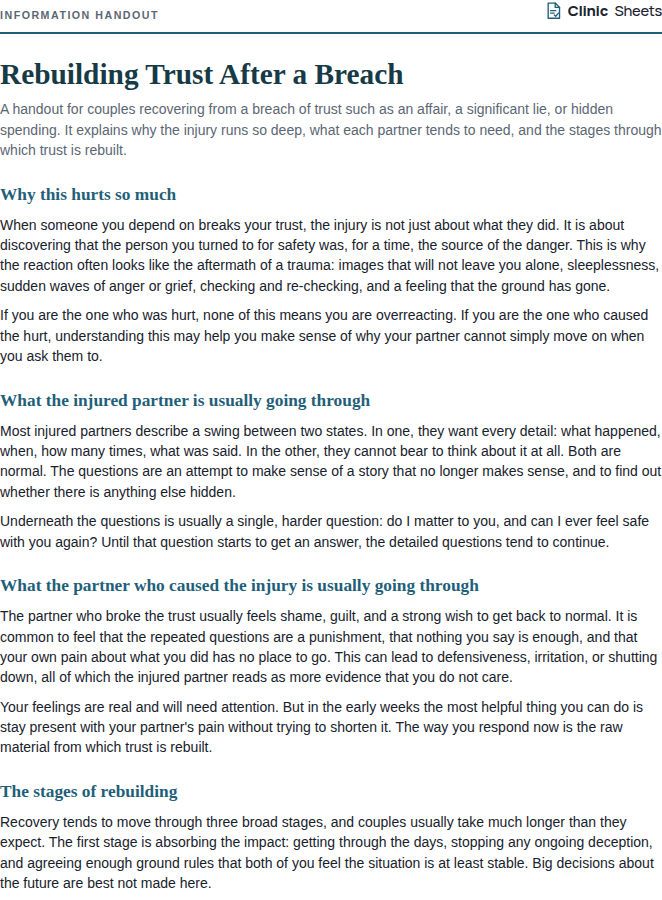
In emotionally focused therapy, infidelity is understood as an attachment injury: a moment of betrayal or abandonment at a time of need that violates the assumption that the partner is a safe haven. Johnson and colleagues describe how such injuries, if not processed, block reconnection and resurface whenever the couple attempts closeness. The injured partner shows trauma-like responses (intrusive images, hypervigilance, checking, numbing, swings between rage and longing); the partner who had the affair often oscillates between shame, defensiveness and impatience for things to move on. Gordon, Baucom and Snyder's integrative model describes three broad stages of recovery: absorbing the impact, making meaning of how the affair came about, and deciding how to move forward.
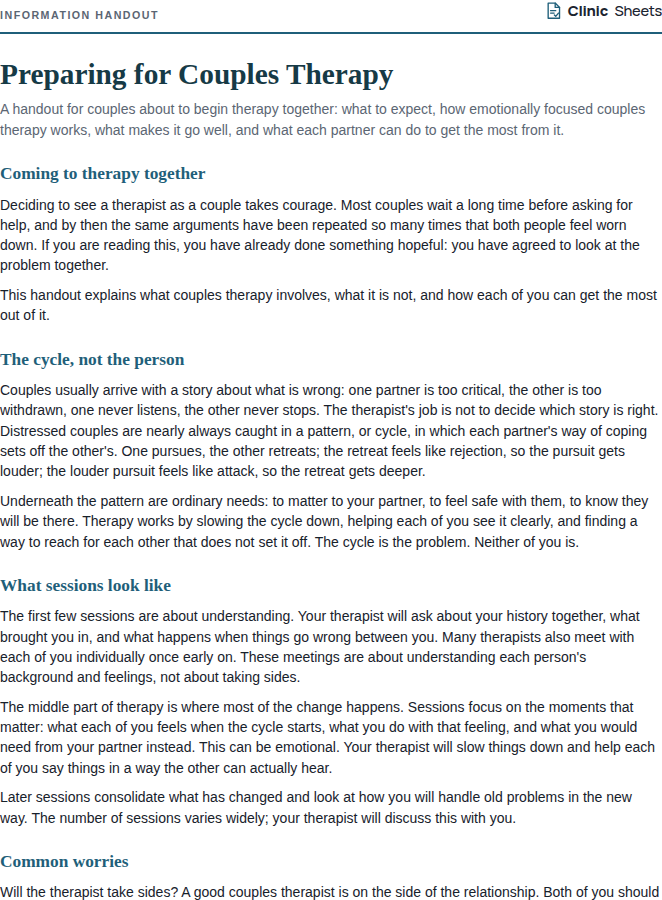
This handout is written to both partners. It explains the injury and the typical reactions of each side so that the couple can recognise their cycle rather than be swept along by it, sets out realistic expectations of the recovery process, and gives concrete guidance for the early weeks: ending the affair fully, agreeing on what information the injured partner needs and how it will be shared, responding to triggers, and pausing the question of the relationship's future until the ground is steadier.
The professional version notes that this work requires the affair to have ended and full disclosure to be underway; that the injured partner's need for detail should be balanced against the traumatising effect of graphic information; that the clinician's stance must be neutral about the outcome of the relationship; and that intimate partner violence, ongoing deception or an active affair are contraindications for couple work until addressed.
How to use it
- Confirm that the affair has ended, that both partners are willing to attend, and that there is no ongoing violence or coercion. If any of these is unclear, address it in individual sessions first.
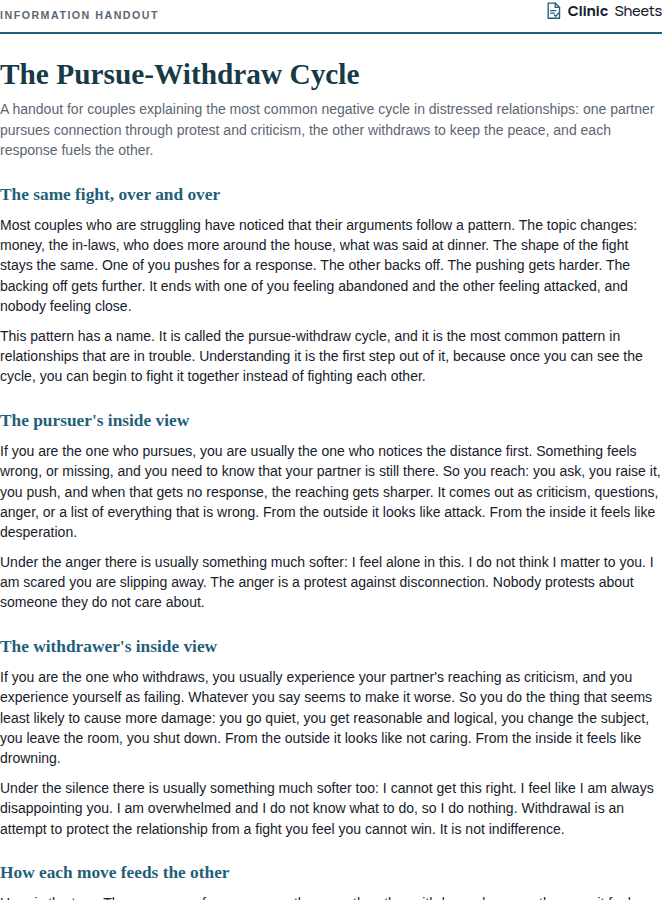
- Give the handout after the first joint session, once the couple's cycle (pursue with questions and anger, defend and withdraw) has been named.
- Use the 'What each of you may be feeling' section to help each partner hear the other's experience without needing to fix or dispute it.
- Set up a structured approach to disclosure: what the injured partner needs to know, when and how it will be shared, and what detail is likely to harm rather than help.
- Hold the outcome open. Help the couple defer the stay-or-go decision until the injury has been processed, and revisit the handout's stages as a map of where they are.
References
- Johnson, S. M., Makinen, J. A., & Millikin, J. W. (2001). Attachment injuries in couple relationships: A new perspective on impasses in couples therapy. Journal of Marital and Family Therapy, 27(2), 145-155.
- Johnson, S. M. (2020). The Practice of Emotionally Focused Couple Therapy: Creating Connection (3rd ed.). Routledge.
- Baucom, D. H., Snyder, D. K., & Gordon, K. C. (2009). Helping Couples Get Past the Affair: A Clinician's Guide. Guilford Press.
- Gordon, K. C., Baucom, D. H., & Snyder, D. K. (2004). An integrative intervention for promoting recovery from extramarital affairs. Journal of Marital and Family Therapy, 30(2), 213-231.