Scrupulosity: Religious and Moral OCD
A handout on scrupulosity, the form of OCD focused on religious and moral doubt: intrusive fears of having sinned, offended God or acted immorally, the confessing, praying and reviewing that follow, and how treatment respects faith while targeting the OCD. For adults.
About this resource
Scrupulosity is a presentation of obsessive-compulsive disorder in which obsessions centre on religious or moral themes: fear of having committed a sin, blasphemous intrusive thoughts, doubt about whether a prayer or ritual was performed correctly, or fear of being a secretly bad person. Compulsions include repeated prayer, confession, seeking reassurance from clergy or family, mental reviewing of past actions, and avoidance of religious settings that trigger the thoughts. Moral scrupulosity, with no religious content, follows the same pattern around honesty, fairness and harm.
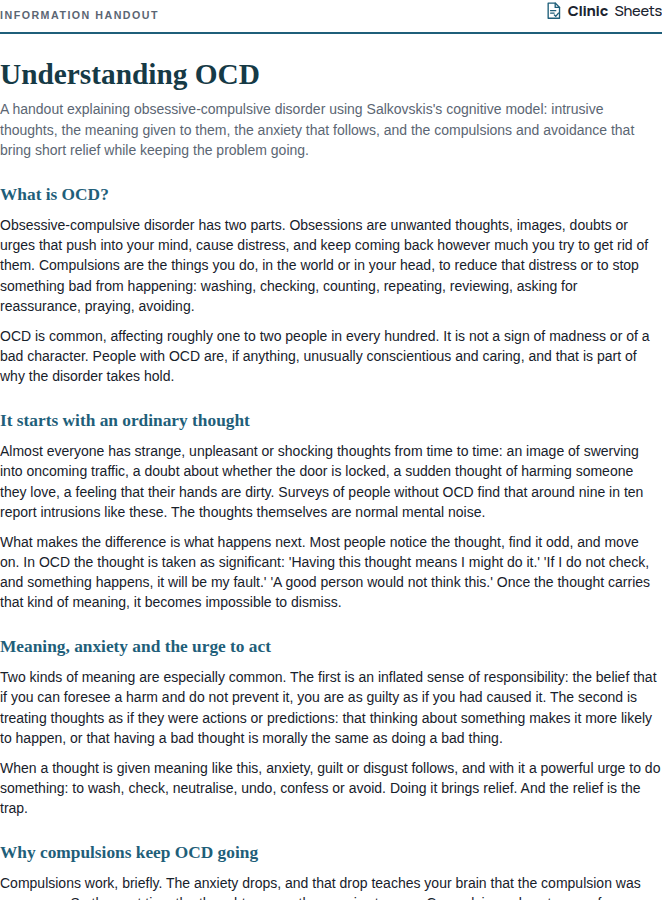
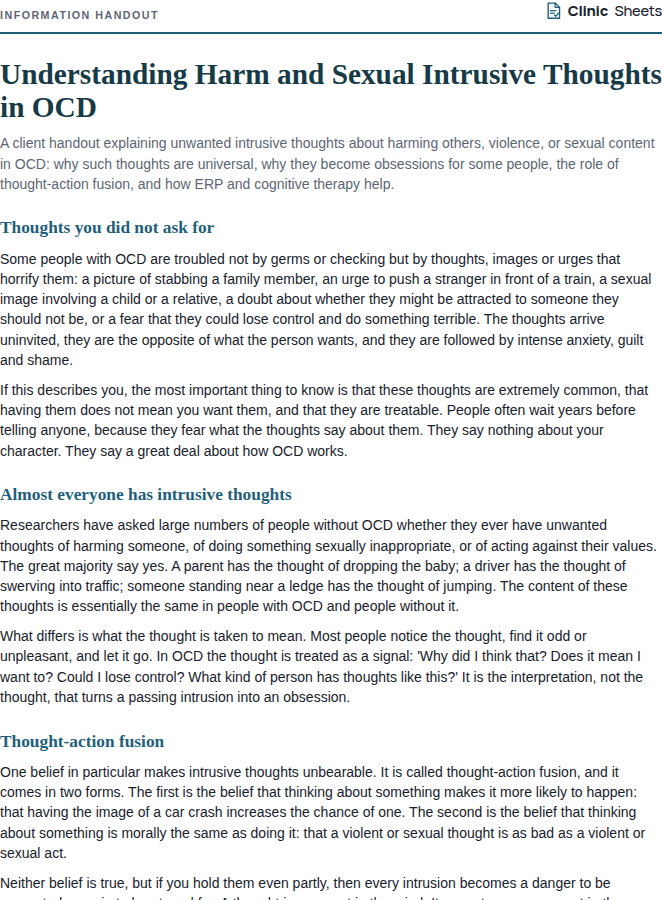
This handout explains the OCD processes involved, especially thought-action fusion (the belief that having a thought is morally equivalent to acting on it, or makes the event more likely) and inflated responsibility, both of which are central in the cognitive model of OCD. It is careful to distinguish OCD from faith: the aim of treatment is to remove the disorder's distortion of religious or moral life, not to change the person's beliefs or values.
The professional version adds guidance on collaborating with the client's own religious framework, when and how to involve a clergy member, and how to design exposures that target uncertainty without asking the client to act against their conscience.
How to use it
- Assess carefully. Scrupulosity is distinguished from devout practice by the distress, the doubt that never settles, the repetition beyond what the tradition requires, and the person's own sense that something is wrong. Ask what the client's faith community would regard as reasonable practice.
- Read the section on thought-action fusion together. Many clients have never had the difference between a thought and an act named, and this alone reduces distress.
- Be explicit that treatment will not ask the client to violate their values. Exposures are to uncertainty (not re-praying, not confessing a doubtful sin again) rather than to genuine wrongdoing.
- With the client's consent, consider a conversation with a trusted clergy member who understands OCD. Many traditions have long recognised scrupulosity and have guidance that supports response prevention, such as trusting one confession or one prayer.
- Use the reflection fields to identify compulsions and one reassurance behaviour to reduce first. Build an ERP hierarchy from there.
References
- Abramowitz, J. S., & Jacoby, R. J. (2014). Scrupulosity: A cognitive-behavioral analysis and implications for treatment. Journal of Obsessive-Compulsive and Related Disorders, 3(2), 140-149.
- Salkovskis, P. M. (1985). Obsessional-compulsive problems: A cognitive-behavioural analysis. Behaviour Research and Therapy, 23(5), 571-583.
- Shafran, R., Thordarson, D. S., & Rachman, S. (1996). Thought-action fusion in obsessive compulsive disorder. Journal of Anxiety Disorders, 10(5), 379-391.
- Rachman, S. (1997). A cognitive theory of obsessions. Behaviour Research and Therapy, 35(9), 793-802.