Relationship OCD
A handout explaining relationship OCD (ROCD): intrusive doubts about whether one loves one's partner or whether the partner is right, the checking and reassurance seeking that maintain them, and how ERP and CBT help. For adults in a relationship or dating.
About this resource
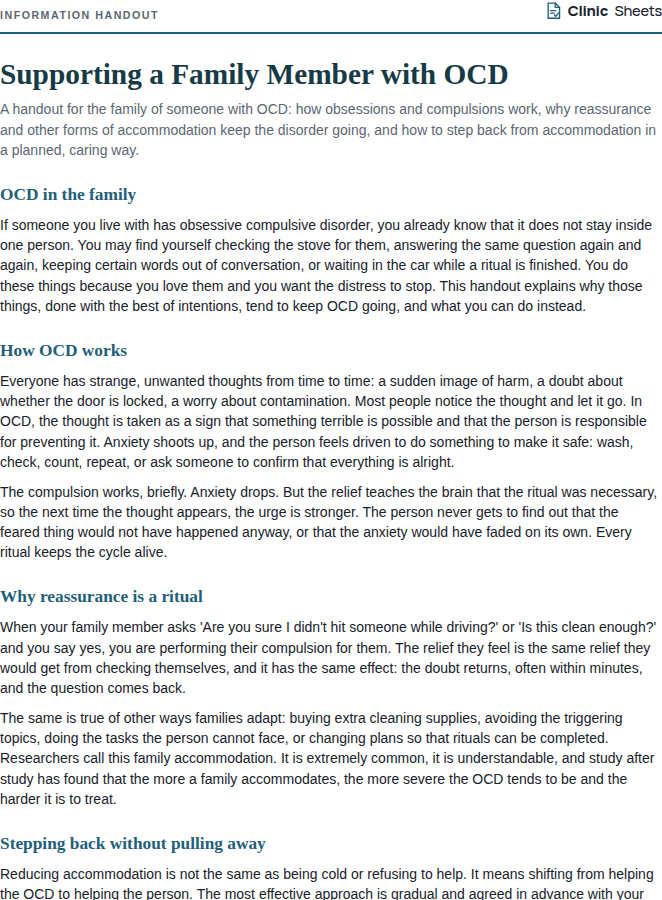
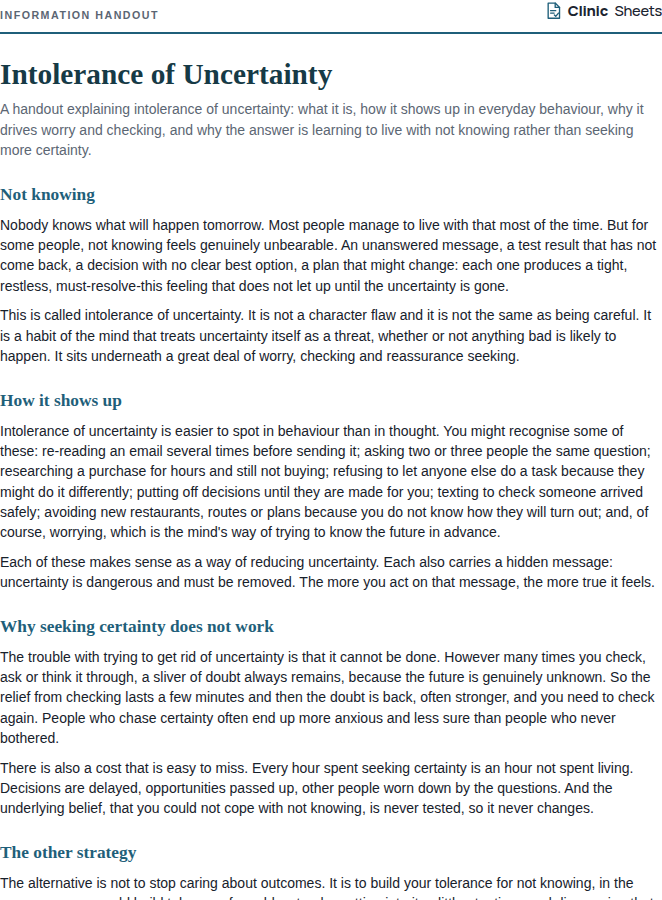
Relationship OCD describes a presentation of obsessive-compulsive disorder in which the obsessional doubt is focused on an intimate relationship. Two themes are commonly described: relationship-centred doubts (do I really love my partner, is this the right relationship, am I attracted enough) and partner-focused doubts (preoccupation with a partner's perceived flaws in appearance, intelligence, morality or social skills). The compulsions include monitoring one's own feelings, comparing the relationship with others, mentally reviewing past interactions, and repeatedly seeking reassurance from the partner, friends or the internet.
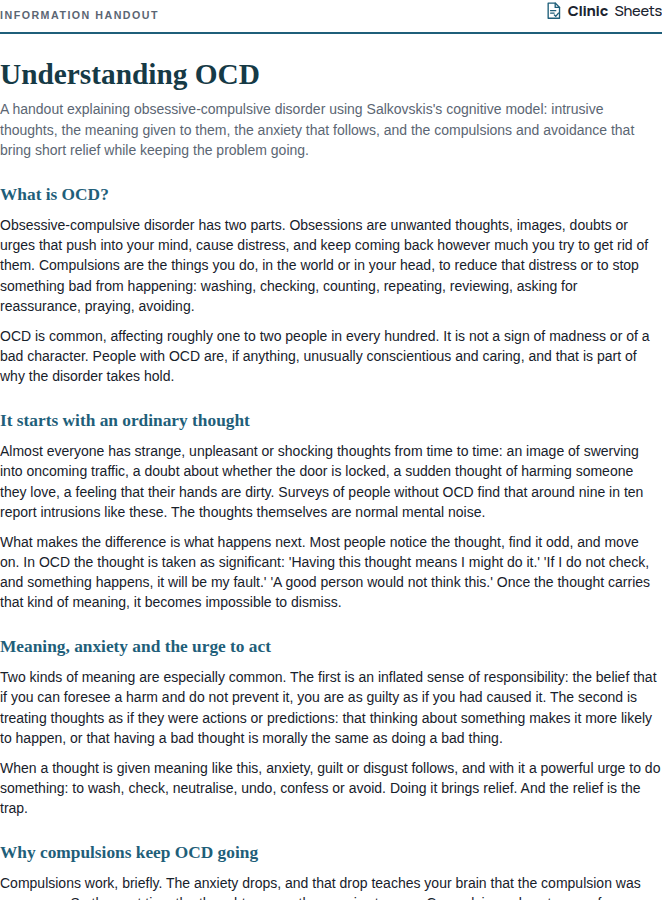
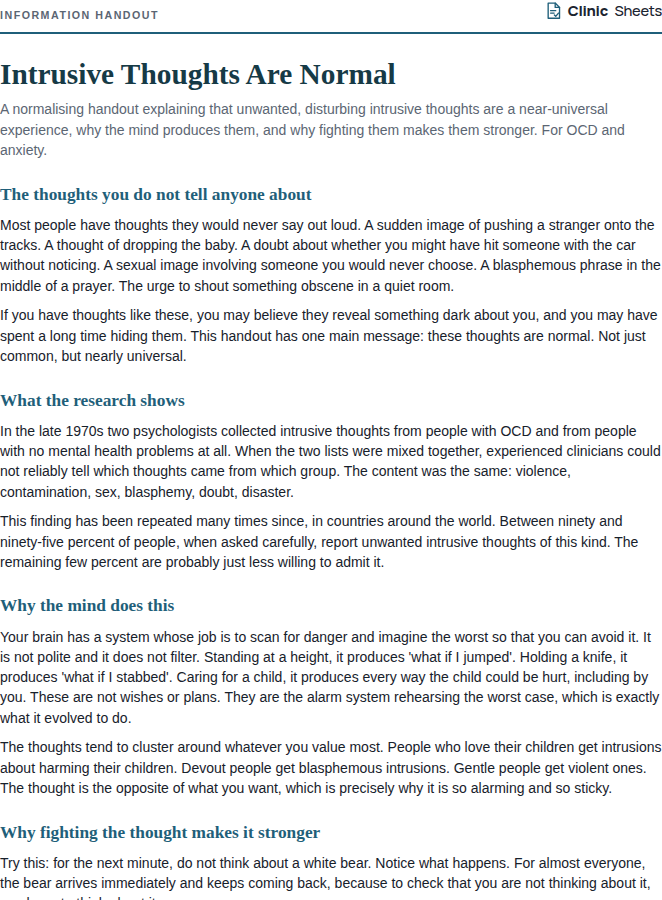
This handout normalises relationship doubt, explains why feelings are a poor test of a relationship when checked compulsively, and outlines how exposure and response prevention and cognitive work target the maintaining processes: thought monitoring, reassurance seeking and the belief that certainty about love is possible and necessary. It draws on Doron and colleagues' descriptive work on ROCD and on the wider cognitive model of OCD.
The professional version adds notes on differentiating ROCD from genuine relationship dissatisfaction, on involving the partner without turning them into a reassurance provider, and on common exposure targets.
How to use it
- Confirm that the presentation fits OCD: the doubts are experienced as intrusive and distressing, they are followed by compulsive checking or reassurance seeking, and the relationship is otherwise valued. Genuine ambivalence about a relationship is not a target for ERP.
- Read the handout together and ask the client to identify their own checking and reassurance behaviours, including subtle ones such as testing how they feel when the partner walks in.
- Frame the goal as tolerating uncertainty about the relationship, not achieving certainty about it. Clients often hope treatment will tell them the answer; be clear that it will not.
- Where the partner is involved, agree with both of them that the partner will lovingly decline to answer repeated reassurance questions, and give the partner a script for doing so.
- Build an exposure hierarchy of triggers (romantic films, couples who seem happier, noticing a partner's flaw) paired with response prevention (no feeling checks, no comparisons, no reassurance). Use the reflection fields as the starting point.
References
- Doron, G., Derby, D. S., & Szepsenwol, O. (2014). Relationship obsessive compulsive disorder (ROCD): A conceptual framework. Frontiers in Psychiatry, 5, 127.
- Salkovskis, P. M. (1985). Obsessional-compulsive problems: A cognitive-behavioural analysis. Behaviour Research and Therapy, 23(5), 571-583.
- Abramowitz, J. S., Deacon, B. J., & Whiteside, S. P. H. (2019). Exposure Therapy for Anxiety: Principles and Practice (2nd ed.). Guilford Press.