Seemingly Irrelevant Decisions (Relapse Prevention)
A worksheet for identifying the small, apparently innocent choices that lead step by step toward a high-risk situation and a lapse. Based on Marlatt's relapse prevention model. Clients trace a recent chain of decisions and plan the early exits.
About this resource
In Marlatt and Gordon's relapse prevention model, lapses rarely arrive from nowhere. They are usually preceded by a chain of minor decisions, each of which seems reasonable on its own and none of which is framed by the person as a decision about using: driving home by the old route, keeping a bottle for guests, agreeing to meet a friend at a bar 'just for the food', deciding not to go to the meeting because of tiredness. Marlatt called these seemingly irrelevant decisions, or 'set-ups', and observed that they allow the person to arrive in a high-risk situation while feeling that they had no part in getting there. Because each step is small, the chain is easy to overlook and easy to rationalise, and by the time the person is in the high-risk situation the pull is at full strength.
This worksheet teaches clients to recognise their own chains. It asks them to reconstruct a recent lapse or near-lapse backwards, decision by decision, to notice the justification attached to each step, and to identify the earliest point at which a different choice was available. It then asks them to list the seemingly irrelevant decisions that recur in their life and to plan a specific alternative for each. The underlying skill is the habit of asking, at small forks in the day, 'where does this road usually lead'. Avoidance is the mechanism in play: the chain is often a way of drifting toward use without having to confront the decision directly.
The professional version adds guidance on doing the backward chain in session without shaming, on distinguishing SIDs from legitimate exposure to previously avoided situations later in recovery, and on linking the worksheet to a broader high-risk situation plan.
How to use it
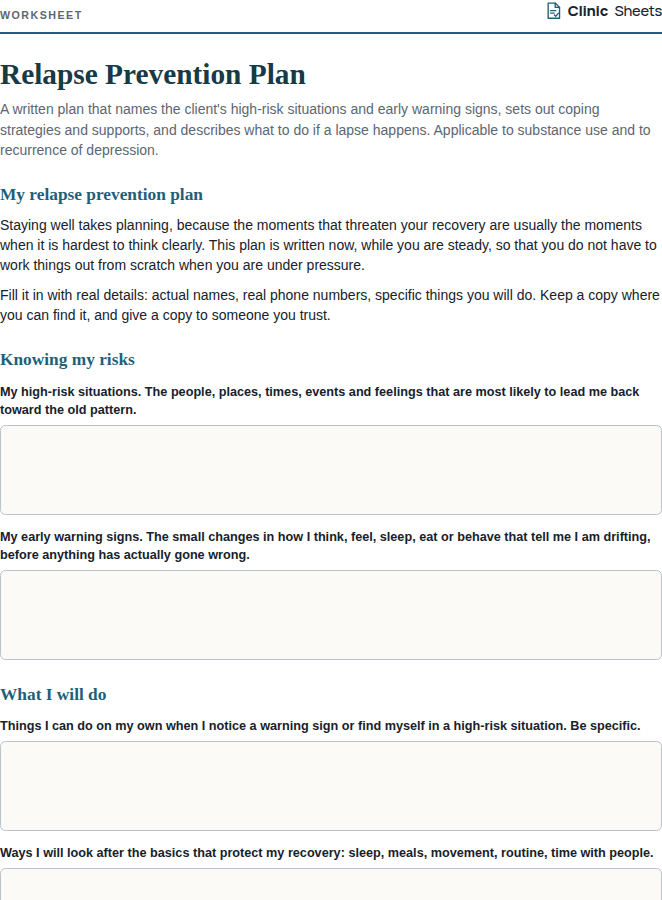
- Introduce the concept with the client's own most recent lapse or close call, once the immediate crisis has passed and the client is ready to look at it.
- Work backwards from the lapse, asking at each step 'and what happened just before that' and 'what did you tell yourself about that choice at the time'. Keep the tone curious rather than accusatory.
- Identify together the earliest fork in the chain where the road could have gone elsewhere. That is usually much earlier than the client expects.
- Help the client name the recurring seemingly irrelevant decisions in their week and attach a concrete alternative to each.
- Revisit the worksheet after future lapses or near misses. Over time, clients start noticing the chain in real time, which is the goal.
References
- Marlatt, G. A., & Gordon, J. R. (Eds.). (1985). Relapse prevention: Maintenance strategies in the treatment of addictive behaviors. Guilford Press.
- Marlatt, G. A., & Donovan, D. M. (Eds.). (2005). Relapse prevention: Maintenance strategies in the treatment of addictive behaviors (2nd ed.). Guilford Press.
- Witkiewitz, K., & Marlatt, G. A. (2004). Relapse prevention for alcohol and drug problems: That was Zen, this is Tao. American Psychologist, 59(4), 224-235.
- Carroll, K. M. (1998). A cognitive-behavioral approach: Treating cocaine addiction (Therapy Manuals for Drug Addiction, Manual 1). National Institute on Drug Abuse.