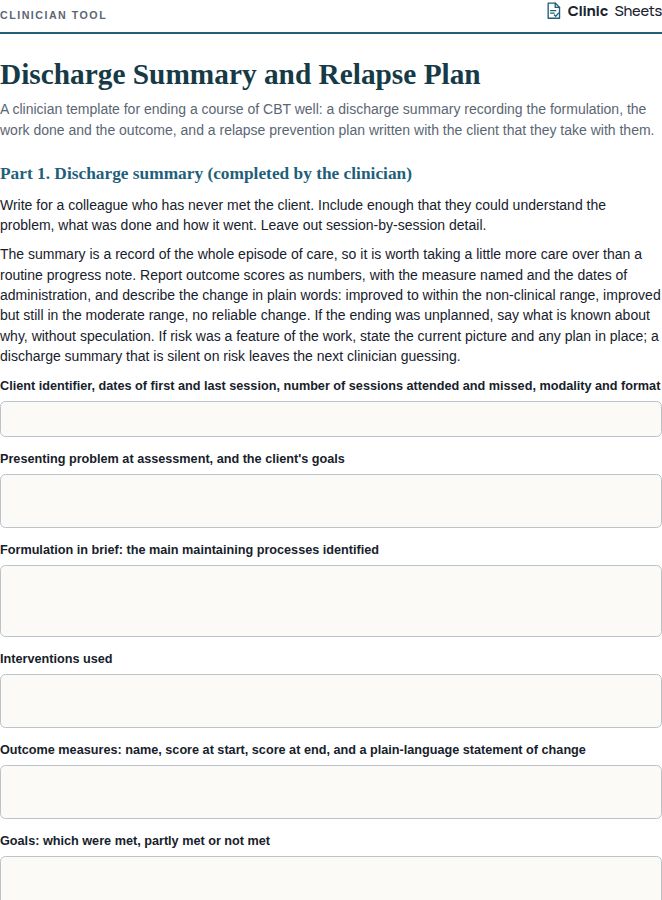
Relapse Prevention Plan
A written plan that names the client's high-risk situations and early warning signs, sets out coping strategies and supports, and describes what to do if a lapse happens. Applicable to substance use and to recurrence of depression.
About this resource
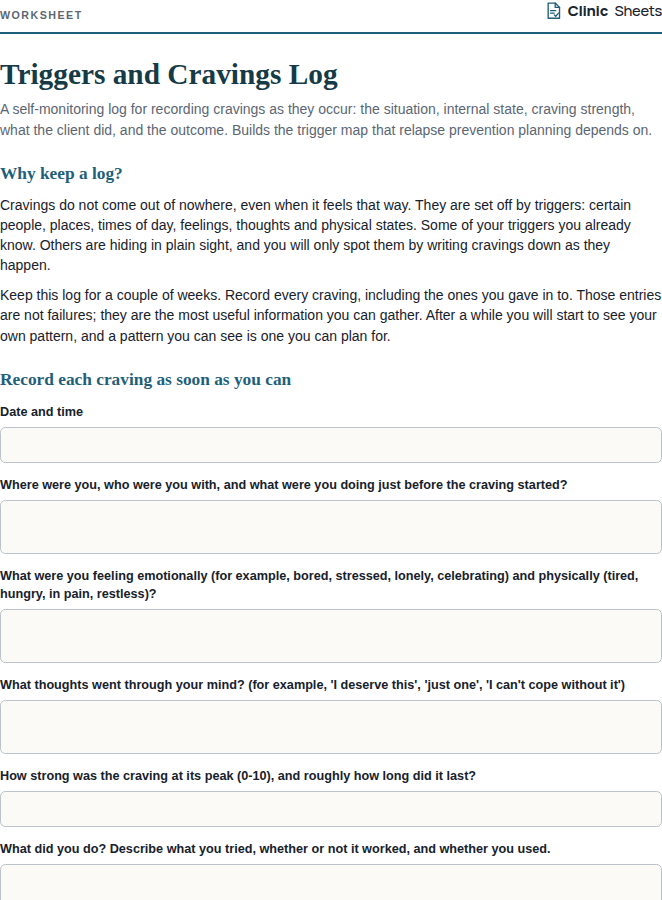
Relapse prevention is a cognitive behavioural approach to maintaining change, developed by Marlatt and Gordon for addictive behaviours and since extended to depression, where the same logic applies: recovery is maintained by recognising early signs of return and responding before the pattern re-establishes itself. The plan is built from the client's own data, ideally from a triggers and cravings log or a record of prior episodes, and it is written down because in a high-risk moment recall is unreliable.
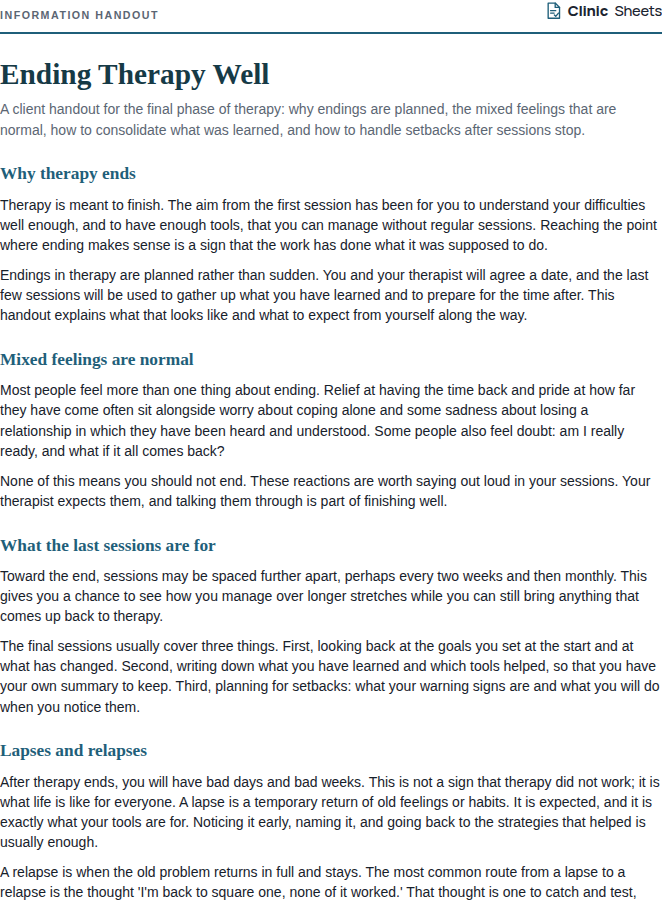
The plan has four parts. First, the high-risk situations and early warning signs specific to this client. Second, the coping strategies they will use, ordered from those they can do alone to those that involve other people. Third, the people and services they can contact. Fourth, a lapse plan: what they will do in the hours after a slip to prevent it becoming a full relapse. This last part addresses what Marlatt called the abstinence violation effect, the guilt and all-or-nothing thinking ('I've blown it now') that turns one drink into a binge or one bad day into a depressive spiral.
The professional version includes prompts for each section, guidance on rehearsing the plan through imagery or role play, and notes on adapting it for depression, where warning signs are typically changes in sleep, withdrawal, reduced activity and self-critical thinking rather than cravings.
How to use it
- Build the plan collaboratively once the client has some period of stability and a clear picture of their triggers or warning signs. Draw on their own log data and past episodes.
- Work through each section with the client writing in their own words. Keep the plan concrete: named people, actual phone numbers, specific actions.
- Give particular attention to the lapse section. Discuss all-or-nothing thinking openly and agree in advance what a slip means and does not mean.
- Rehearse the plan. Ask the client to imagine a high-risk situation in detail and walk through what they would do.
- Ask the client to keep copies in more than one place and to share the plan with at least one supportive person.
- Review and update the plan at intervals, after any lapse, and before known high-risk periods such as holidays or anniversaries.
References
- Marlatt, G. A., & Donovan, D. M. (Eds.). (2005). Relapse Prevention: Maintenance Strategies in the Treatment of Addictive Behaviors (2nd ed.). Guilford Press.
- Marlatt, G. A., & Gordon, J. R. (Eds.). (1985). Relapse Prevention: Maintenance Strategies in the Treatment of Addictive Behaviors. Guilford Press.
- Segal, Z. V., Williams, J. M. G., & Teasdale, J. D. (2013). Mindfulness-Based Cognitive Therapy for Depression (2nd ed.). Guilford Press.