Triggers and Cravings Log
A self-monitoring log for recording cravings as they occur: the situation, internal state, craving strength, what the client did, and the outcome. Builds the trigger map that relapse prevention planning depends on.
About this resource
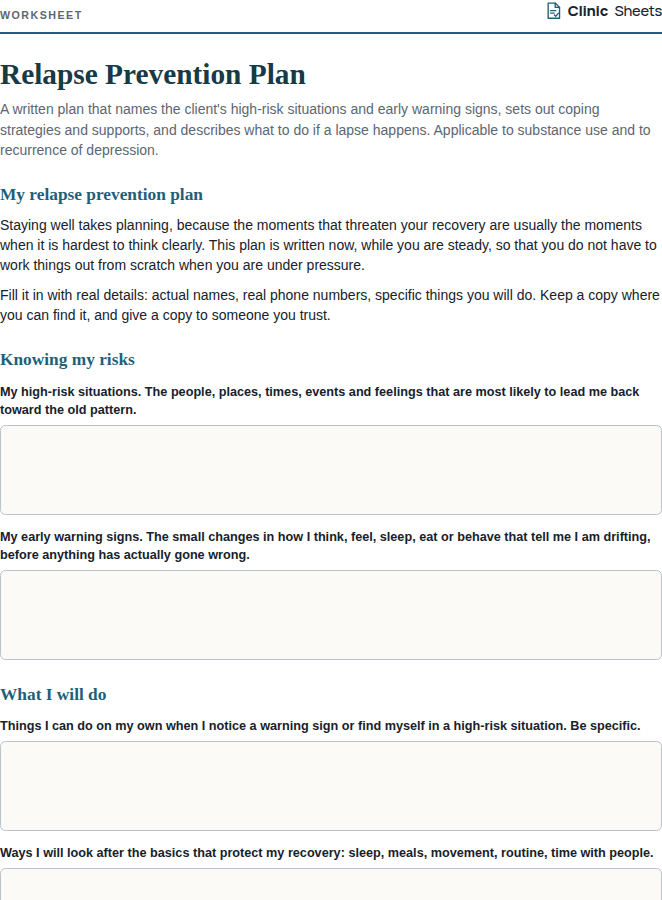
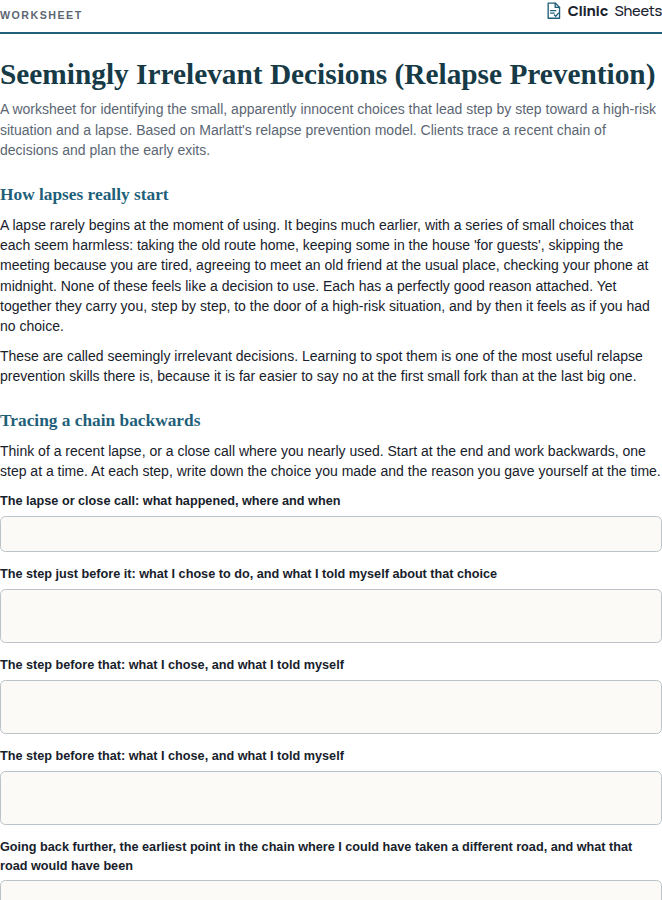
Relapse prevention, as described by Marlatt and Gordon, rests on the idea that lapses are not random. They follow from identifiable high-risk situations, which include external triggers (people, places, times, objects) and internal ones (emotions, physical states, thoughts). Most clients have a rough sense of their triggers but underestimate some and overlook others, particularly the internal ones. Prospective monitoring is far more accurate than recollection.
This log asks the client to record each craving close to the time it happens: what was going on, what they were feeling and thinking, how strong the craving was and how long it lasted, what they did, and what happened next. Over two or three weeks the entries reveal patterns: which triggers recur, which coping responses work, and how craving intensity relates to particular emotional states. The exercise also has a therapeutic effect in itself, since noticing and naming a craving creates a pause between urge and action.
The professional version includes guidance on reviewing the log to build a functional analysis, on handling entries where the client used, and on using the data to select targets for coping skills training. It also covers common problems: clients who only record cravings they resisted, and clients who record so little detail that patterns cannot be seen.
How to use it
- Introduce the log once the client has some commitment to change, and frame it as information gathering rather than a test.
- Complete one example together in session using a recent craving, so the client sees the level of detail that is useful.
- Ask the client to record every craving for at least two weeks, including ones they acted on. Emphasise that entries where they used are the most informative.
- Review the log at the start of each session. Sort triggers into external and internal, and look for the emotional states that most often precede strong cravings.
- Use the coping column to identify what already works and what needs to be added. Carry the findings into the relapse prevention plan.
- Repeat the log for a week at intervals during maintenance to check whether triggers have shifted.
References
- Marlatt, G. A., & Gordon, J. R. (Eds.). (1985). Relapse Prevention: Maintenance Strategies in the Treatment of Addictive Behaviors. Guilford Press.
- Marlatt, G. A., & Donovan, D. M. (Eds.). (2005). Relapse Prevention: Maintenance Strategies in the Treatment of Addictive Behaviors (2nd ed.). Guilford Press.
- Carroll, K. M. (1998). A Cognitive-Behavioral Approach: Treating Cocaine Addiction (Therapy Manuals for Drug Addiction, Manual 1). National Institute on Drug Abuse.