Therapy Goals and Progress Review
A clinician template for setting therapy goals in measurable terms and reviewing progress against them at fixed points, combining goal ratings with standardised outcome measures and the client's own view.
About this resource
Goals give therapy a direction, and regular review keeps it honest. Without a scheduled review, courses of therapy tend to drift: the original goals fade, sessions become weekly check-ins, and neither clinician nor client can say clearly whether things are improving. Research on routine outcome monitoring has shown that clinicians are poor at detecting clients who are not improving unless they measure, and that feeding measurement back into the work reduces the rate of treatment failure.
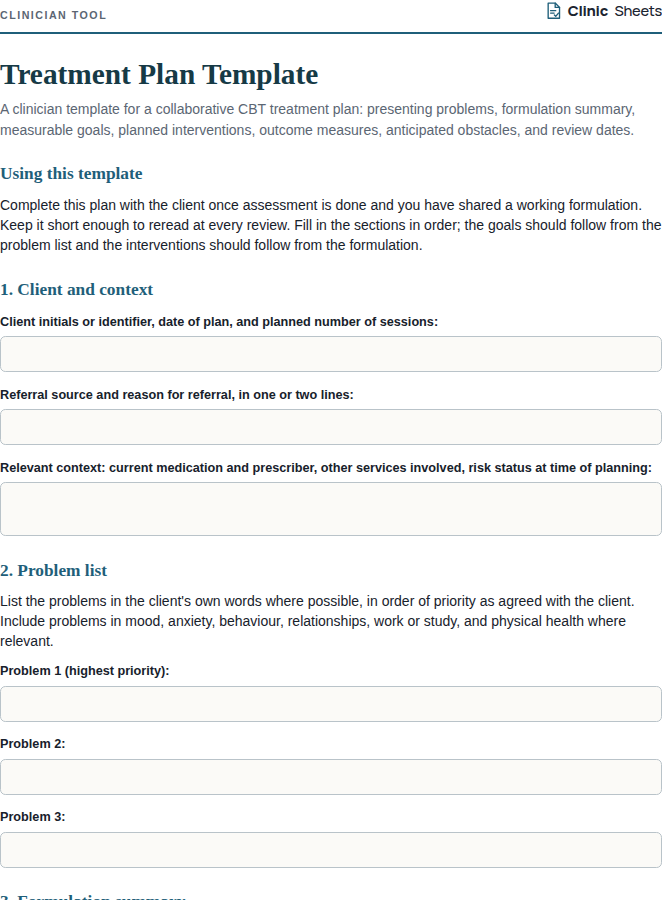
This template supports both halves of the task. The first part sets goals in observable terms with a rating scale, so that each goal has a baseline and can be re-rated. The approach draws on goal attainment scaling and on the goal-setting guidance in the standard CBT texts. The second part is a review sheet to be completed at agreed intervals, typically every four to six sessions: goal re-ratings, current scores on the outcome measures in use, the client's own account of what has changed, what has helped, what has not, and decisions about the direction of the work.
The professional version includes guidance on writing goals with clients who find it hard to imagine change, on distinguishing outcome goals from process goals, on what to do when measures and the client's report disagree, and on using a poor review as a prompt to revisit the formulation rather than simply continuing.
How to use it
- Set goals in the first two or three sessions, once the problem list is clear. Ask the client what they would be doing differently if therapy worked, and keep asking for detail until each goal describes something observable.
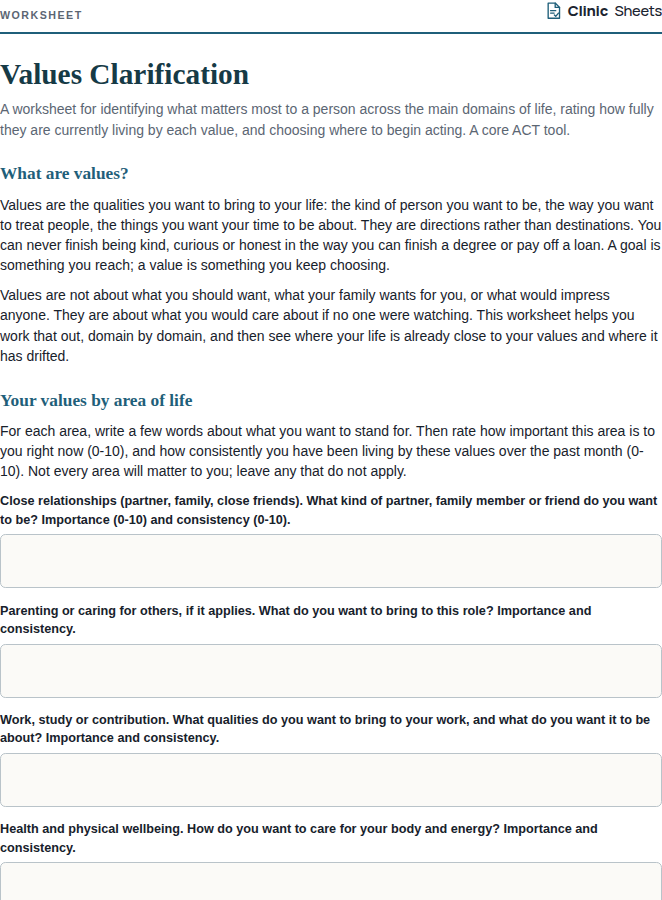
- Rate each goal at baseline on a 0 to 10 scale, where 0 is no progress and 10 is the goal fully achieved. Record the date. Three goals is usually enough; more than five dilutes attention.
- Choose the outcome measures you will track alongside the goals and record baseline scores on the same sheet, so that goal ratings and measures can be read together.
- Book the review in advance and tell the client when it will happen. At review, re-rate the goals before looking at the measures, then compare. Ask the client for their own account of change before offering yours.
- If progress is poor, do not simply continue. Return to the formulation, check whether the interventions are targeting the maintaining processes, consider obstacles, and revise the plan. Record the decision and the reasons.
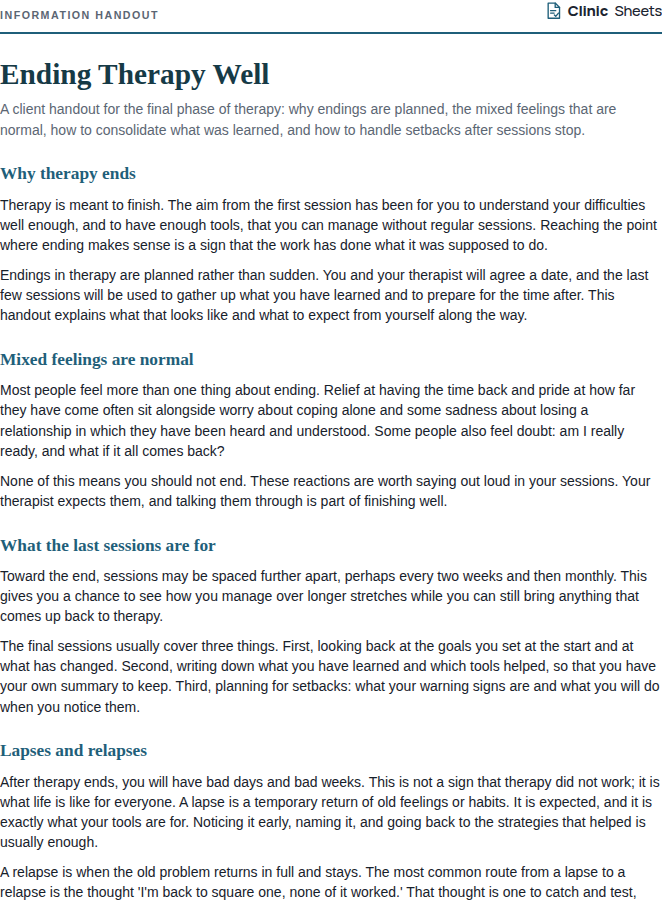
- Use the final review to plan the ending: which goals are met, which are close enough to continue independently, and which need a different approach or a referral elsewhere.
References
- Lambert, M. J. (2010). Prevention of Treatment Failure: The Use of Measuring, Monitoring, and Feedback in Clinical Practice. American Psychological Association.
- Kiresuk, T. J., & Sherman, R. E. (1968). Goal attainment scaling: A general method for evaluating comprehensive community mental health programs. Community Mental Health Journal, 4(6), 443-453.
- Beck, J. S. (2020). Cognitive Behavior Therapy: Basics and Beyond (3rd ed.). Guilford Press.