Outcome Monitoring Tracker
A clinician template for tracking a client's session-by-session outcome scores, goals and homework across a course of therapy, so that progress, plateaus and deterioration are visible early enough to act on.
About this resource
Routine outcome monitoring means administering a brief measure at regular intervals, usually every session, and using the scores to guide treatment decisions. Reviews of feedback-informed practice consistently find that clinicians are poor at predicting which clients will deteriorate, and that giving clinicians regular score feedback improves outcomes, particularly for clients who are not on track. The gain comes not from the measurement itself but from what the clinician does with it: noticing early that a plan is not working and changing course.
This tracker keeps the scores, the goals and the between-session tasks on a single page for one client. It is deliberately measure-agnostic: it works with the PHQ-9, GAD-7, PCL-5, DASS-21, a session rating scale, or an idiographic 0-10 rating of the client's own target problem. The columns for goal progress sit beside the symptom scores because symptom change and goal change do not always move together, and both matter.
The professional version adds decision rules for what counts as a meaningful change and what to do when scores are flat or rising, and a short protocol for sharing scores with the client without turning the session into a data review.
How to use it
- Choose one primary measure at assessment and administer it at the same point in each session, ideally before the session begins. Record the baseline on the first line of the tracker.
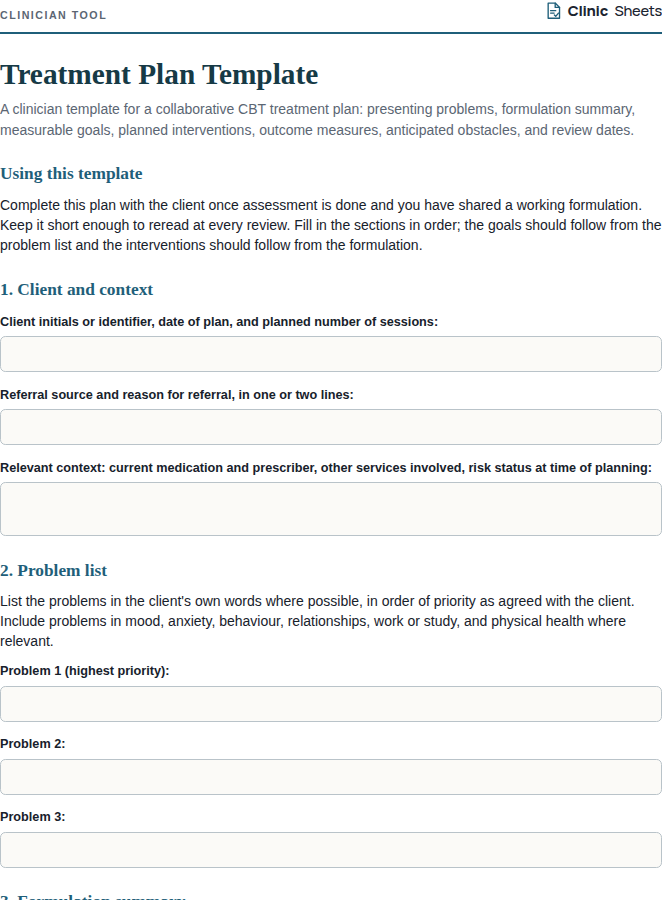
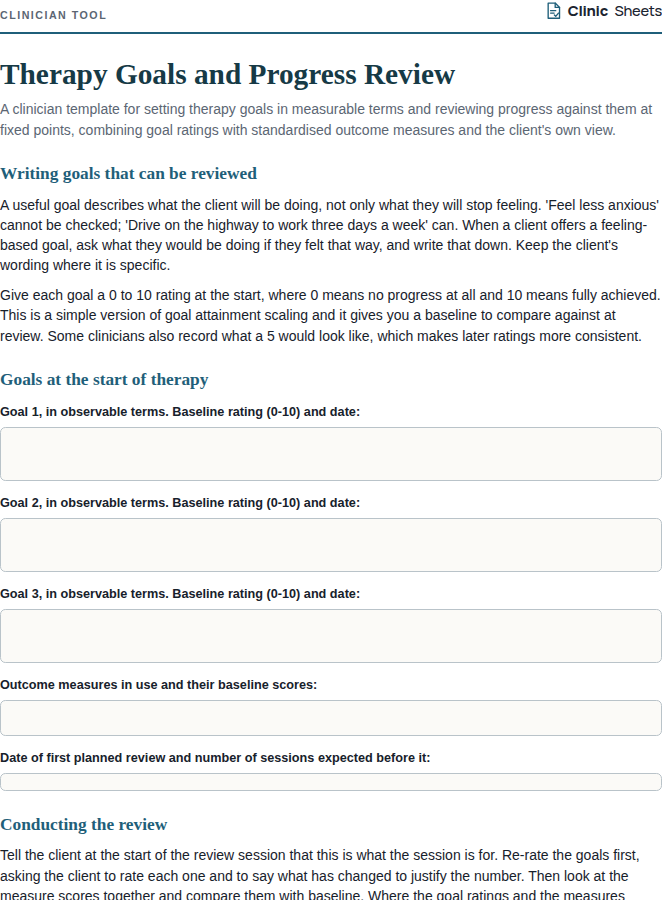
- Agree two or three specific, observable goals with the client and write them at the top. Rate each goal 0-10 at baseline and at review points (every fourth session is a reasonable default).
- After each session, record the score, the main focus of the session and the agreed between-session task. Note anything that could explain a sudden change, such as a life event or a medication change.
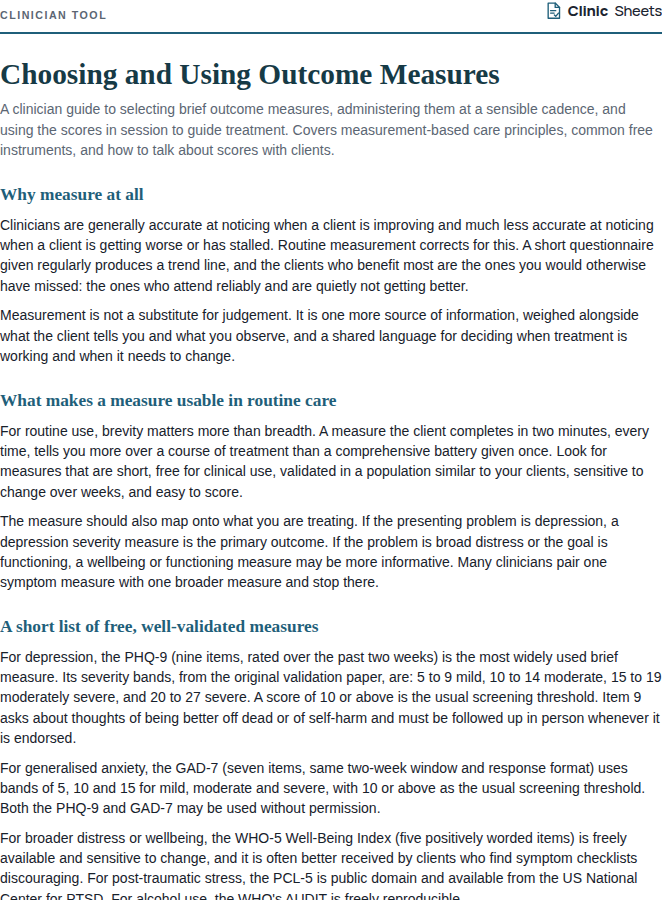
- At each review point, compare the current score with baseline. For the PHQ-9 and GAD-7, a change of about five points is commonly treated as clinically meaningful; for other measures use the reliable change figures in the measure's manual or published guide.
- If scores have not improved by session four to six, or have worsened over two consecutive sessions, review the formulation with the client and, where appropriate, in supervision. Adjust the plan rather than continuing unchanged.
- Share the trajectory with the client in plain language at review points. A simple line drawn through the scores is often more useful to the client than the numbers themselves.
References
- Lambert, M. J., Whipple, J. L., & Kleinstäuber, M. (2018). Collecting and delivering progress feedback: A meta-analysis of routine outcome monitoring. Psychotherapy, 55(4), 520-537.
- Miller, S. D., Duncan, B. L., Sorrell, R., & Brown, G. S. (2005). The Partners for Change Outcome Management System. Journal of Clinical Psychology, 61(2), 199-208.
- Kroenke, K., Spitzer, R. L., & Williams, J. B. W. (2001). The PHQ-9: Validity of a brief depression severity measure. Journal of General Internal Medicine, 16(9), 606-613.