Understanding Autism (for adults)
A respectful, neurodiversity-informed handout for adults who are autistic or exploring an autism identification: what autism is, common strengths and challenges, masking and burnout, and what support can look like.
About this resource
Increasing numbers of adults are identified as autistic in their twenties, thirties and beyond, often after years of difficulties attributed to anxiety, depression or personality. Many arrive at therapy with a history of feeling different without knowing why, of exhausting effort to appear typical, and of being misunderstood by services that expected autism to look like the childhood stereotype. Psychoeducation that is accurate, non-pathologising and written for adults is a first step in helping such clients make sense of their experience.
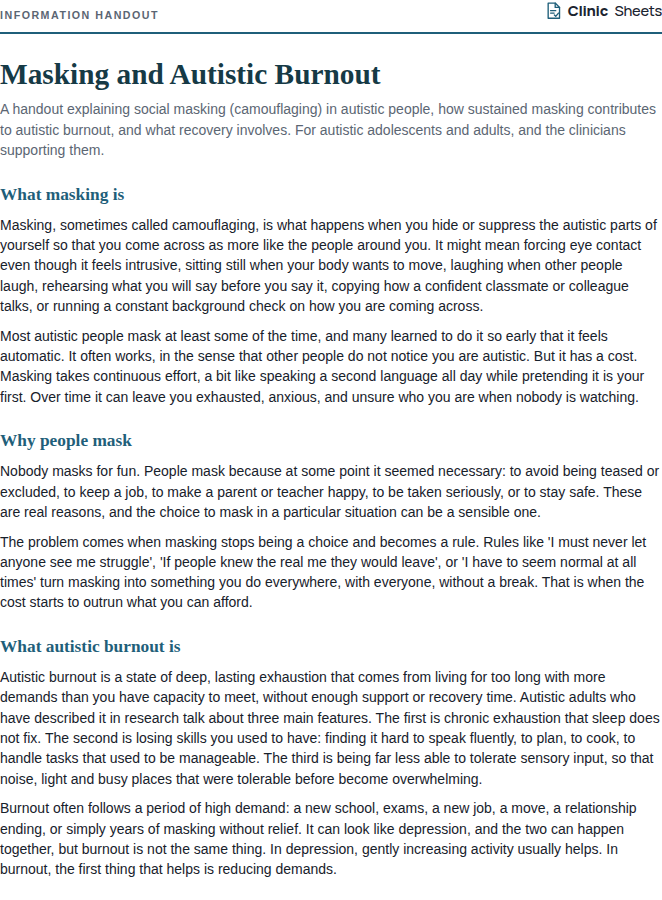
This handout takes a neurodiversity-informed stance: autism is a difference in how the nervous system processes sensory, social and cognitive information, with genuine strengths and genuine challenges, rather than a set of deficits to be corrected. It covers social communication differences (including the double empathy problem, in which misunderstanding runs in both directions), sensory processing, the need for predictability and depth of interest, masking and its cost, and autistic burnout. It closes with an outline of what helpful support looks like, emphasising accommodation and self-understanding over behavioural normalisation.
The professional version adds guidance on adapting therapy for autistic adults (explicit structure, concrete language, sensory considerations, longer processing time, written summaries), notes on common co-occurring conditions, and prompts for helping a client reframe past experiences in light of a new understanding without minimising the losses that late identification can bring to light.
How to use it
- Offer the handout to clients who have been identified as autistic, are awaiting assessment, or are exploring the possibility. Frame it as one description that may or may not fit.
- Invite the client to read it in their own time and mark what resonates, what does not, and what they have questions about. Many autistic adults prefer to process written material before discussing it.
- Discuss masking and burnout directly. Ask what the client does to appear typical and what it costs them.
- Explore the emotional impact of late identification, including relief, grief and anger, and validate each without hurrying toward acceptance.
- Use the final section to plan concrete accommodations in the client's life and in therapy itself.
References
- Milton, D. E. M. (2012). On the ontological status of autism: The 'double empathy problem'. Disability & Society, 27(6), 883-887.
- Raymaker, D. M., et al. (2020). 'Having all of your internal resources exhausted beyond measure and being left with no clean-up crew': Defining autistic burnout. Autism in Adulthood, 2(2), 132-143.
- Hull, L., Petrides, K. V., Allison, C., Smith, P., Baron-Cohen, S., Lai, M.-C., & Mandy, W. (2017). 'Putting on my best normal': Social camouflaging in adults with autism spectrum conditions. Journal of Autism and Developmental Disorders, 47(8), 2519-2534.
- Lai, M.-C., Lombardo, M. V., & Baron-Cohen, S. (2014). Autism. The Lancet, 383(9920), 896-910.