Masking and Autistic Burnout
A handout explaining social masking (camouflaging) in autistic people, how sustained masking contributes to autistic burnout, and what recovery involves. For autistic adolescents and adults, and the clinicians supporting them.
About this resource
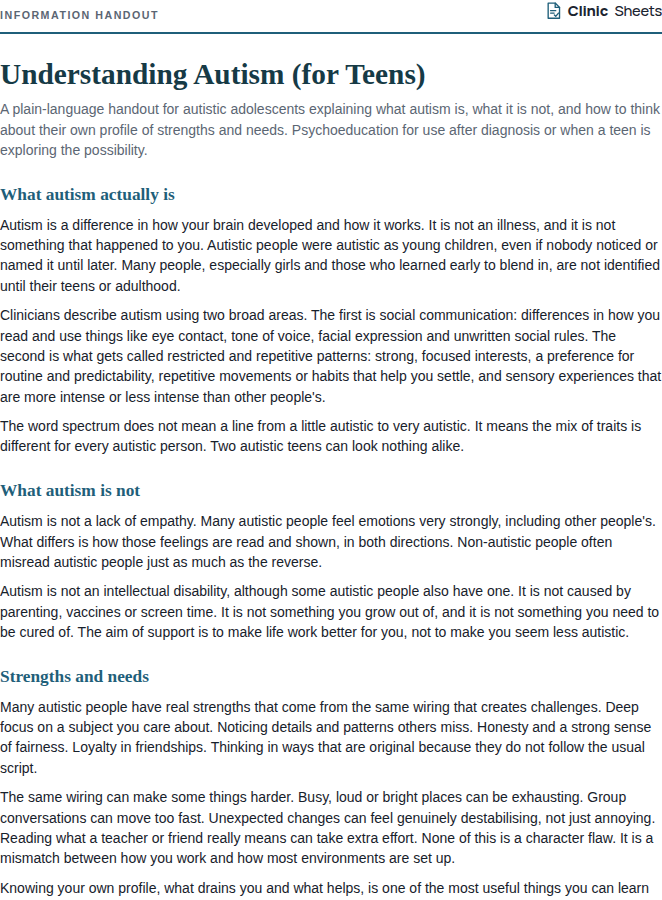
Masking, also called camouflaging, refers to the strategies autistic people use to hide autistic traits and appear non-autistic: suppressing stimming, forcing eye contact, rehearsing conversations, copying other people's mannerisms, and monitoring themselves constantly in social settings. Research by Hull and colleagues (2017) found that masking is common, effortful, and associated with exhaustion, anxiety and a sense of losing track of one's own identity.
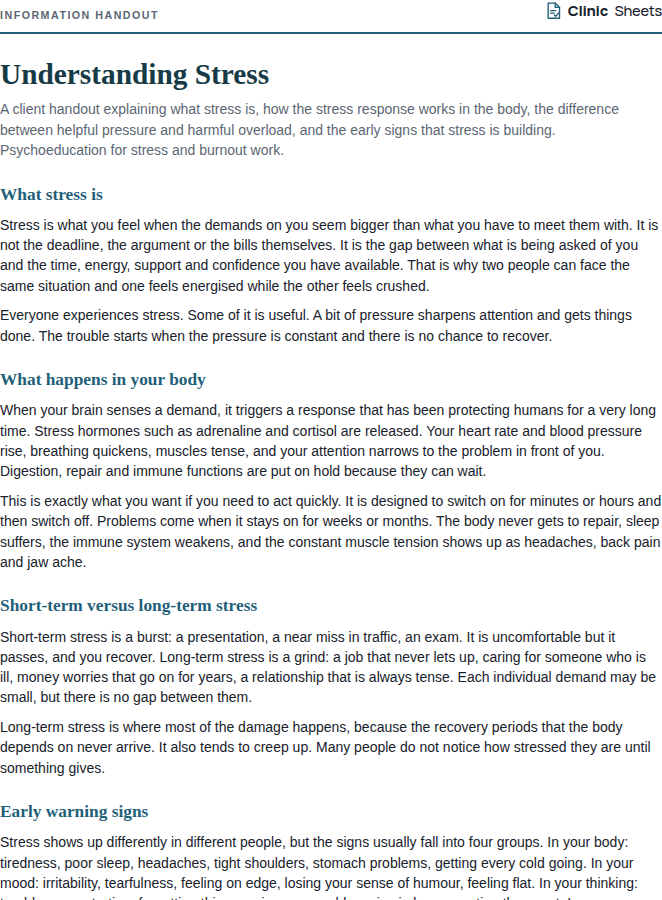
Autistic burnout is a state described by autistic adults and defined in qualitative research by Raymaker and colleagues (2020) as chronic exhaustion, loss of skills and reduced tolerance to stimulation, arising when the demands of life persistently exceed a person's capacity, often without adequate support. Prolonged masking is one of the most commonly identified contributors. Burnout is frequently mistaken for depression, and the two can co-occur, but the treatment logic differs: burnout calls for reducing demands and restoring energy rather than pushing activity.
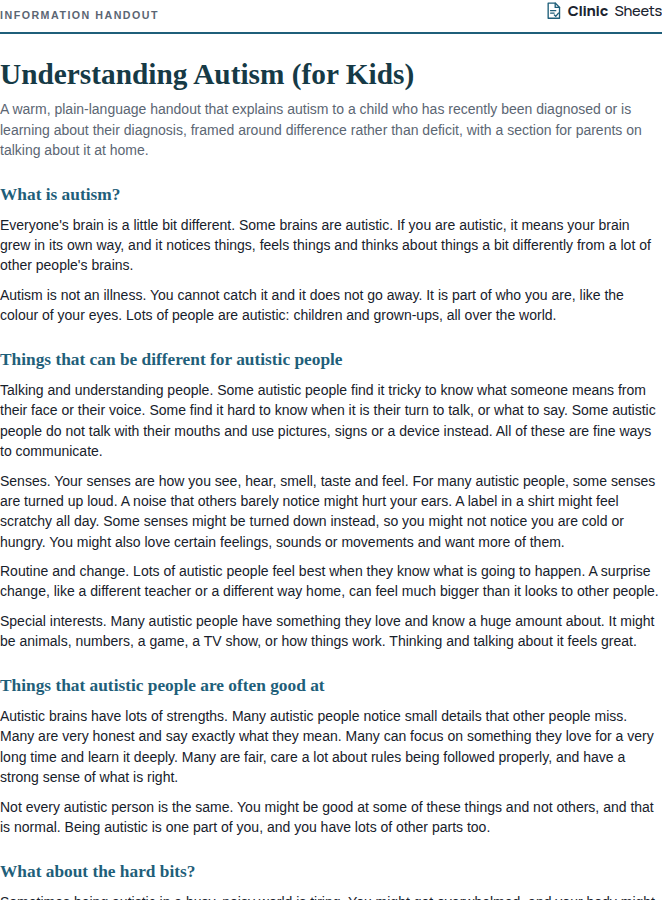
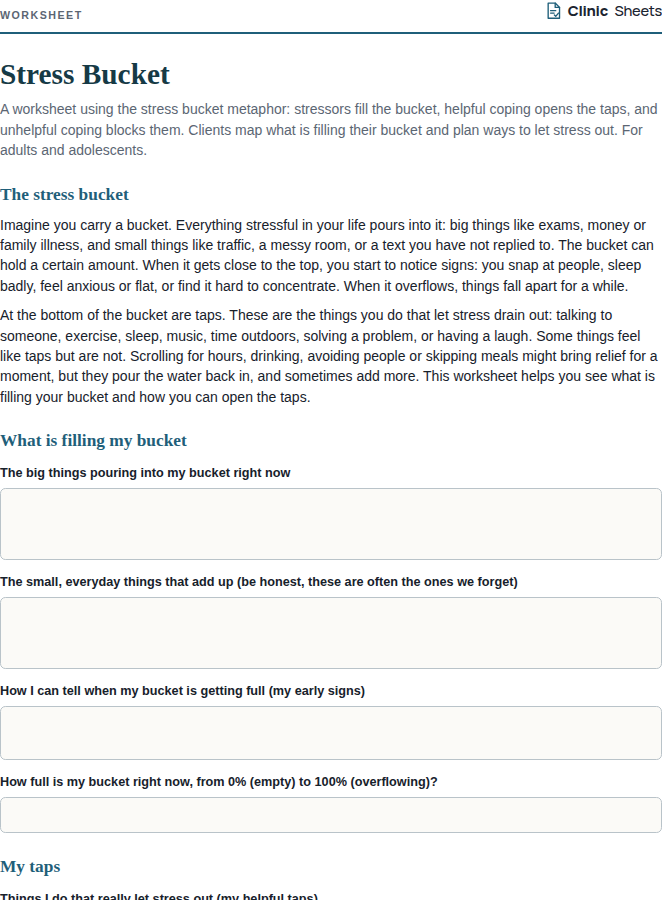
This handout explains both concepts in plain language, helps the reader recognise their own masking and early signs of burnout, and outlines a recovery approach drawing on ACT (choosing where to spend limited energy in line with values) and CBT (examining the rules that drive relentless masking, such as 'I must never let anyone see me struggle'). The professional version adds guidance on distinguishing burnout from depression and on working with clients for whom unmasking feels unsafe.
How to use it
- Introduce this handout when a client describes exhaustion after social or work demands that seems disproportionate, or when they say they feel like a different person around others.
- Work through the masking section together and ask the client to identify their own strategies. Many have never named them and experience relief at doing so.
- Use the burnout signs section to build a personal early-warning list. Compare with their history: have there been earlier periods that fit?
- Explore the rules that keep masking going. Where a rule is rigid ('I can never let people see I am struggling'), treat it as a belief to test rather than a fact.
- Plan recovery collaboratively. Reducing demands is the first step; do not schedule behavioural activation as you would for depression until energy has begun to return.
- Discuss where and with whom the client could safely mask less. Unmasking is a series of small choices, not a single reveal, and the client decides the pace.
References
- Hull, L., Petrides, K. V., Allison, C., Smith, P., Baron-Cohen, S., Lai, M.-C., & Mandy, W. (2017). "Putting on my best normal": Social camouflaging in adults with autism spectrum conditions. Journal of Autism and Developmental Disorders, 47(8), 2519-2534.
- Raymaker, D. M., Teo, A. R., Steckler, N. A., Lentz, B., Scharer, M., Delos Santos, A., Kapp, S. K., Hunter, M., Joyce, A., & Nicolaidis, C. (2020). "Having all of your internal resources exhausted beyond measure and being left with no clean-up crew": Defining autistic burnout. Autism in Adulthood, 2(2), 132-143.
- Hayes, S. C., Strosahl, K. D., & Wilson, K. G. (2012). Acceptance and Commitment Therapy: The Process and Practice of Mindful Change (2nd ed.). Guilford Press.