Group Session Plan: Social Skills Group for Children
A facilitator's plan for an eight-week social skills group for children aged roughly seven to eleven with social anxiety, autism or peer difficulties: purpose, format, materials, session-by-session aims, content and home practice, a concurrent parent component, and common challenges.
About this resource
Social skills training for children rests on a straightforward behavioural method that has been used for decades: a skill is broken into steps, explained, modelled, rehearsed in role play with feedback, and then practised at home and school with adult support. Spence's review of the field and the Skillstreaming curriculum describe this method in detail, and Frankel and Myatt's Children's Friendship Training adds two elements that improve generalisation markedly: a concurrent parent group, and structured home practice through supervised play dates. Evidence is strongest for children with peer relationship difficulties and for children with autism when the programme is adapted for their learning style, and for socially anxious children when exposure to feared social situations is built in.
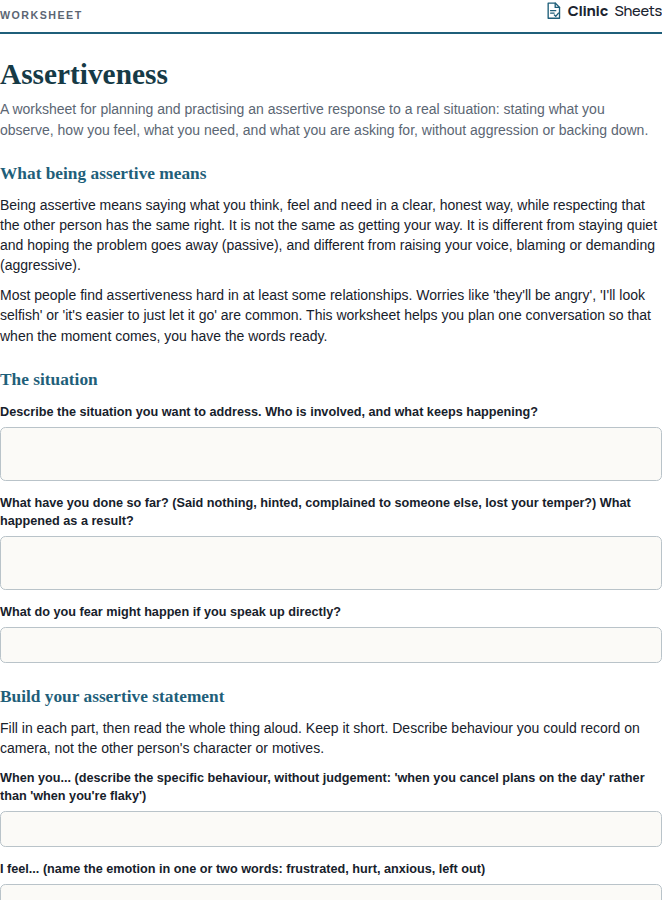
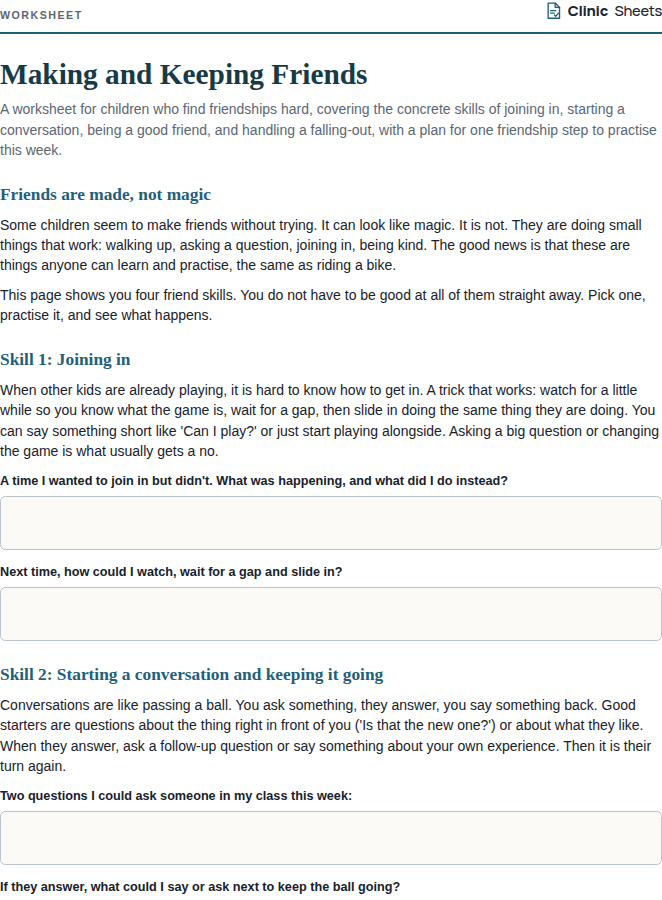
This plan sets out an eight-session group covering the skills most children with social difficulties need in sequence: joining others, holding a conversation, taking turns and sharing, reading feelings, handling teasing and disagreement, and hosting a play date. Each session uses the same teaching cycle, and each includes a game or activity in which the skill is practised naturally. A parallel parent session each week explains the skill, assigns the home practice, and coaches parents in how to prompt and praise it.
The professional version gives the facilitator the full session outlines and parent session notes, guidance on group composition, and a section on managing the difficulties that commonly arise, including a child who cannot tolerate losing games, a child who is rejected by the others, and the gap between skill in the room and behaviour in the playground.
How to use it
- Screen each child with the parent before the group. Establish the child's main social difficulties, any diagnosis, how they manage in groups, and whether they can follow adult direction well enough to take part safely. Administer a parent-report measure such as the Strengths and Difficulties Questionnaire or the Social Skills Improvement System as a baseline, and gather a brief teacher report where possible.
- Compose the group carefully. Four to six children of similar age and developmental level, with a mix of shy and more outgoing children, works better than a group of children who all have the same difficulty. Avoid placing a child with a peer who already rejects or bullies them.
- Run with two facilitators, and a third adult if any child has significant behavioural needs. One facilitator leads teaching and games; the other coaches individual children, manages behaviour and records progress.
- Run the parent group in parallel or immediately before the children's session. Parents who understand the week's skill and its home practice are the main reason the skill transfers.
- Use a simple, visible reward system for participation and for practising the skill in group, and praise generously and specifically. Keep the pace fast, alternate sitting and moving, and end each session with a game.
- Repeat the outcome measure at session 8 and, if possible, at three months, and share results with parents.
References
- Spence, S. H. (2003). Social skills training with children and young people: Theory, evidence and practice. Child and Adolescent Mental Health, 8(2), 84-96.
- McGinnis, E. (2012). Skillstreaming the Elementary School Child: A Guide for Teaching Prosocial Skills (3rd ed.). Research Press.
- Frankel, F., & Myatt, R. (2003). Children's Friendship Training. Brunner-Routledge.