ADHD: Task Breakdown and Time Blocking
A planning worksheet for adults with ADHD that turns a vague or overwhelming task into concrete first steps, estimates time realistically, and places the steps into protected blocks in the day. Targets task initiation and time blindness.
About this resource
Two executive function difficulties sit behind much of the procrastination seen in adult ADHD. The first is task initiation: a task that is large, unclear or uninteresting produces an aversive feeling that the ADHD brain avoids, and the task does not begin. The second is time perception: adults with ADHD tend to underestimate how long things take, overestimate how much time is available, and struggle to feel the approach of a deadline until it is imminent. The result is a cycle of avoidance, last-minute rushing and self-blame.
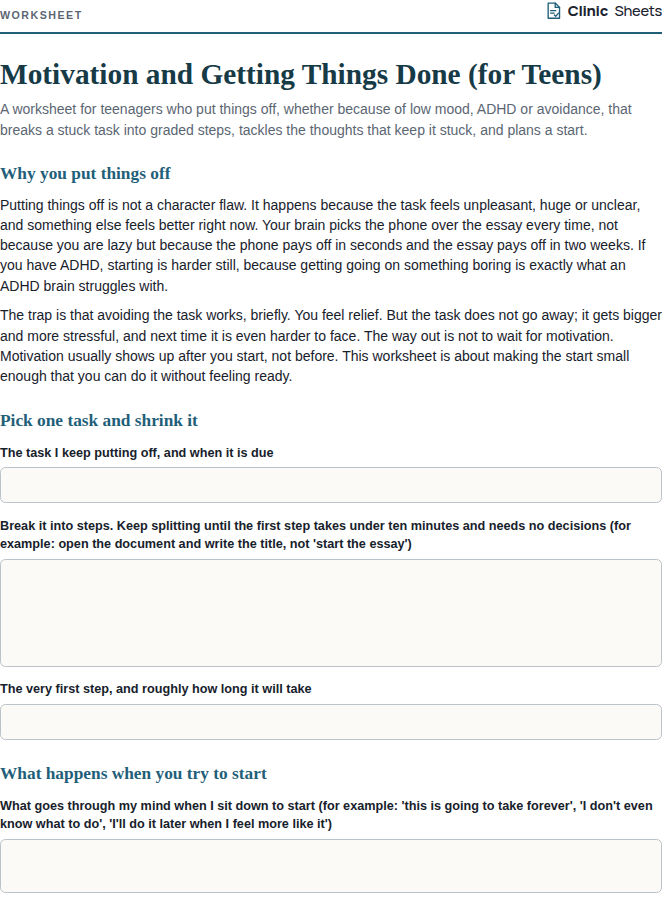
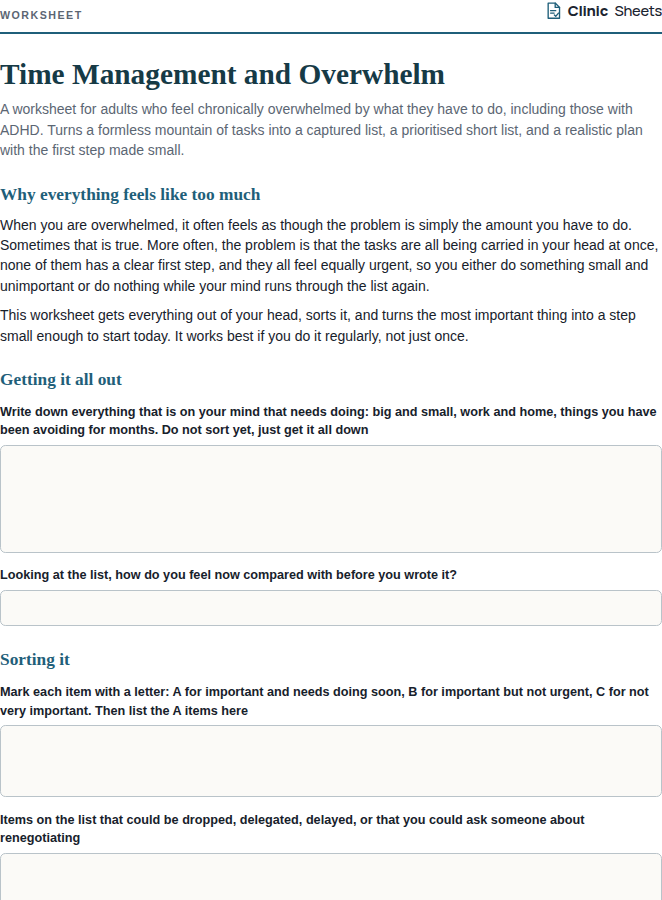
This worksheet addresses both. It asks the client to take one task, break it into steps small enough that the first one can be started within a few minutes, estimate the time for each step and then add a buffer, and place the steps into specific time blocks with a start cue. The approach follows the organisational and planning modules of Safren and colleagues' CBT programme for adult ADHD, where task breakdown and calendar use are foundational skills taught before cognitive work.
The professional version includes guidance on calibrating time estimates against actual time taken (a useful ongoing experiment), on identifying the point in the task where avoidance typically occurs, and on adapting the worksheet for clients who resist structure because past planning attempts failed.
How to use it
- Introduce the worksheet with a task the client is currently avoiding. Choose something moderately sized for the first attempt; a task that will take days is better broken across several worksheets.
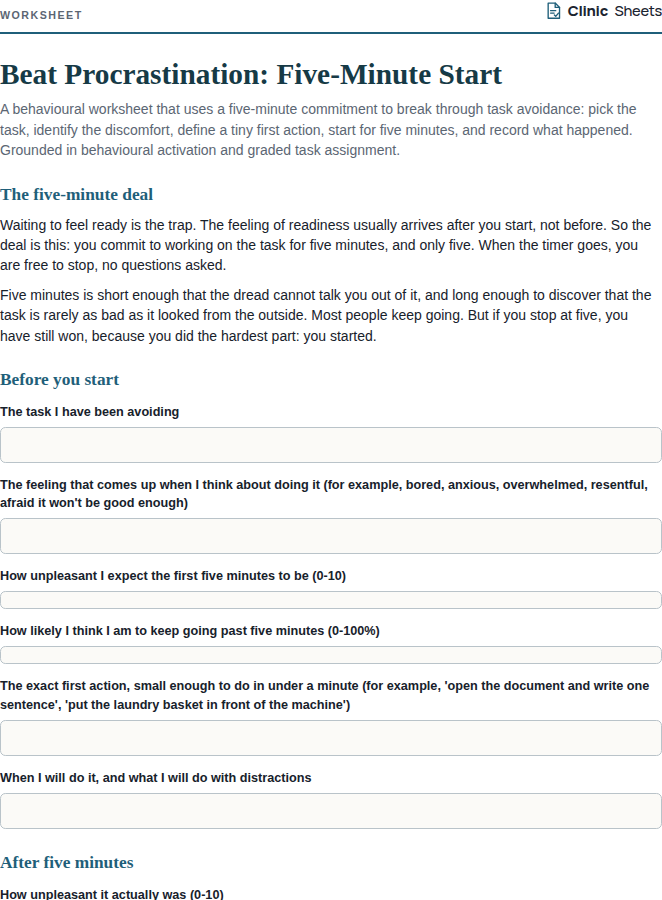
- Break the task down together until the first step is something the client could start right now with no further decisions. If the client says 'I'd need to find the file first', that is the first step.
- Ask for a time estimate for each step, then ask the client to record the actual time afterwards. Over several tasks this builds a personal correction factor.
- Place the steps into the client's actual calendar, not just the worksheet. Blocks should be short (25 to 50 minutes) with a clear cue for starting and a planned end.
- Review in the next session: which blocks happened, which did not, and what got in the way. Treat the results as data, not as success or failure.
- Once the client can do this reliably on paper, move toward doing it in whatever digital or paper system they will actually keep using.
References
- Safren, S. A., Sprich, S. E., Perlman, C. A., & Otto, M. W. (2017). Mastering Your Adult ADHD: A Cognitive-Behavioral Treatment Program, Therapist Guide (2nd ed.). Oxford University Press.
- Barkley, R. A. (2015). Attention-Deficit Hyperactivity Disorder: A Handbook for Diagnosis and Treatment (4th ed.). Guilford Press.
- Solanto, M. V. (2011). Cognitive-Behavioral Therapy for Adult ADHD: Targeting Executive Dysfunction. Guilford Press.