Study Skills with ADHD
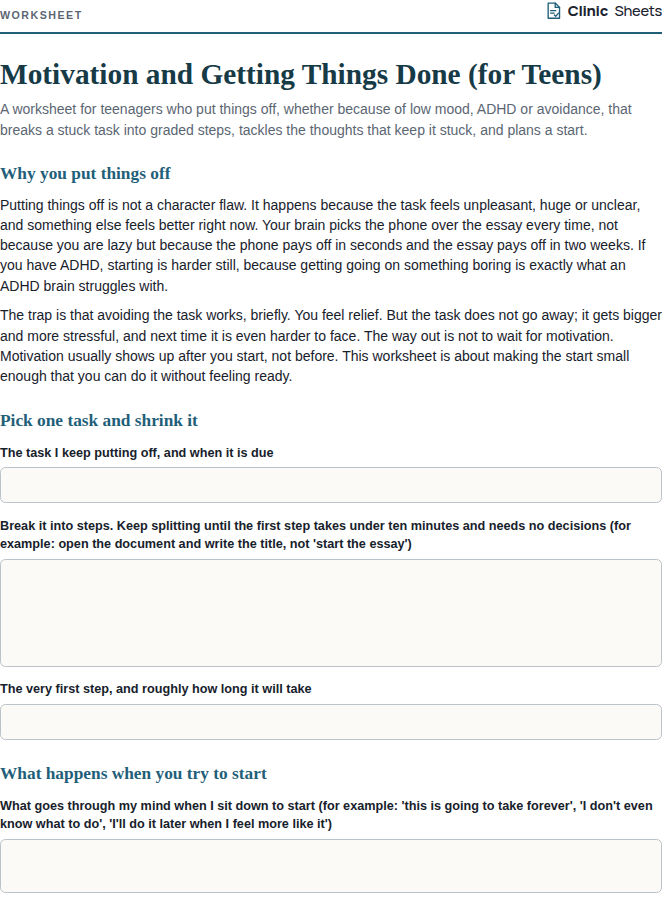
A worksheet for teenagers with ADHD that builds a concrete study system: capturing tasks in one place, breaking work into short graded blocks, setting up the environment, and using timers and external cues to get started and keep going.
About this resource
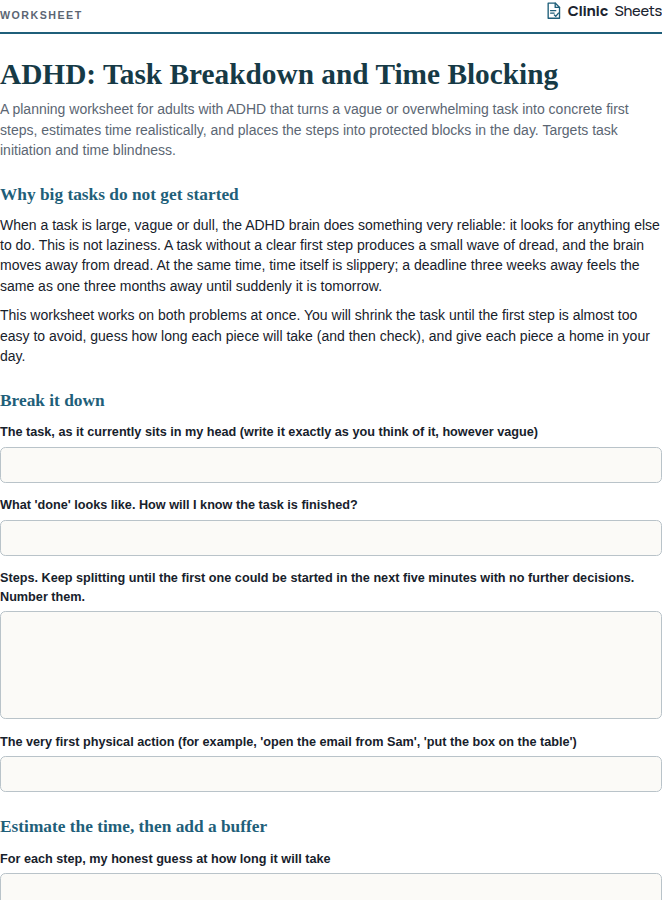
Studying with ADHD fails at predictable points: the task is never written down, it is not started, it is started but abandoned when attention drifts, or it is finished and not handed in. CBT for adolescent and adult ADHD, as in the Safren and colleagues programme, addresses these points with external organisational structures rather than by trying to strengthen internal attention: a single capture system, task breakdown, prioritisation, environmental modification and the use of timers and cues. The approach is behavioural and skills-based and has trial support in medication-treated adolescents.
This worksheet turns those principles into a set-up exercise the young person can complete in session and use immediately. It walks through choosing one capture system, breaking the current week's work into short blocks, designing the study space, and planning the start of each session using a timer. It closes with a short review of what worked, since study systems for ADHD need adjusting rather than adopting whole.
The professional version adds guidance on the level of parental scaffolding appropriate at different ages, on collaborating with school for accommodations, and on keeping the system simple enough that the young person will actually maintain it.
How to use it
- Assess the current system first, however chaotic. Where do tasks currently get recorded, and where does the process break down?
- Choose one capture tool with the young person, whichever they will actually check: a planner, a phone app, or a single notebook. One, not several.
- Complete the task breakdown for the current week in session so they leave with a concrete plan rather than a method.
- Design the study environment together and agree what parents will and will not do to support it.
- Review the following week using the final section. Expect to adjust block length, timing and environment several times before it sticks.
References
- Safren, S. A., Sprich, S. E., Perlman, C. A., & Otto, M. W. (2017). Mastering Your Adult ADHD: A Cognitive-Behavioral Treatment Program, Therapist Guide (2nd ed.). Oxford University Press.
- Sprich, S. E., Safren, S. A., Finkelstein, D., Remmert, J. E., & Hammerness, P. (2016). A randomized controlled trial of cognitive behavioral therapy for ADHD in medication-treated adolescents. Journal of Child Psychology and Psychiatry, 57(11), 1218-1226.
- Barkley, R. A. (Ed.). (2015). Attention-Deficit Hyperactivity Disorder: A Handbook for Diagnosis and Treatment (4th ed.). Guilford Press.