Time Management and Overwhelm
A worksheet for adults who feel chronically overwhelmed by what they have to do, including those with ADHD. Turns a formless mountain of tasks into a captured list, a prioritised short list, and a realistic plan with the first step made small.
About this resource
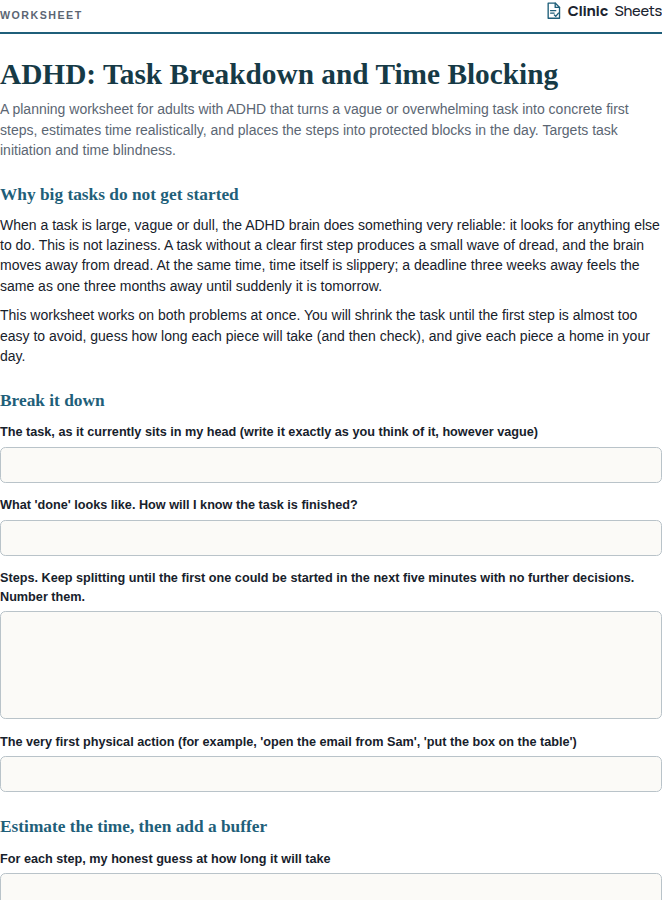
The feeling of being overwhelmed usually has less to do with the total amount of work than with how it is held: as an undifferentiated cloud of obligations, none of them started, all of them equally urgent, with the mind cycling through them rather than acting on any. This is a problem-solving failure of a specific kind. Tasks are not written down, so they have to be kept in working memory; they are not broken down, so the first step is unclear and the whole task is avoided; and they are not prioritised, so the person either does the easiest thing or freezes. For adults with ADHD, difficulties with working memory, planning and task initiation make this pattern the default rather than an occasional lapse, and CBT for adult ADHD (Safren and colleagues; Solanto) puts organisation and planning skills at the front of treatment for that reason.
This worksheet applies those skills in a single pass. The client captures everything that is on their mind, sorts it by importance and urgency, breaks the most important task into a first step that takes under fifteen minutes, and plans when and where it will happen. It also asks the client to notice their own avoidance patterns, since overwhelm and procrastination feed each other. The structure draws on problem-solving therapy and on graded task assignment from CBT for depression.
The professional version notes that the sheet is a starting point rather than a system: clients with ADHD in particular need a single external place where tasks live (paper or digital, but one) and a daily habit of looking at it, and the worksheet should be repeated until that habit is established. It also flags that overwhelm sometimes reflects genuinely unsustainable demands, in which case the work is about reducing load, not organising it better.
How to use it
- Complete the capture section in session the first time. Many clients have never written everything down and find the act itself relieving, even before anything is sorted.
- Be firm about the size of the first step. Under fifteen minutes, concrete, with a clear finish. 'Open the tax folder and find last year's return' is a step; 'do taxes' is not.
- For clients with ADHD, add the where and when explicitly and, if possible, an external cue (alarm, note, telling someone). Intention alone rarely survives the day.
- Repeat the exercise weekly until the client has a working list they check daily. The worksheet is scaffolding for a habit, not a one-time fix.
- If the sorted list makes clear that the demands are not achievable, shift to problem-solving around reducing them: what can be dropped, delegated, delayed or renegotiated.
References
- Safren, S. A., Sprich, S. E., Perlman, C. A., & Otto, M. W. (2017). Mastering Your Adult ADHD: A Cognitive-Behavioral Treatment Program, Therapist Guide (2nd ed.). Oxford University Press.
- Solanto, M. V. (2011). Cognitive-Behavioral Therapy for Adult ADHD: Targeting Executive Dysfunction. Guilford Press.
- Nezu, A. M., Nezu, C. M., & D'Zurilla, T. J. (2013). Problem-Solving Therapy: A Treatment Manual. Springer.