Motivation and Getting Things Done (for Teens)
A worksheet for teenagers who put things off, whether because of low mood, ADHD or avoidance, that breaks a stuck task into graded steps, tackles the thoughts that keep it stuck, and plans a start.
About this resource
Procrastination in adolescence is rarely laziness. It is usually avoidance of a task that feels aversive, overwhelming or likely to end in failure, combined with a strong pull toward something immediately rewarding. Behavioural research on procrastination identifies task aversiveness, distance of the reward, and low confidence as the main drivers, and ADHD adds difficulties with initiating, sustaining attention and holding a plan in mind. Whatever the cause, the maintaining cycle is the same: avoiding the task brings relief, the task grows, and the next attempt is harder.
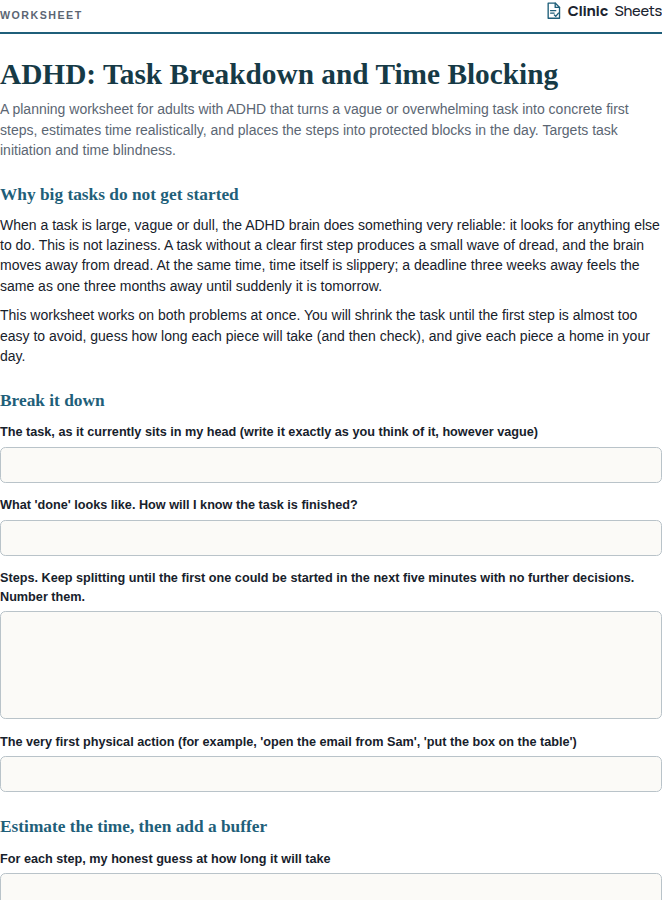
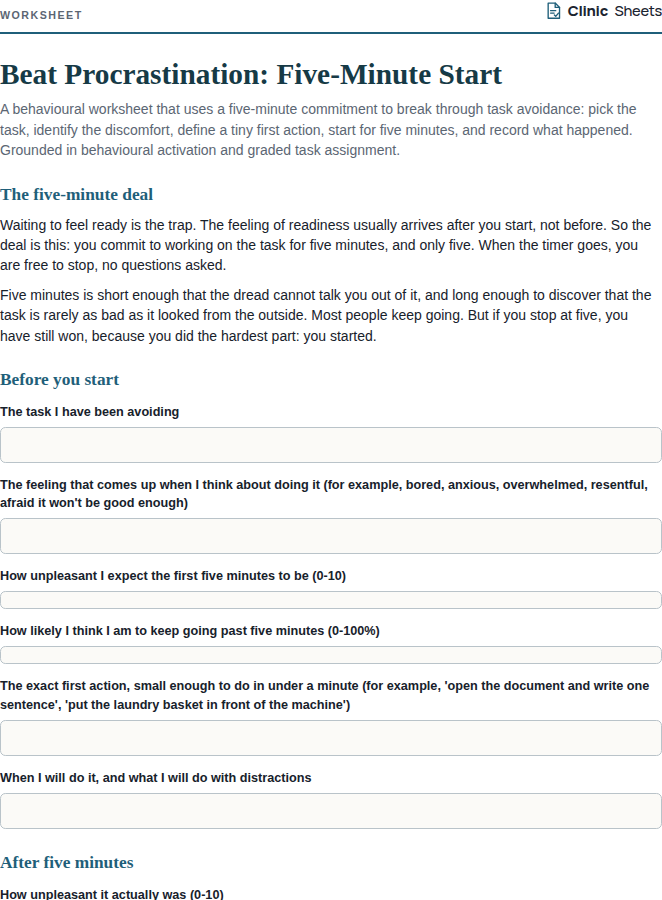
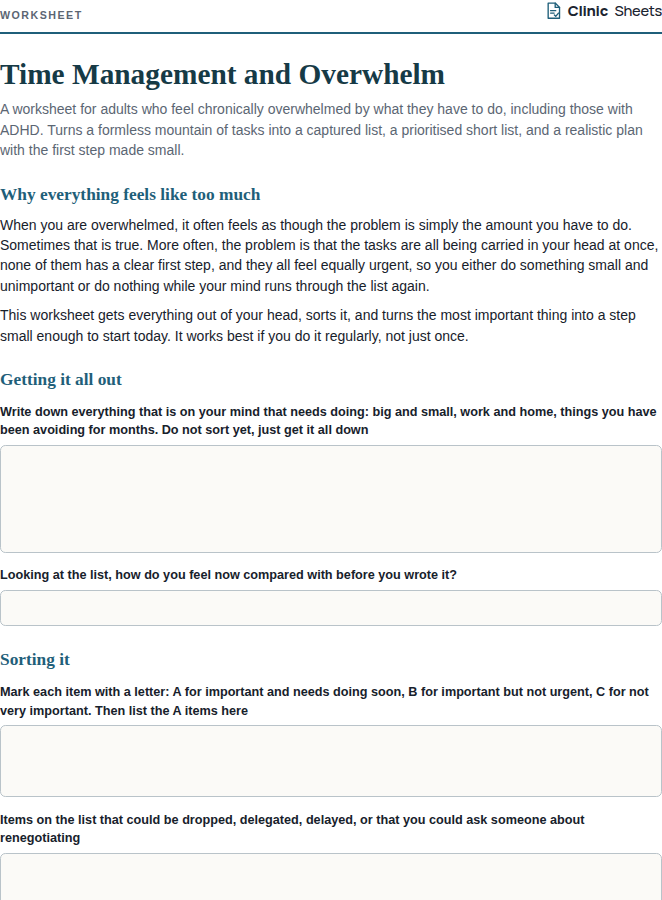
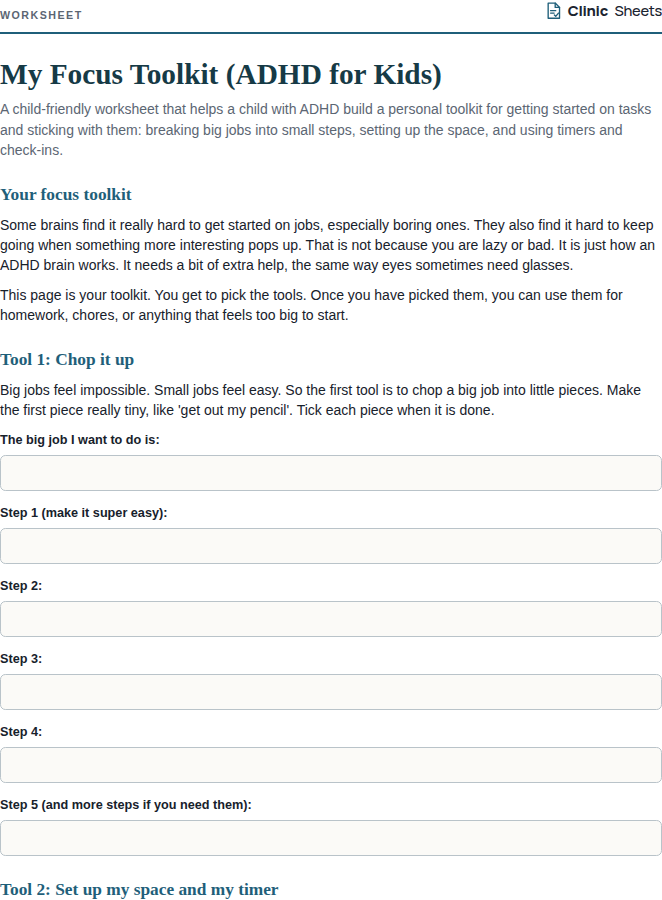
This worksheet applies graded task assignment from behavioural activation. The young person picks one stuck task, breaks it into steps small enough that the first can be started in under ten minutes, identifies the thoughts and feelings that show up at the point of starting, and plans a specific time, place and first step. A short section covers the thought that 'I need to feel motivated first', which is the most common cognitive barrier and is directly contradicted by the behavioural model: action generally precedes motivation.
The professional version adds guidance on distinguishing depressive avoidance from ADHD initiation difficulties, on involving parents as scaffolding without nagging, and on adapting the step size for the individual.
How to use it
- Choose one stuck task with the young person, ideally something due within the next week so that the plan can be tested before the next session.
- Break the task down in session. Keep dividing until the first step is something that takes less than ten minutes and requires no decisions.
- Draw out what happens at the moment of starting: the thought, the feeling, and what they do instead. Name the avoidance cycle.
- Plan the first step with a specific time and place, and remove the obvious obstacles. Agree how they will start even if they do not feel like it.
- Review what happened. Whether or not the task was finished, focus on whether the first step was taken and what was learned, then plan the next step.
References
- Steel, P. (2007). The nature of procrastination: A meta-analytic and theoretical review of quintessential self-regulatory failure. Psychological Bulletin, 133(1), 65-94.
- Martell, C. R., Dimidjian, S., & Herman-Dunn, R. (2010). Behavioral Activation for Depression: A Clinician's Guide. Guilford Press.
- Safren, S. A., Sprich, S. E., Perlman, C. A., & Otto, M. W. (2017). Mastering Your Adult ADHD: A Cognitive-Behavioral Treatment Program, Therapist Guide (2nd ed.). Oxford University Press.