Attachment Needs and Raw Spots
An emotionally focused couples worksheet for identifying each partner's core attachment needs, the raw spots that get touched in conflict, the protective moves that follow, and how these lock together into the couple's negative cycle.
About this resource
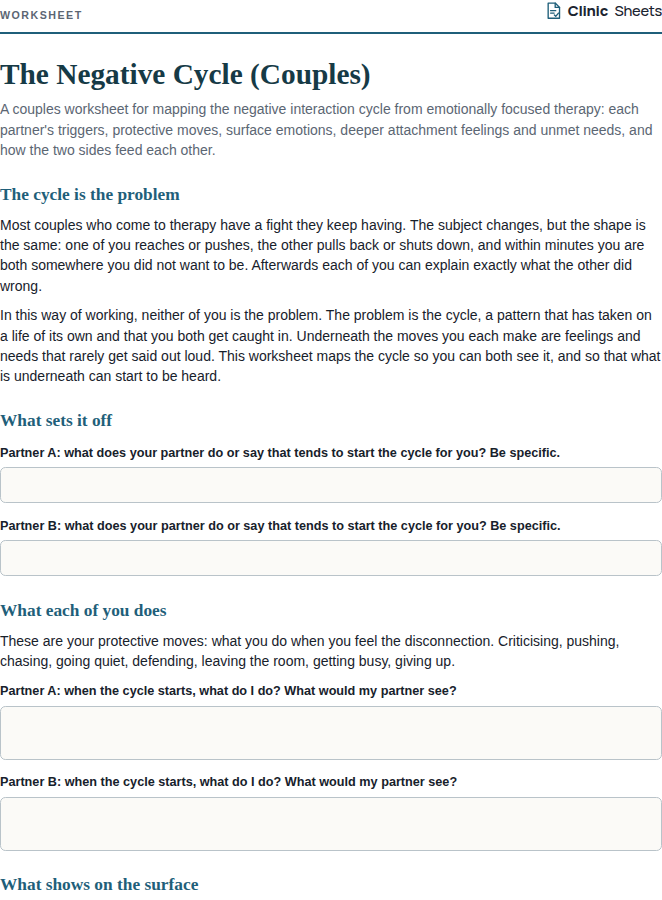
Emotionally focused therapy understands couple distress as the result of insecure attachment: partners who cannot reliably reach each other for comfort and reassurance become caught in a self-perpetuating cycle of protest and withdrawal. Sue Johnson's term for the moments that set the cycle off is a raw spot: a place of particular sensitivity, usually formed by earlier experiences of being let down, dismissed or abandoned, which when touched produces a sudden and disproportionate emotional reaction. The reaction is typically a secondary emotion (anger, irritation, coldness) covering a primary one (fear, hurt, loneliness, shame), and it is followed by a protective move, most often pursuing harder or withdrawing, which happens to touch the other partner's raw spot in turn.
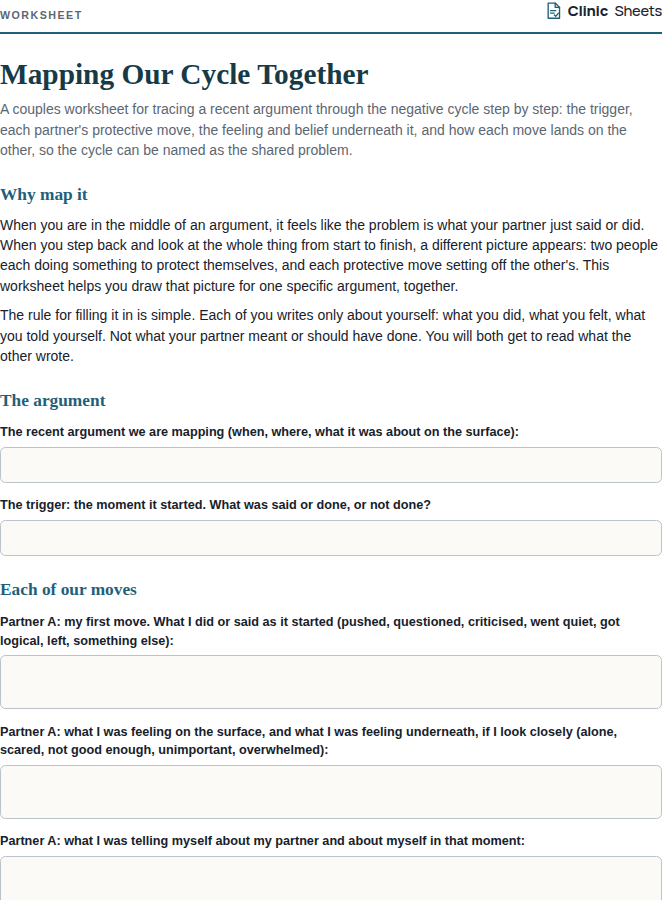
This worksheet helps each partner map their own side of this process: the attachment need underneath (to be seen, to matter, to be safe, to be accepted), the raw spot and what tends to touch it, the surface reaction and the softer feeling beneath, and the protective move they make. The final section brings the two maps together so the couple can see how each partner's protection becomes the other's trigger. Completing it is a formulation exercise; the aim is not to solve the cycle in one sitting but to make it visible enough that the couple can begin to name it together rather than being run by it.
The professional version adds guidance on helping partners find the primary emotion when they can only report the secondary one, on the withdrawer who says they feel nothing, and on using the completed maps to build the de-escalation conversation in which each partner speaks about their own cycle position rather than the other's.
How to use it
- Use after you have tracked the couple's negative cycle in at least one session and have a working sense of who pursues and who withdraws. The worksheet is a way of deepening and consolidating that work, not a substitute for it.
- Complete it in session, one partner at a time, with the other listening. Move slowly through the layers: the surface reaction is easy to name, the softer feeling underneath usually needs your help to find, and the attachment need is often something the partner has never said aloud.
- When a partner cannot find the softer feeling, slow the moment down. Ask what happens in their body when the raw spot is touched, what they fear will happen next, and what they most need from their partner in that moment.
- Complete the final section together. Draw the loop: A's protective move touches B's raw spot, B's protective move touches A's raw spot. Give the cycle a name the couple chooses.
- Ask the couple to notice the cycle once during the week and to name it out loud rather than fight inside it. Review at the next session.
References
- Johnson, S. M. (2004). The Practice of Emotionally Focused Couple Therapy: Creating Connection (2nd ed.). Brunner-Routledge.
- Johnson, S. M. (2008). Hold Me Tight: Seven Conversations for a Lifetime of Love. Little, Brown.
- Johnson, S. M. (2019). Attachment Theory in Practice: Emotionally Focused Therapy (EFT) with Individuals, Couples, and Families. Guilford Press.