Mapping Our Cycle Together
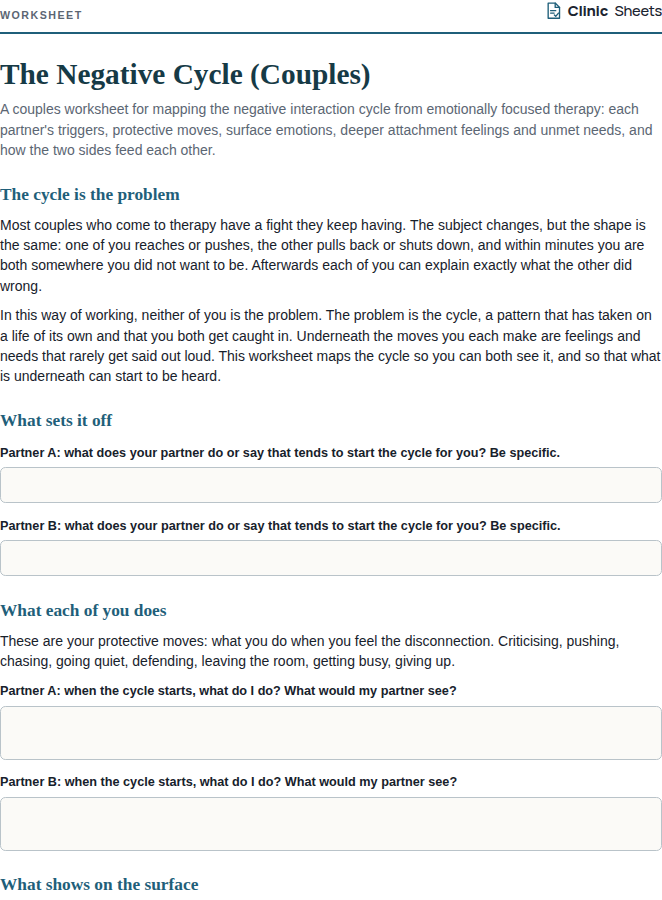
A couples worksheet for tracing a recent argument through the negative cycle step by step: the trigger, each partner's protective move, the feeling and belief underneath it, and how each move lands on the other, so the cycle can be named as the shared problem.
About this resource
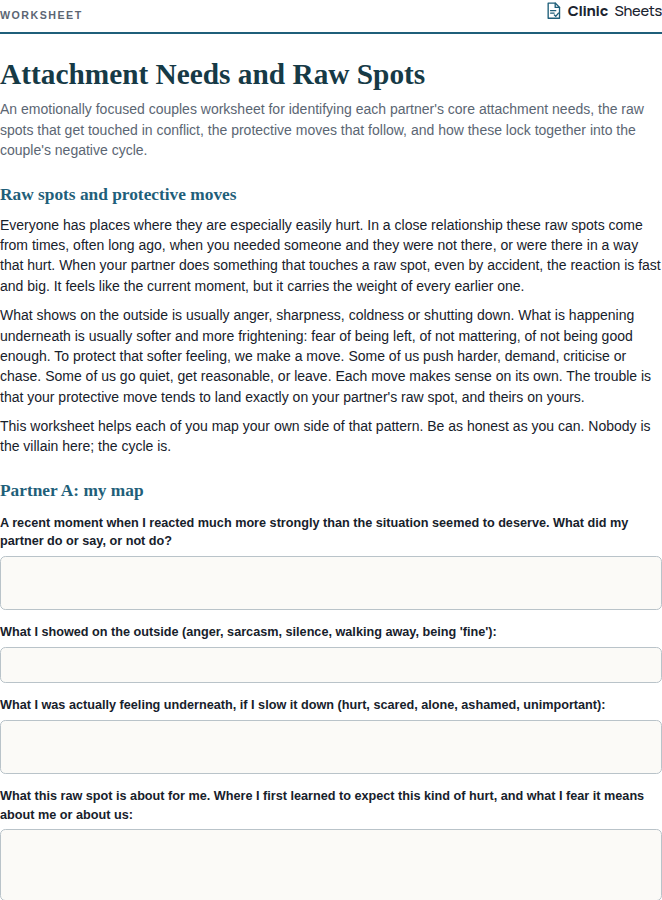
In Emotionally Focused Therapy, the first stage of treatment is de-escalation, and its central task is to help the couple identify their negative interaction cycle and reframe it as the problem, rather than either partner. Johnson describes the cycle in terms of each partner's position (typically pursue or withdraw), the secondary reactive emotion that is visible on the surface (anger, coldness, defensiveness), the primary attachment emotion underneath (fear of abandonment, fear of failure, shame, loneliness), and the attachment need that is not being met. Once the couple can see this map of their own cycle, blame tends to soften, and each partner becomes able to talk about their own experience rather than their partner's faults.
This worksheet gives the couple a structure for building that map together, using one specific recent argument. It moves through the trigger, each partner's outward move, what each was feeling and telling themselves, how each move landed on the other, and how the argument ended and left them feeling. It then asks the couple to write a short description of the cycle in their own words, as a thing they are both caught in, and to give it a name. The worksheet is designed to be started in session and completed or repeated at home.
The professional version adds guidance on keeping each partner focused on their own position rather than narrating the other's, on slowing the process when a partner cannot yet access the softer emotion, on couples with a withdraw-withdraw or attack-attack pattern, and on using the completed map as the reference point for the rest of treatment.
How to use it
- Use after introducing the pursue-withdraw cycle, once the couple can each broadly identify their position. Choose a recent argument that was typical but not the most painful one.
- Complete the map in session the first time, with the clinician guiding. Ask each partner to speak only about their own steps and feelings; gently block narration of the other partner's motives.
- When a partner offers only the surface emotion (anger, irritation, nothing), stay with it and ask what happens in the seconds just before the move, and what they fear would happen if they did not make it.
- After the map is complete, ask each partner to read the other's inside view and say what it was like to hear it. Reflect the cycle back as a whole and invite them to name it.
- Send the worksheet home for a second argument. Review it next session and use it to track de-escalation over time.
References
- Johnson, S. M. (2020). The Practice of Emotionally Focused Couple Therapy: Creating Connection (3rd ed.). Routledge.
- Johnson, S. M. (2008). Hold Me Tight: Seven Conversations for a Lifetime of Love. Little, Brown.
- Wiebe, S. A., & Johnson, S. M. (2016). A review of the research in emotionally focused therapy for couples. Family Process, 55(3), 390-407.