The Negative Cycle (Couples)
A couples worksheet for mapping the negative interaction cycle from emotionally focused therapy: each partner's triggers, protective moves, surface emotions, deeper attachment feelings and unmet needs, and how the two sides feed each other.
About this resource
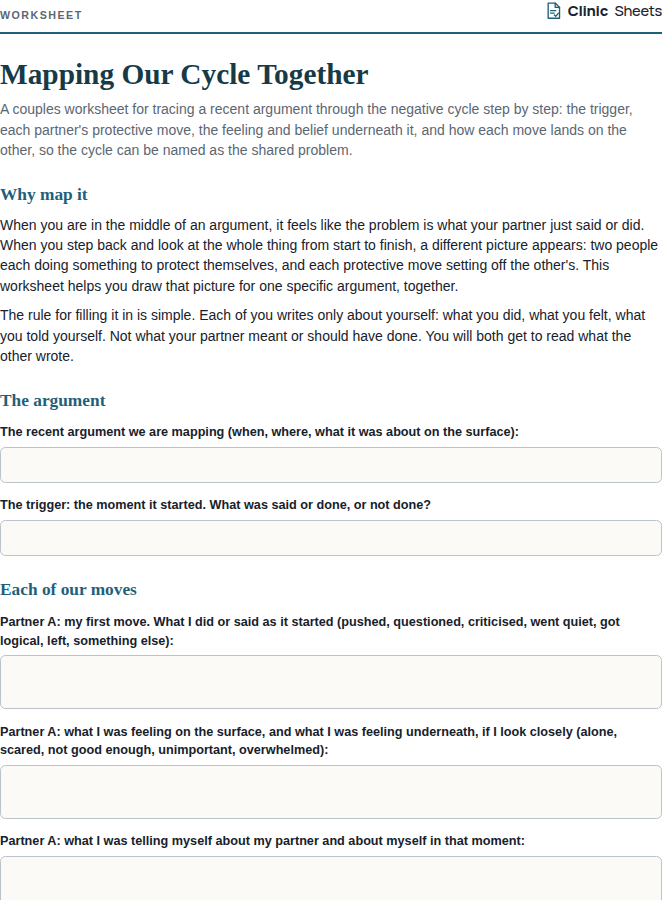
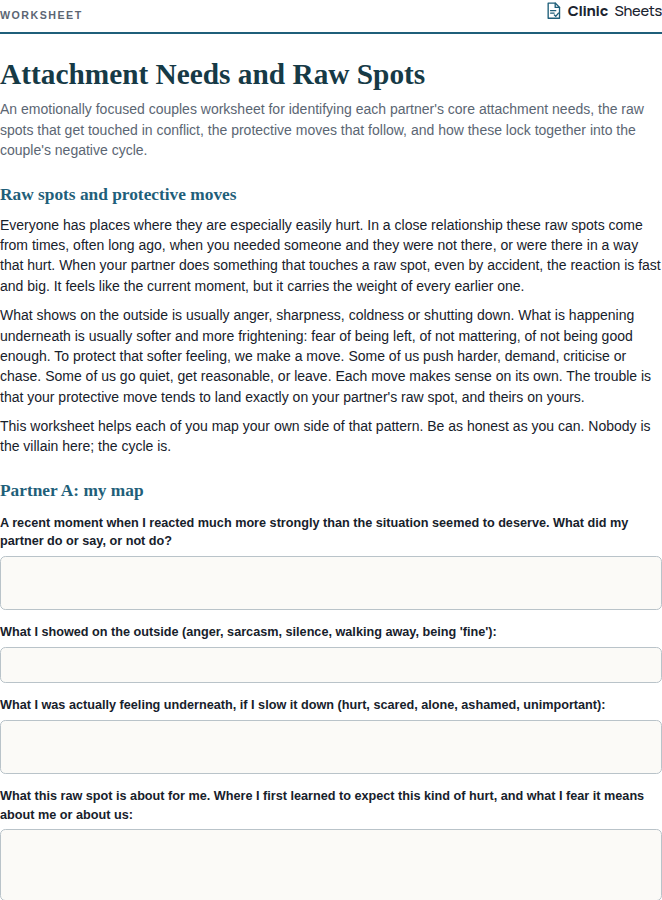
In emotionally focused therapy, developed by Sue Johnson, the first stage of treatment is to help a couple identify and de-escalate their negative cycle: the self-reinforcing pattern of moves each partner makes when they feel disconnected. The most common form is pursue-withdraw, in which one partner protests, criticises or pushes for engagement while the other goes quiet, defends or leaves, each move confirming the other partner's worst fear. Other patterns include withdraw-withdraw and attack-attack. The cycle, rather than either partner, is framed as the problem, which allows both to step back from blame and see what is happening between them.
This worksheet walks the couple through the cycle from the outside in: the situation that triggers it, what each partner does (their protective move), what each shows on the surface (usually anger, coldness or defensiveness), what each is feeling underneath (typically fear, hurt, loneliness or shame), and what each needs from the other. It ends by asking the couple to describe the cycle as a whole, in their own words, as something they can name and catch. The structure follows Johnson's model of the cycle as a set of reciprocal positions, surface and underlying emotions, and attachment needs.
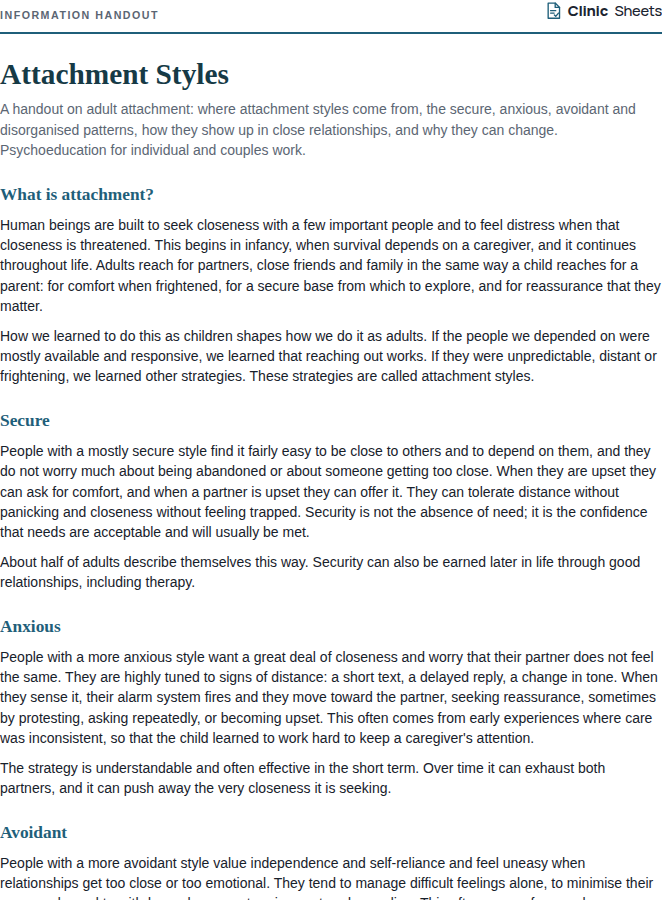
Use it in the assessment and de-escalation stage, after each partner has been seen individually and after the attachment frame has been introduced (see Attachment Styles). The professional version adds a clinician guide to eliciting underlying emotions when partners can only report anger or nothing, common cycle patterns with examples, and guidance on when a couple is ready to move from cycle mapping to the restructuring stage.
How to use it
- Complete the worksheet in session with both partners present. Take one side of the cycle at a time, slowing each partner down and reflecting what you hear before moving to the other.
- Start with a recent, specific argument rather than the relationship in general. Ask each partner what the other did that set them off and what they did in response.
- For the emotion fields, expect the surface emotion first. Ask gently what was under it: 'When they went quiet, and you felt the anger rising, what was the feeling just before the anger?' Validate whatever comes.
- When one partner's underlying feeling is spoken, check the other partner's reaction. Often this is the first time they have heard it, and it changes the room.
- Help the couple describe the cycle as a loop in the final section and give it a name they both accept. Ask them to notice it during the week and to say 'there it is' rather than to fix it.
- Return to the worksheet in later sessions. As partners become more able to express underlying emotions and needs, the cycle description deepens.
References
- Johnson, S. M. (2020). The Practice of Emotionally Focused Couple Therapy: Creating Connection (3rd ed.). Routledge.
- Johnson, S. M. (2008). Hold Me Tight: Seven Conversations for a Lifetime of Love. Little, Brown.
- Wiebe, S. A., & Johnson, S. M. (2016). A review of the research in emotionally focused therapy for couples. Family Process, 55(3), 390-407.
- Christensen, A., & Heavey, C. L. (1990). Gender and social structure in the demand/withdraw pattern of marital conflict. Journal of Personality and Social Psychology, 59(1), 73-81.