Communication: Soft Start-Ups and I-Statements
A couples handout on raising a difficult topic without triggering defensiveness: why the first minute matters, how to open gently, the structure of an I-statement, and what to do when it goes wrong anyway.
About this resource
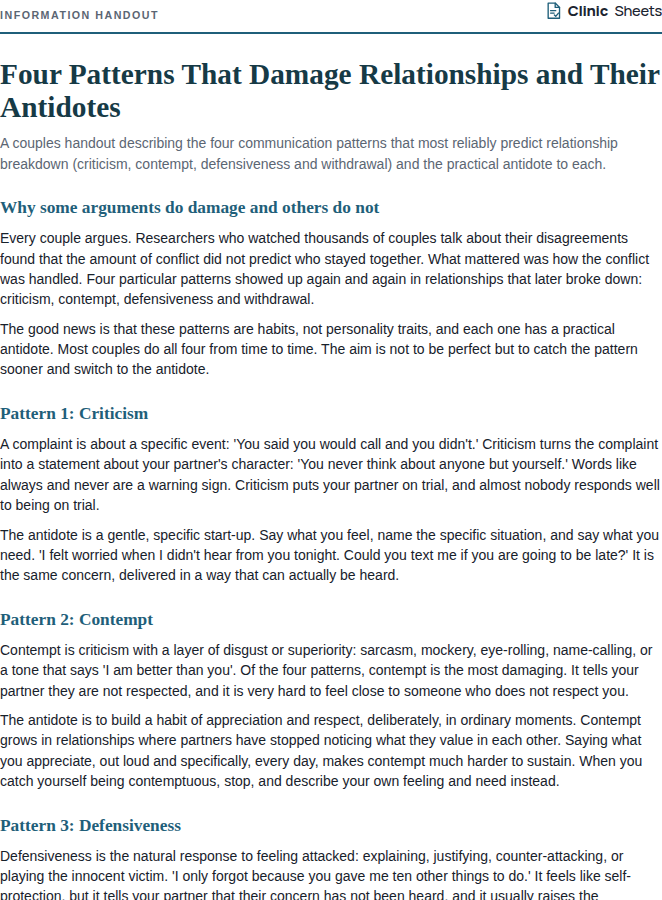
How a conversation begins strongly predicts how it ends. Gottman's observational research found that the first few minutes of a couple's conflict discussion, and in particular whether it opens with criticism and contempt or with a softened complaint, predicted the outcome of the discussion and the long-term trajectory of the relationship with striking accuracy. A harsh start-up activates the listener's threat response, and once a partner is defensive or flooded, little that follows will be heard. A soft start-up keeps both partners regulated enough to stay in the conversation.
This handout teaches two related skills. The soft start-up is about tone, timing and framing: starting with something positive or neutral, describing rather than judging, stating a need rather than a grievance, and choosing a moment when both partners have some capacity. The I-statement, which has been part of communication training since Gordon's parent effectiveness work, gives a simple structure for expressing a feeling and a need without assigning blame. Within an EFT frame, both skills serve the deeper goal of allowing the vulnerable feeling and attachment need to be heard rather than the protective move.
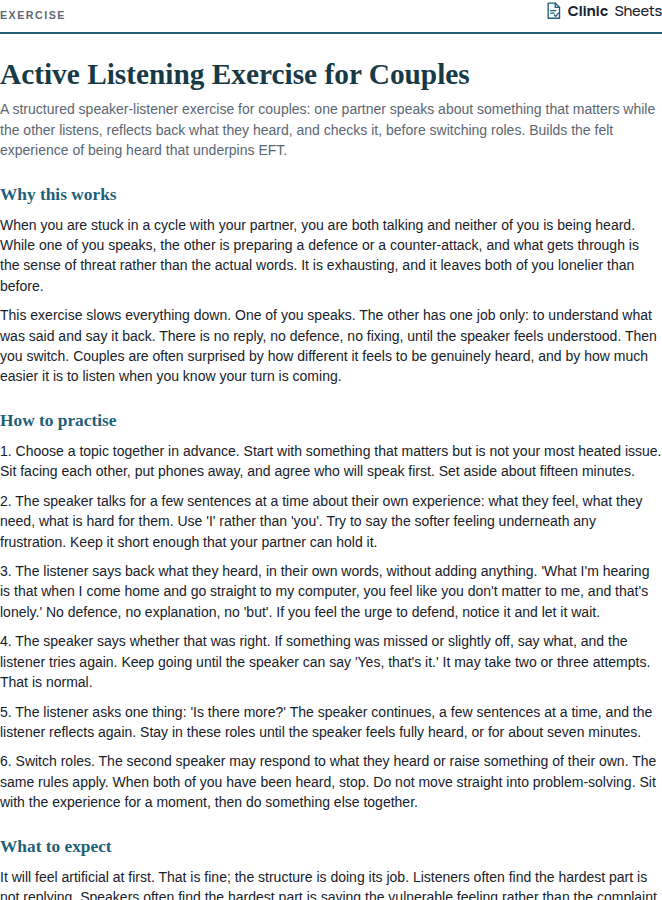
The handout is suited to couples at any stage of therapy once the negative cycle has been identified, and it is often given alongside The Negative Cycle (Couples) and the Active Listening Exercise. The professional version adds guidance on why I-statements sometimes fail (disguised you-statements, statements delivered in a hostile tone, and statements used as a weapon), examples of rewording harsh openers, and notes on adapting the material for partners who find any expression of need shameful.
How to use it
- Introduce after the couple can recognise their negative cycle. Present the soft start-up as a way of not feeding the cycle rather than as a communication rule.
- Take a real recent example of a harsh start from the couple and rework it together into a soft start. Ask the receiving partner how each version lands.
- Practise the I-statement structure in session on a low-stakes topic first. Listen for you-statements in disguise ('I feel that you never listen') and gently rework them.
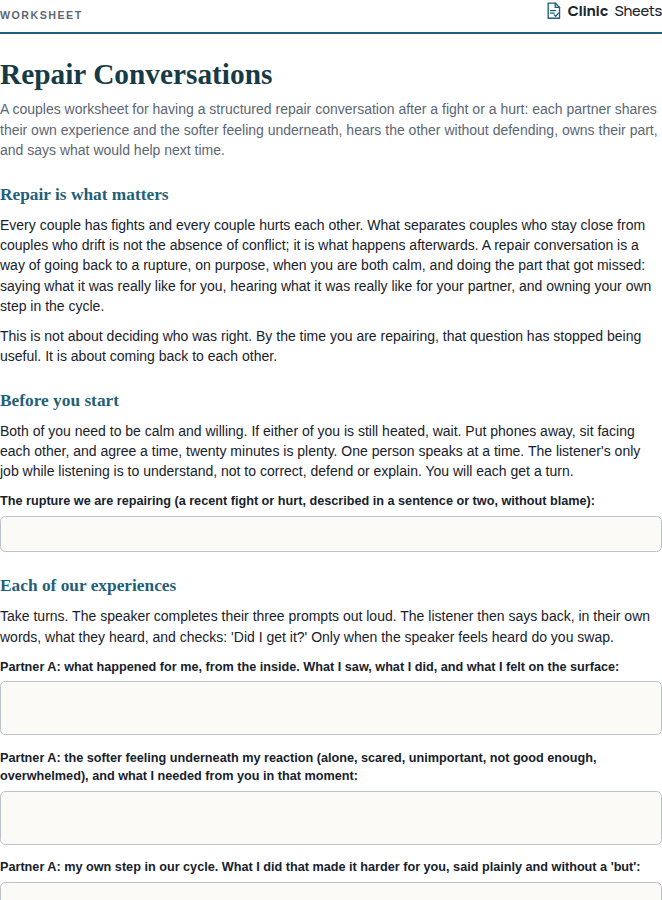
- Connect the skill to the underlying emotion work: the point of a soft start is to make it possible to say the softer feeling underneath the anger.
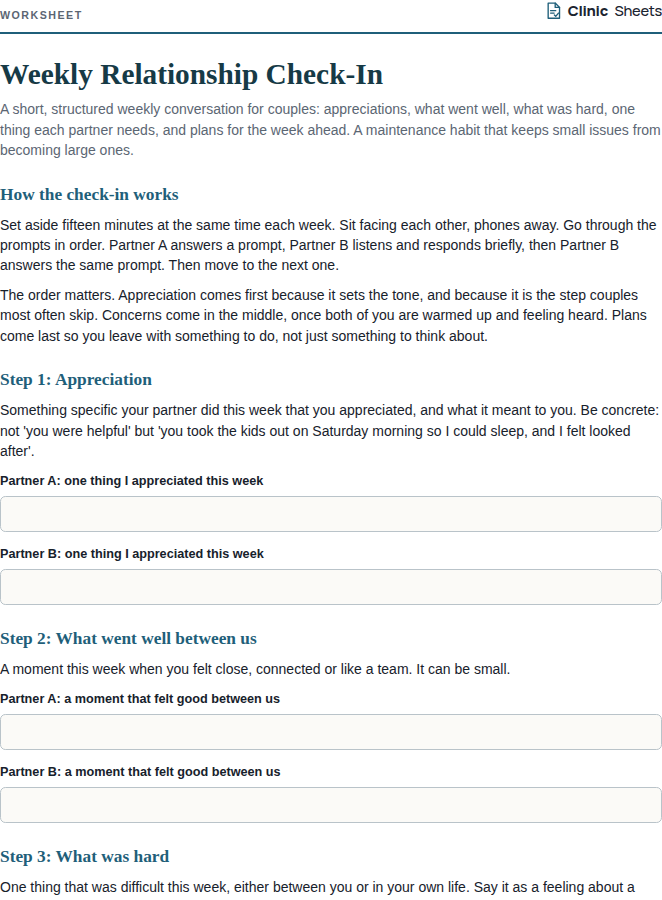
- Assign one soft start-up conversation for the week on a topic both partners agree in advance is manageable. Review at the next session.
References
- Gottman, J. M., & Silver, N. (2015). The Seven Principles for Making Marriage Work (revised ed.). Harmony Books.
- Gottman, J. M., & Levenson, R. W. (2000). The timing of divorce: Predicting when a couple will divorce over a 14-year period. Journal of Marriage and Family, 62(3), 737-745.
- Gordon, T. (1970). Parent Effectiveness Training. Peter H. Wyden.
- Johnson, S. M. (2008). Hold Me Tight: Seven Conversations for a Lifetime of Love. Little, Brown.