Attention Training for Social Anxiety
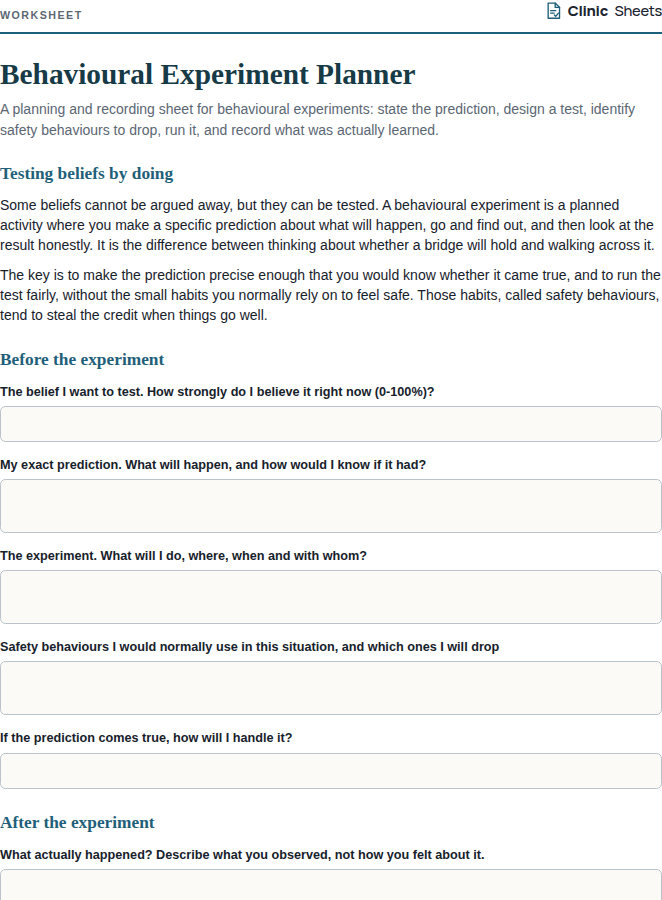
A graded practice for shifting attention outward in social situations, from neutral everyday settings to feared ones, paired with a two-part experiment comparing self-focused and externally focused attention in the same conversation.
About this resource
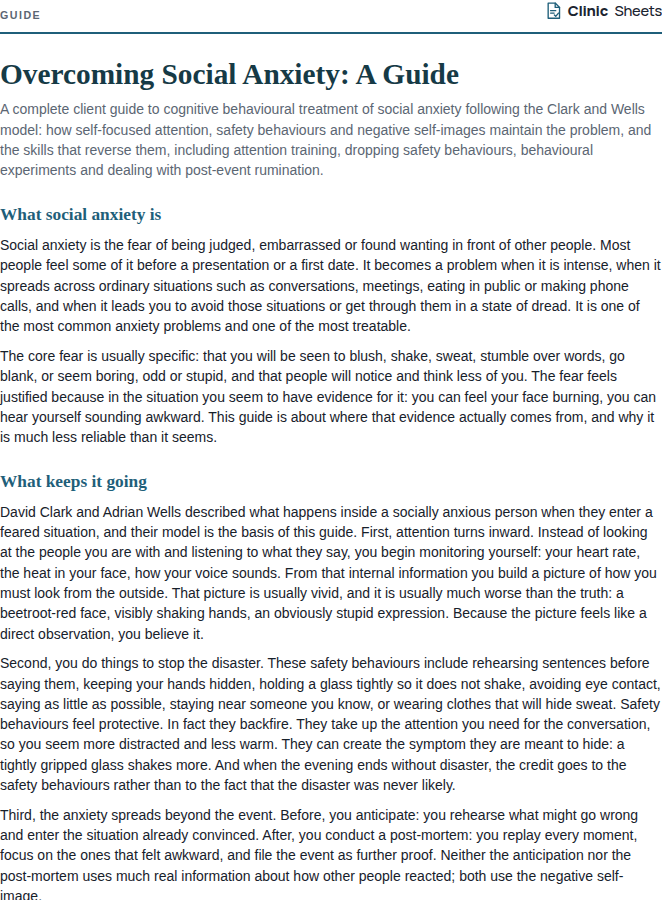
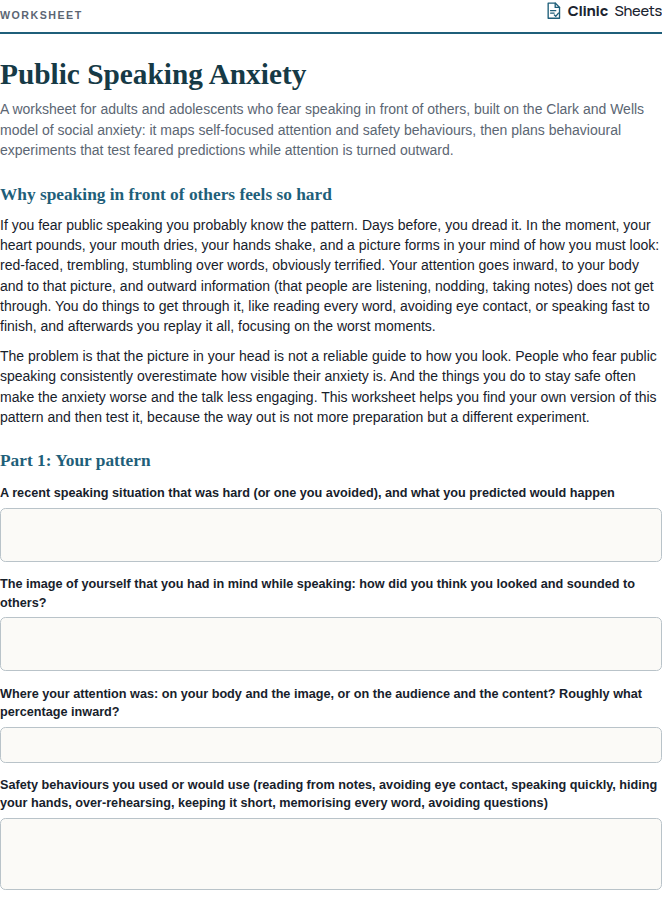
Self-focused attention is one of the most powerful maintaining factors in the Clark and Wells model of social anxiety. When attention is directed inward, the person monitors sensations and constructs a distorted self-image, misses the actual reactions of others, and performs less well because cognitive resources are consumed by monitoring. Training the client to direct attention outward, onto the environment and the people in it, reduces anxiety, improves performance and, crucially, allows the person to gather accurate evidence about how they are received. In the Clark and Wells treatment this is introduced early, usually alongside the dropping of safety behaviours, and is often demonstrated with an in-session experiment in which the client holds two short conversations, one while deliberately self-focused and one while deliberately externally focused, and compares the results.
This resource gives the client the rationale, a graded practice sequence that begins in non-social settings (noticing detail in a room, on a walk) and moves through low-stakes interactions to feared ones, and instructions for running the two-conversation experiment with a therapist or trusted person. A 'What to expect' section pre-empts the common finding that the mind snaps back to self-focus repeatedly and explains that each return of attention is a repetition of the skill. The practice log records the proportion of attention directed outward, anxiety, and what the client noticed about others that they would otherwise have missed.
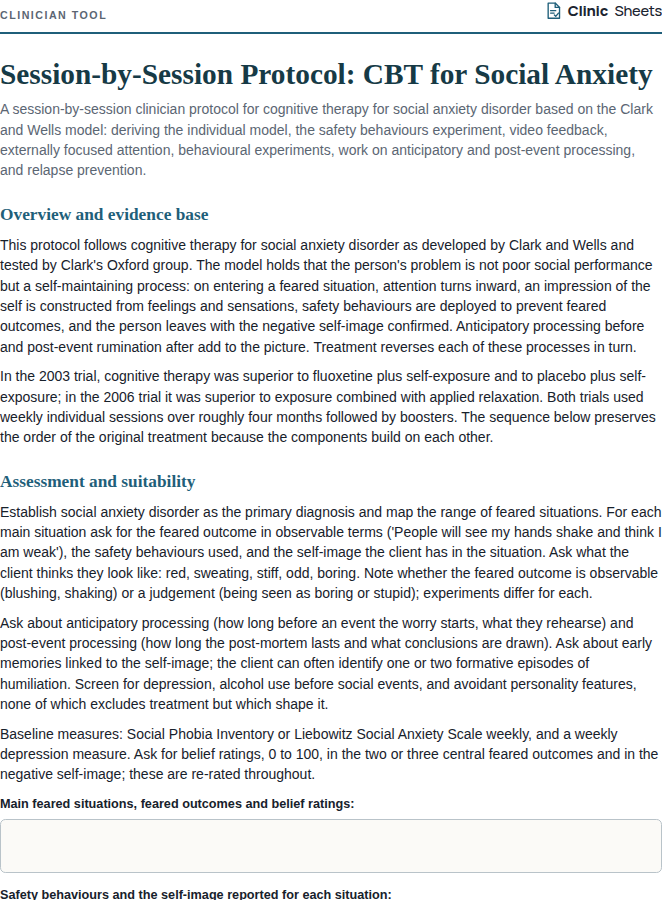
The professional version adds a script for the in-session experiment, guidance on using it alongside video feedback, and notes on the distinction between externally focused attention and distraction: the aim is to attend to the social task and the other person's actual reactions, not to look away from the situation altogether.
How to use it
- Introduce after the formulation, once the client has recognised that their attention goes inward in feared situations and that this is part of the problem.
- Run the two-conversation experiment in session before assigning home practice. Have a brief conversation with the client while they attend fully to their sensations and self-image, then a second while they attend fully to you: your face, your words, the room. Rate anxiety, self-consciousness and how well they thought the conversation went after each. The contrast is usually striking and makes the rationale self-evident.
- Assign the graded practice starting with non-social settings, several minutes several times a day, for the first week.
- Move through low-stakes interactions (shop assistants, colleagues in passing) before feared situations. Pair with dropping one safety behaviour at a time.
- Review the log each session. Ask specifically what the client noticed about other people that they would previously have missed. This is the evidence that corrects the self-image.
- Remind the client that the skill is the return of attention, not the absence of self-focus. Progress is measured by how quickly they notice and redirect.
References
- Clark, D. M., & Wells, A. (1995). A cognitive model of social phobia. In R. G. Heimberg, M. R. Liebowitz, D. A. Hope, & F. R. Schneier (Eds.), Social Phobia: Diagnosis, Assessment, and Treatment (pp. 69-93). Guilford Press.
- Wells, A., & Papageorgiou, C. (1998). Social phobia: Effects of external attention on anxiety, negative beliefs, and perspective taking. Behavior Therapy, 29(3), 357-370.
- Bögels, S. M., & Mansell, W. (2004). Attention processes in the maintenance and treatment of social phobia: Hypervigilance, avoidance and self-focused attention. Clinical Psychology Review, 24(7), 827-856.