Public Speaking Anxiety
A worksheet for adults and adolescents who fear speaking in front of others, built on the Clark and Wells model of social anxiety: it maps self-focused attention and safety behaviours, then plans behavioural experiments that test feared predictions while attention is turned outward.
About this resource
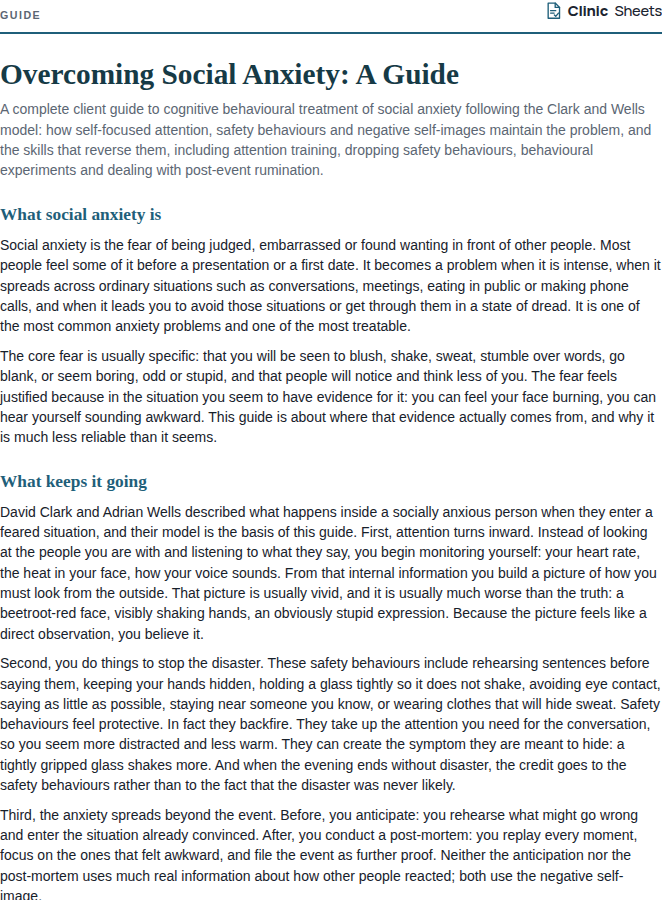
Fear of public speaking is the most common social fear and, for many clients, the one that costs them most at work, school or in their community. The Clark and Wells cognitive model of social anxiety explains why it persists despite repeated experience. When the speaker enters the situation they shift attention inward, monitoring their own sensations and constructing an image of how they must look (red, shaking, incoherent). This self-focused attention starves them of information about how the audience is actually responding, makes the sensations feel more visible than they are, and impairs performance. Safety behaviours such as reading from notes, avoiding eye contact, speaking quickly, gripping the lectern or over-rehearsing every word are intended to prevent disaster but maintain the belief that disaster was narrowly avoided, and often make the speaker seem less engaged.
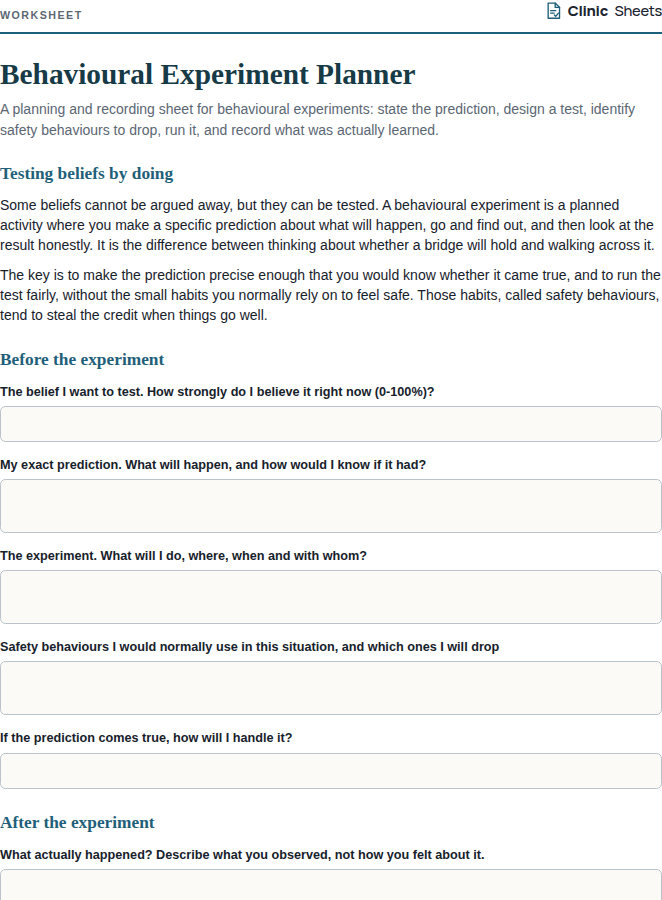
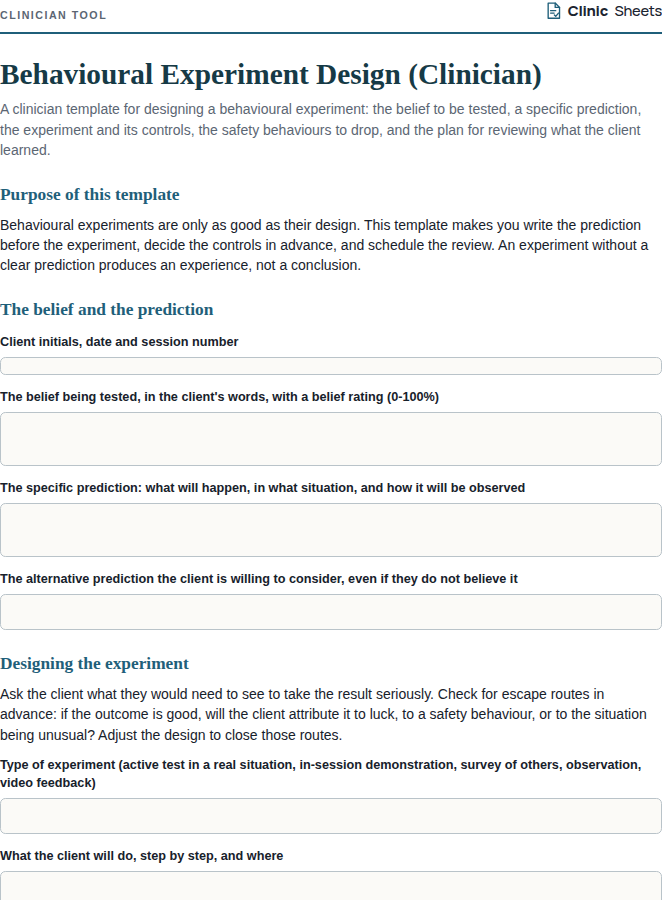
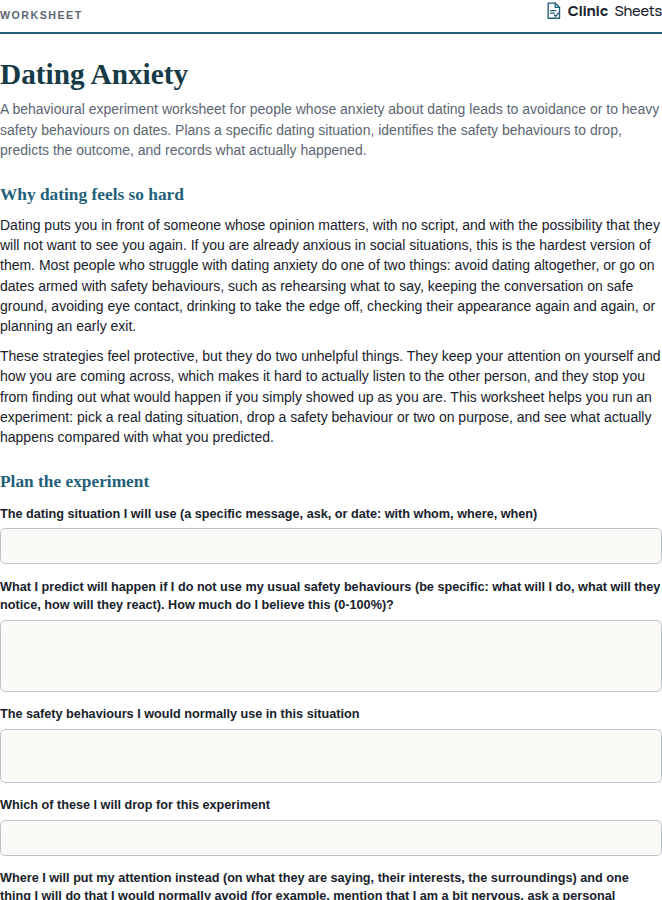
This worksheet walks the client through their own version of the model and then plans behavioural experiments: speaking tasks in which safety behaviours are deliberately dropped, attention is directed outward to the audience, and a specific prediction (I will go blank, people will see my hands shaking, someone will laugh) is tested against what actually happens. Video feedback, where available, is a powerful addition because clients consistently overestimate how anxious they appear.
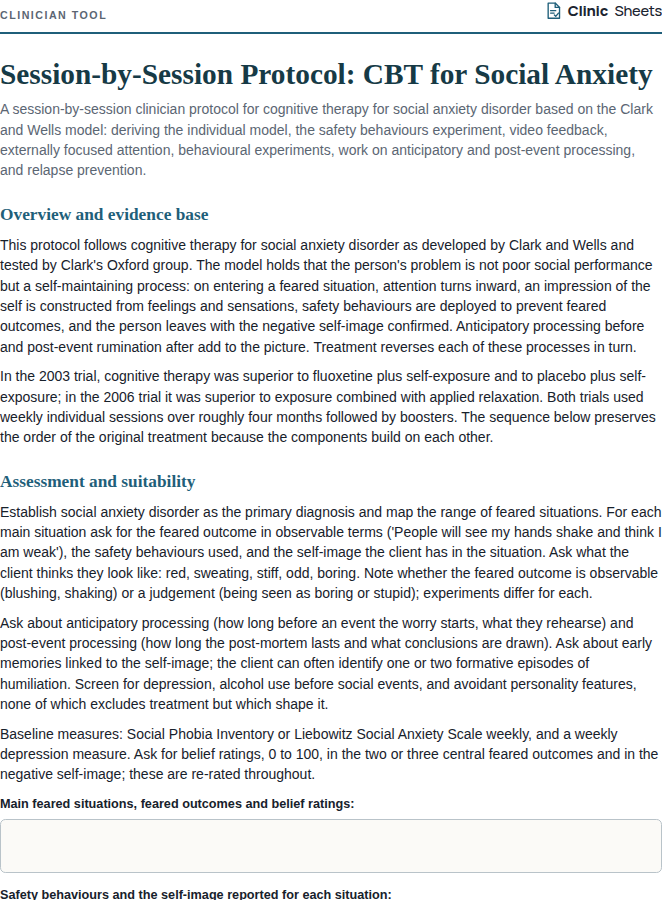
The professional version adds guidance on constructing a graded series of speaking tasks in and out of session, on using video feedback safely, and on the attention training that supports externally focused attention.
How to use it
- Elicit a recent speaking situation and use it to complete Part 1, drawing out the specific feared image, the safety behaviours and where attention was directed. Most clients recognise the model immediately.
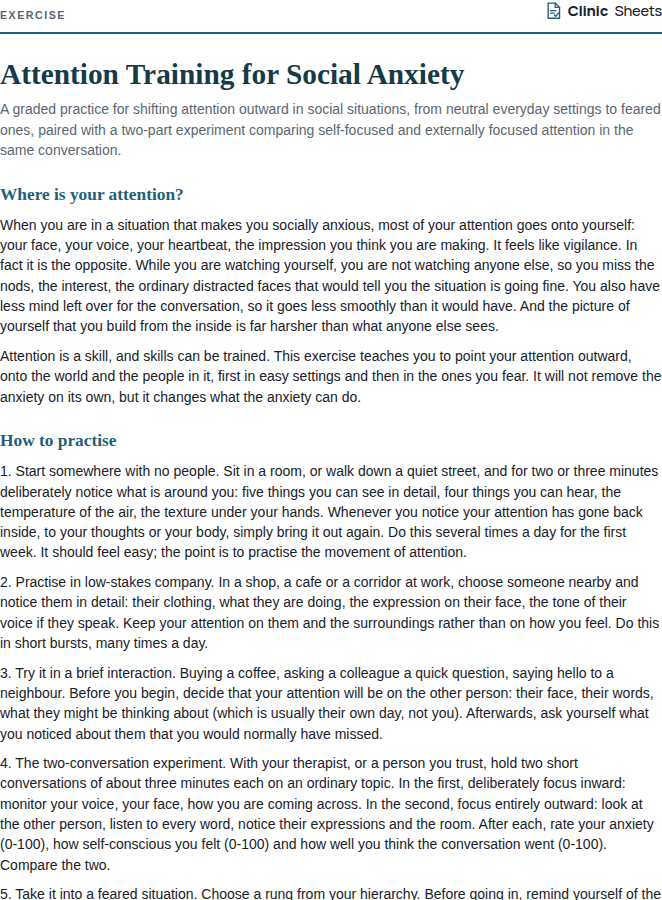
- Demonstrate the effect of attention in session: ask the client to speak for a minute while focusing on their sensations, then again while focusing on your face and the room. Compare anxiety and performance.
- Plan the first experiment in Part 2 with a clear, testable prediction and an agreed way of judging the result. Start with a short talk to you or a small group rather than the full feared situation.
- Use video feedback if possible. Before watching, have the client predict in detail how they will look; then watch together and compare. This is often the single most persuasive intervention.
- Work up through a series of experiments toward the real situations the client faces, dropping one safety behaviour at a time and keeping the attention shift central.
References
- Clark, D. M., & Wells, A. (1995). A cognitive model of social phobia. In R. G. Heimberg, M. R. Liebowitz, D. A. Hope, & F. R. Schneier (Eds.), Social Phobia: Diagnosis, Assessment, and Treatment (pp. 69-93). Guilford Press.
- Clark, D. M. (2001). A cognitive perspective on social phobia. In W. R. Crozier & L. E. Alden (Eds.), International Handbook of Social Anxiety (pp. 405-430). Wiley.
- Bennett-Levy, J., Butler, G., Fennell, M., Hackmann, A., Mueller, M., & Westbrook, D. (Eds.). (2004). Oxford Guide to Behavioural Experiments in Cognitive Therapy. Oxford University Press.