Session-by-Session Protocol: CBT for Social Anxiety
A session-by-session clinician protocol for cognitive therapy for social anxiety disorder based on the Clark and Wells model: deriving the individual model, the safety behaviours experiment, video feedback, externally focused attention, behavioural experiments, work on anticipatory and post-event processing, and relapse prevention.
About this resource
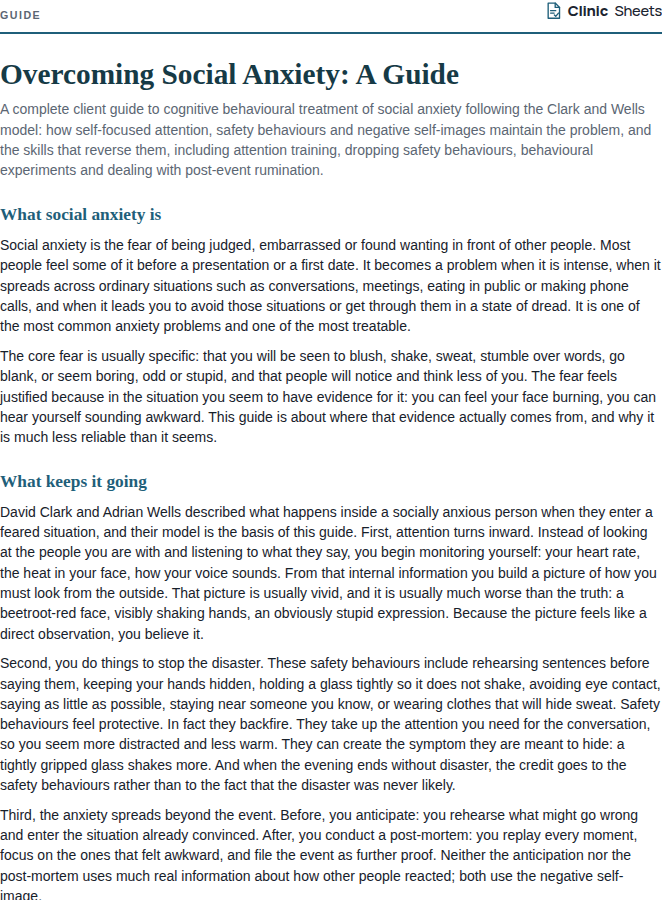
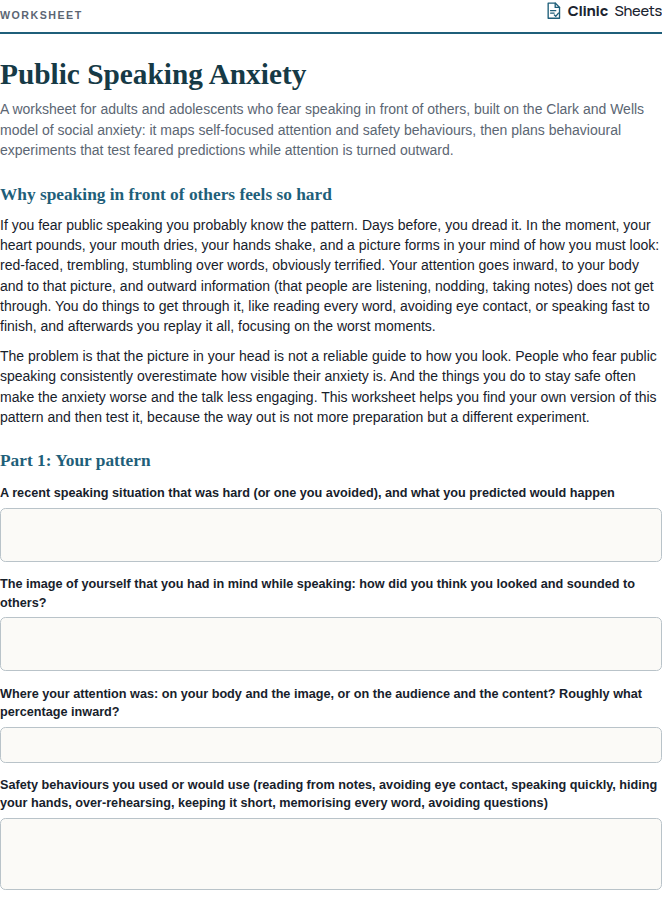
The Clark and Wells (1995) model proposes that social anxiety persists because, on entering a feared social situation, the person shifts attention inward, constructs a distorted image of how they appear to others from their internal sensations, and uses safety behaviours (rehearsing sentences, avoiding eye contact, gripping a glass, saying little) that both worsen performance and prevent disconfirmation of feared outcomes. Anticipatory worry before events and the post-mortem afterwards consolidate the negative self-image. Cognitive therapy built on this model has outperformed exposure with applied relaxation, fluoxetine and group CBT in randomised trials led by David Clark's group.
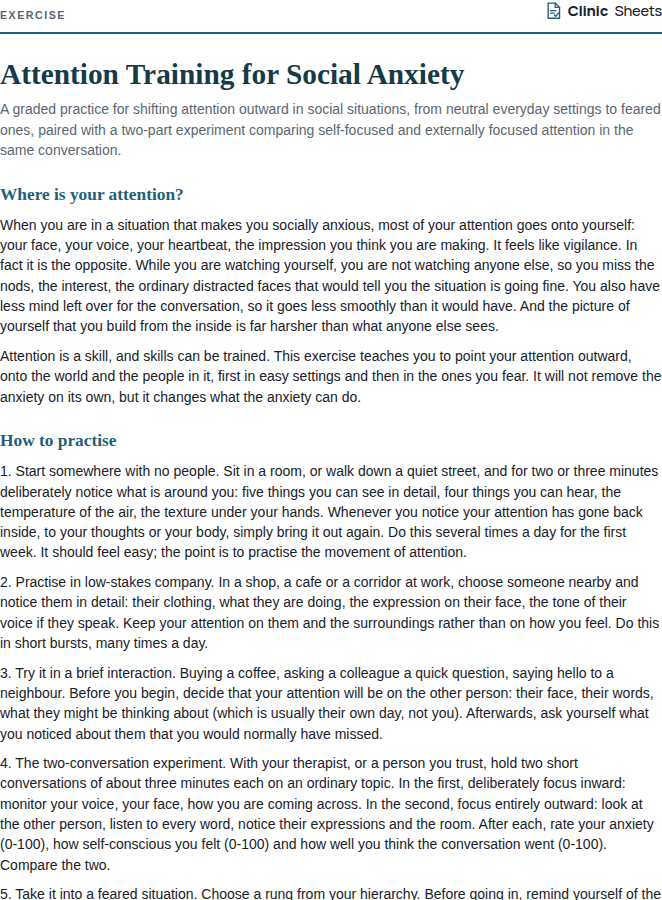
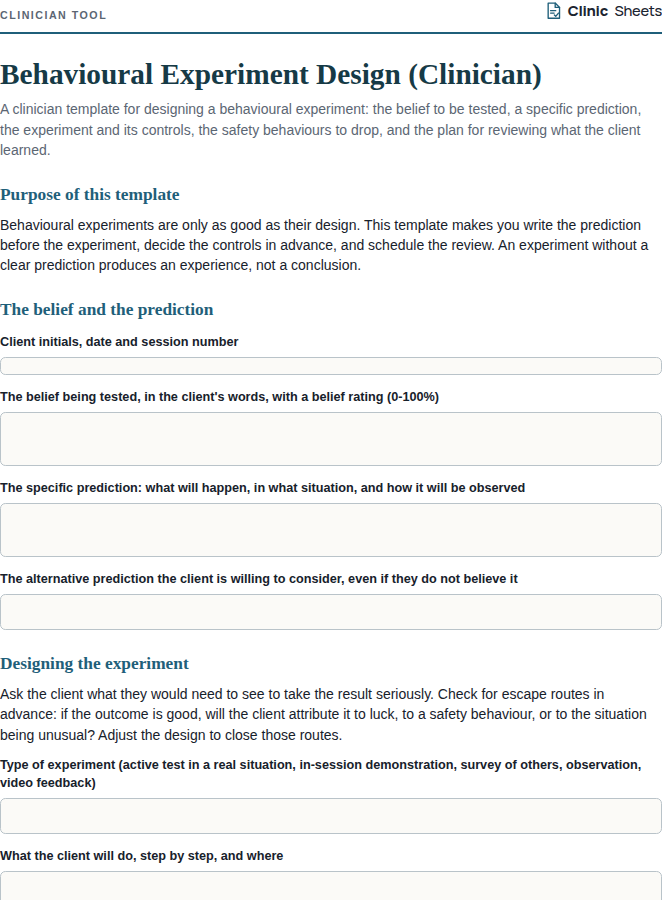
This protocol follows the sequence used in the Clark et al. (2003, 2006) trials, delivered in approximately fourteen weekly sessions of up to ninety minutes with booster sessions. Its distinctive elements are the early safety behaviours and self-focused attention experiment, video feedback to correct the distorted self-image, training in external attention, behavioural experiments designed to test specific predictions, surveys, work on anticipatory and post-event processing, and, where indicated, imagery rescripting of the early memories linked to the self-image.
The professional version explains why the order matters (the safety behaviours experiment must precede video feedback, and both must precede the main behavioural experiment phase), the most common errors (turning experiments into graded exposure, allowing the client to preview the video in their mind before watching it, and leaving post-event processing unaddressed), and how to handle clients whose feared outcome is not observable, such as being thought boring.
How to use it
- Confirm that social anxiety disorder is the primary problem and identify the client's feared social situations, their specific feared outcomes and the safety behaviours used in each. Complete the Social Phobia Inventory or Liebowitz Social Anxiety Scale at baseline and weekly thereafter.
- Derive the individual model in session one using a recent, specific episode. The model should be on paper and the client should be able to explain it back to you before you move on.
- Run the safety behaviours experiment in session two or three, then video feedback within the next session or two. Do not start the main behavioural experiment phase until the client has seen a gap between how they felt and how they looked.
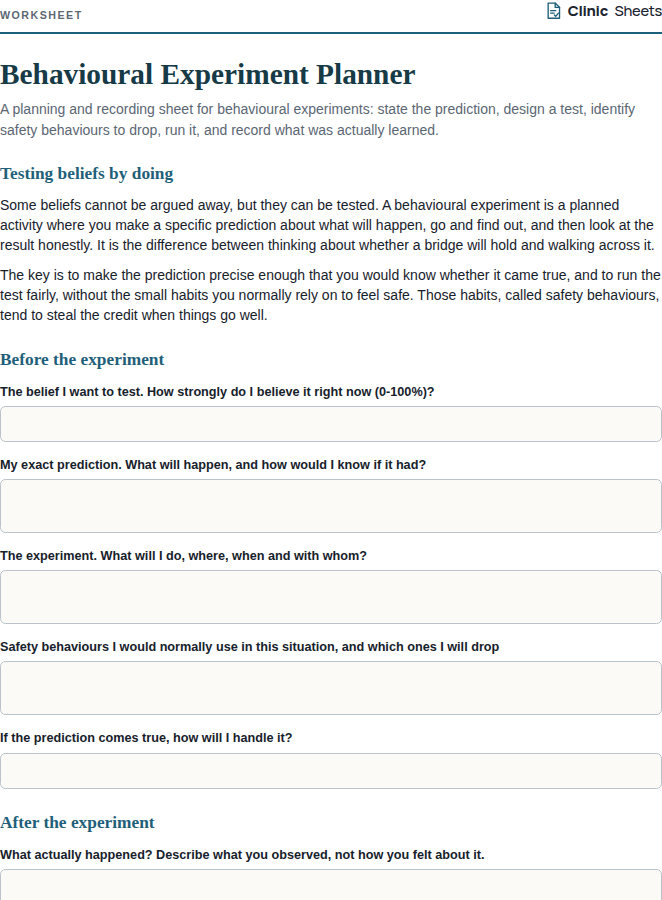
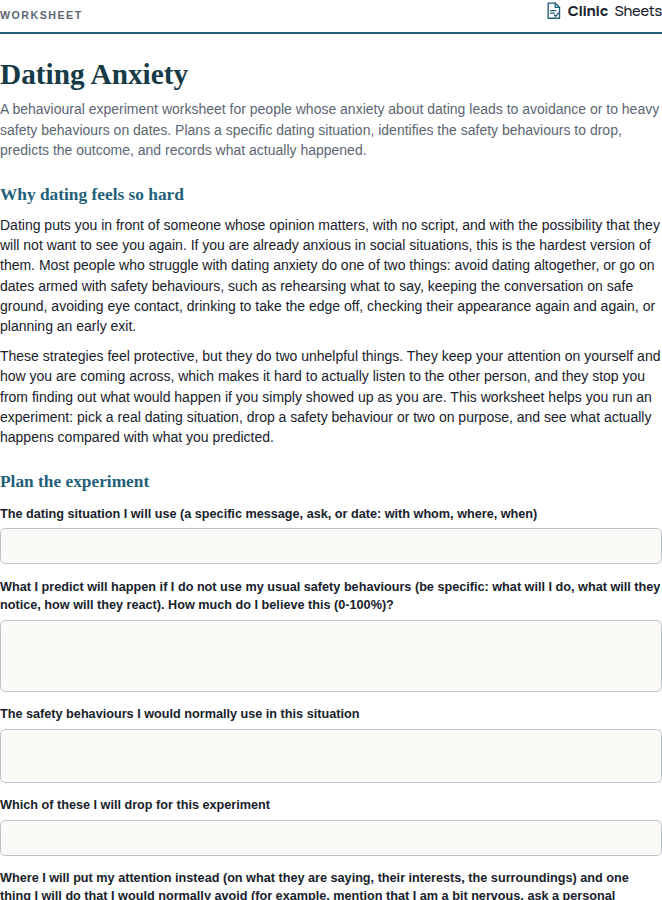
- From the middle of treatment, design a behavioural experiment every session and set one or more for between sessions. Each experiment tests a written prediction with a belief rating and is followed by a comparison of prediction and outcome.
- Address post-event processing as soon as it is identified and give the client an explicit alternative to the post-mortem. Reserve the final two sessions for the blueprint and booster planning.
References
- Clark, D. M., & Wells, A. (1995). A cognitive model of social phobia. In R. G. Heimberg, M. R. Liebowitz, D. A. Hope, & F. R. Schneier (Eds.), Social Phobia: Diagnosis, Assessment, and Treatment (pp. 69-93). Guilford Press.
- Clark, D. M., Ehlers, A., McManus, F., Hackmann, A., Fennell, M., Campbell, H., Flower, T., Davenport, C., & Louis, B. (2003). Cognitive therapy versus fluoxetine in generalized social phobia: A randomized placebo-controlled trial. Journal of Consulting and Clinical Psychology, 71(6), 1058-1067.
- Clark, D. M., Ehlers, A., Hackmann, A., McManus, F., Fennell, M., Grey, N., Waddington, L., & Wild, J. (2006). Cognitive therapy versus exposure and applied relaxation in social phobia: A randomized controlled trial. Journal of Consulting and Clinical Psychology, 74(3), 568-578.
- Wild, J., Hackmann, A., & Clark, D. M. (2008). Rescripting early memories linked to negative images in social phobia: A pilot study. Behavior Therapy, 39(1), 47-56.