Overcoming Social Anxiety: A Guide
A complete client guide to cognitive behavioural treatment of social anxiety following the Clark and Wells model: how self-focused attention, safety behaviours and negative self-images maintain the problem, and the skills that reverse them, including attention training, dropping safety behaviours, behavioural experiments and dealing with post-event rumination.
About this resource
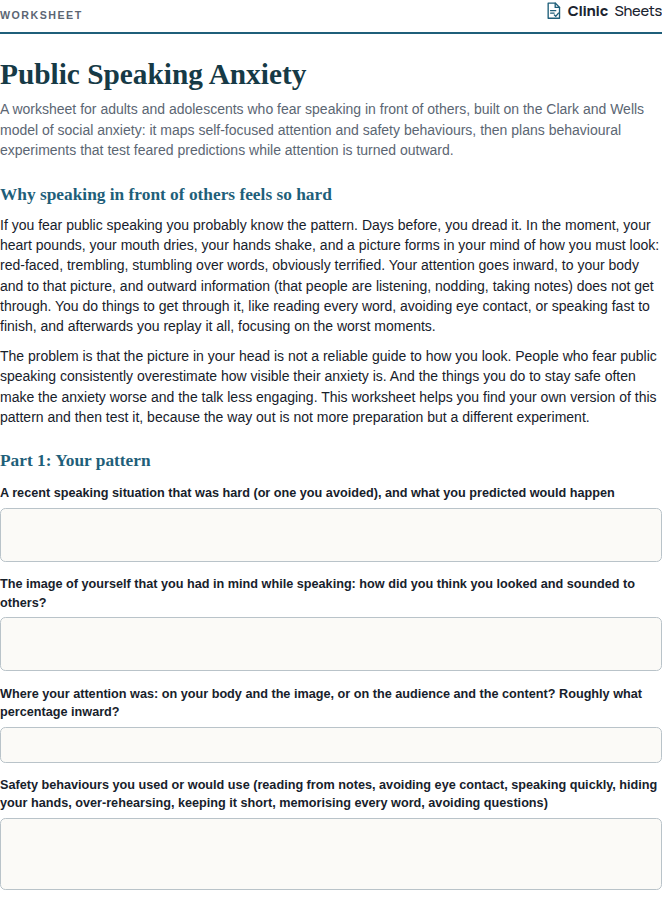
The Clark and Wells cognitive model of social anxiety proposes that when a socially anxious person enters a feared situation, attention shifts inward. They monitor their own sensations and construct an image of how they appear to others, usually far more negative than the reality, and treat that image as fact. Safety behaviours (rehearsing sentences, avoiding eye contact, gripping a glass, saying little) are used to prevent the feared catastrophe, but they increase self-focus, impair performance, and prevent the person from discovering that the feared outcome does not occur. Before the event, anticipatory worry primes the negative image; afterwards, a detailed post-mortem confirms it. Rapee and Heimberg's model adds the role of perceived audience standards and the comparison between the mental representation of self and what the audience expects.
Cognitive therapy for social anxiety based on this model is among the most effective psychological treatments for any anxiety disorder. This guide takes the client through the sequence used in that treatment: understanding the model through their own example, an experiment demonstrating the effect of self-focus and safety behaviours, training attention outward, behavioural experiments that test specific predictions without safety behaviours, updating the self-image (including the use of video or trusted feedback), and dropping anticipatory worry and post-event rumination. Each skill has a short practice field.
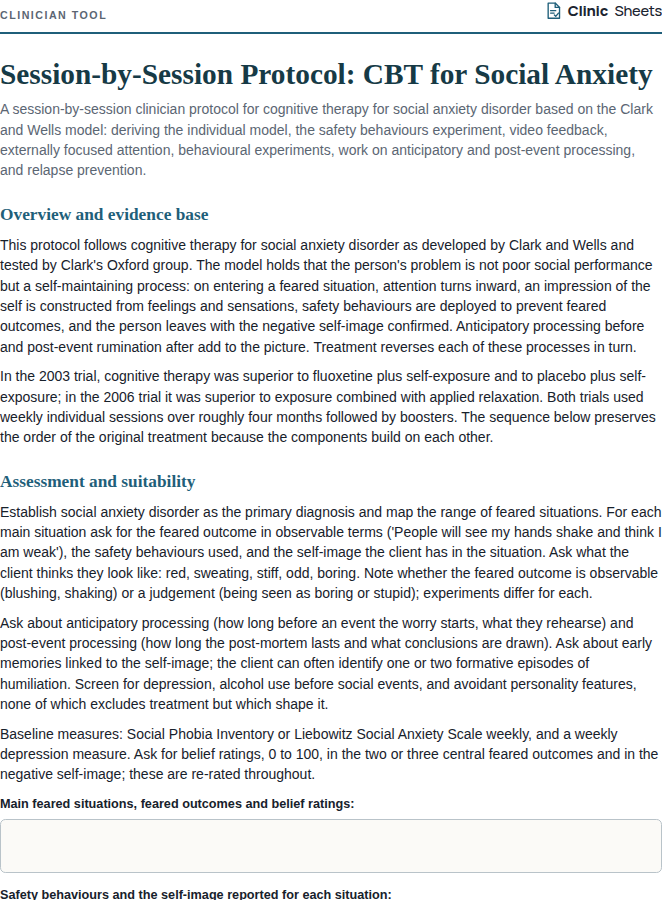
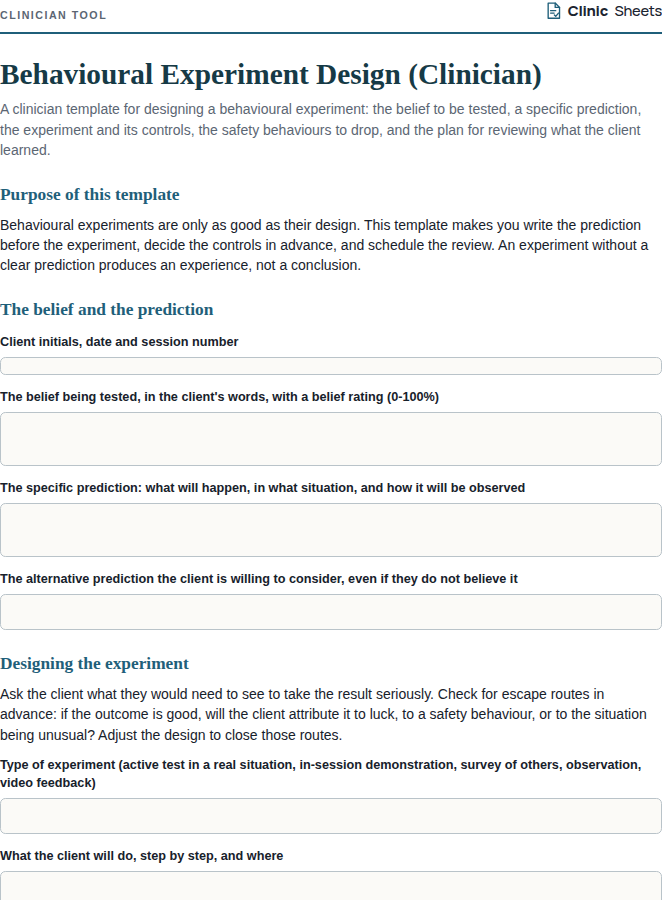
The professional version adds guidance on eliciting the client's self-image and its origins, on running the safety-behaviours experiment in session, and on video feedback, including how to prepare the client to watch the recording so that it corrects rather than confirms the negative image.
How to use it
- Derive the model from a recent situation in session one, using the client's own words for the feared outcome, the self-image, and the safety behaviours. Assign the first two sections as reading.
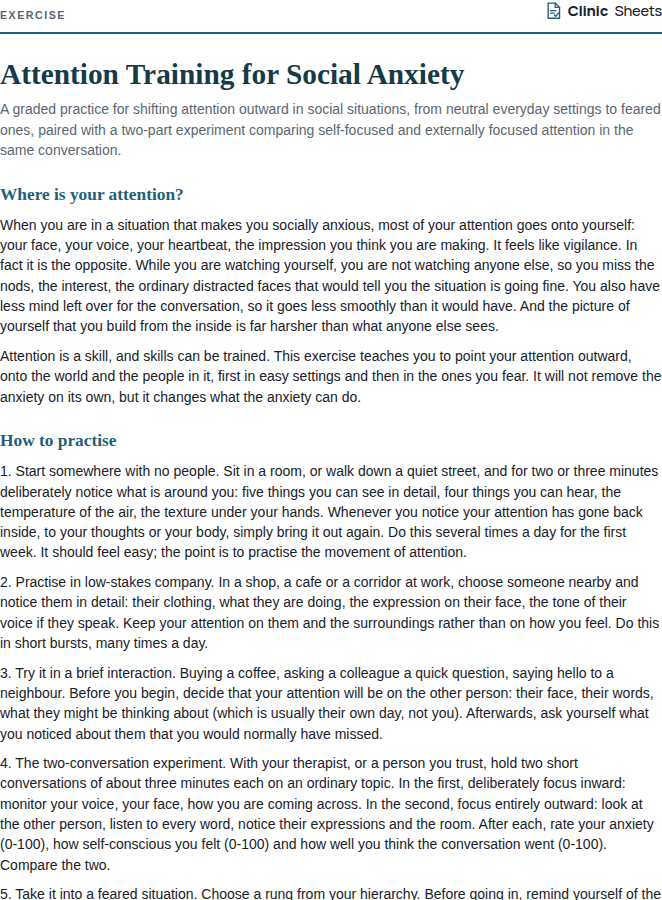
- Run the safety-behaviours experiment in session two: a short conversation with safety behaviours and self-focus, then the same conversation with attention outward and safety behaviours dropped. Compare ratings.
- Introduce attention training and assign daily practice in low-anxiety situations before using it in feared ones.
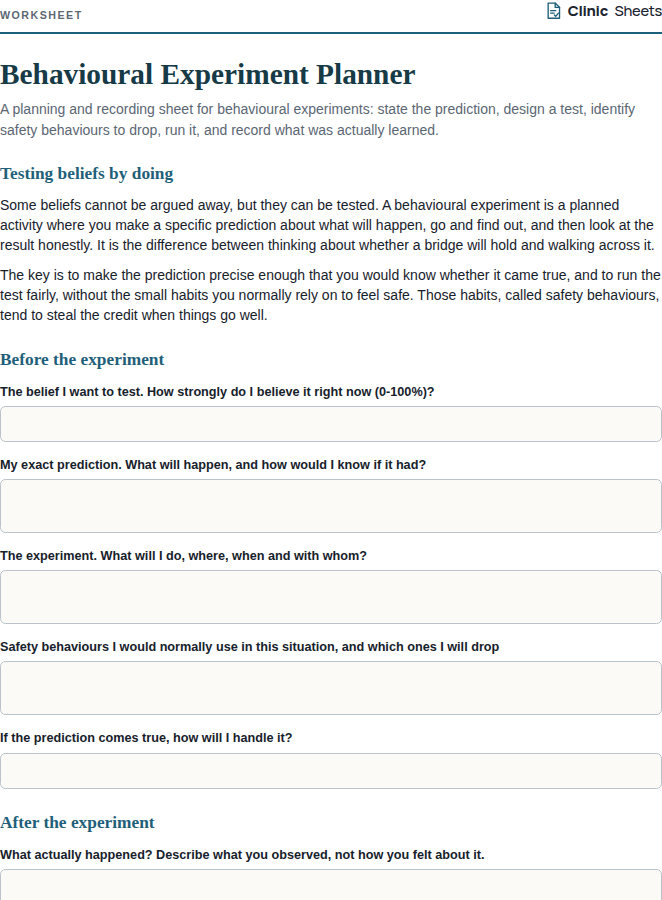
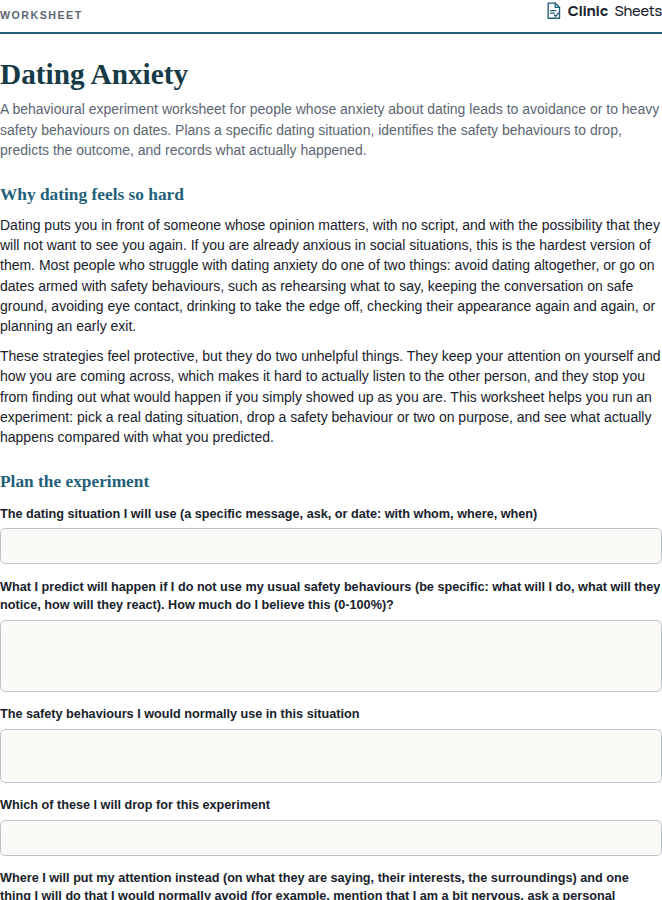
- Design behavioural experiments around specific predictions ('if I pause, they will think I am stupid') and always specify what the client will drop and what they will observe.
- Use video feedback where possible, with careful preparation, to update the self-image. Where video is not available, gather structured feedback from trusted others.
- Address post-event rumination once experiments are underway, and build the maintenance plan around continued experiments and the attention skill.
References
- Clark, D. M., & Wells, A. (1995). A cognitive model of social phobia. In R. G. Heimberg, M. R. Liebowitz, D. A. Hope, & F. R. Schneier (Eds.), Social Phobia: Diagnosis, Assessment, and Treatment (pp. 69-93). Guilford Press.
- Rapee, R. M., & Heimberg, R. G. (1997). A cognitive-behavioral model of anxiety in social phobia. Behaviour Research and Therapy, 35(8), 741-756.
- Butler, G. (2016). Overcoming Social Anxiety and Shyness (2nd ed.). Robinson.
- Antony, M. M., & Swinson, R. P. (2008). The Shyness and Social Anxiety Workbook: Proven, Step-by-Step Techniques for Overcoming Your Fear (2nd ed.). New Harbinger.