Behavioural Experiment Design (Clinician)
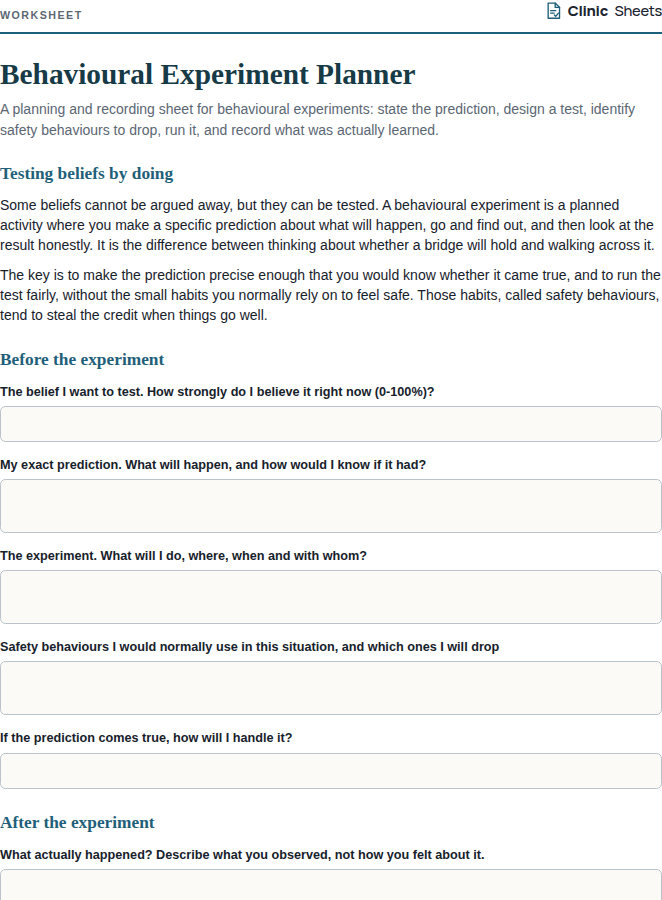
A clinician template for designing a behavioural experiment: the belief to be tested, a specific prediction, the experiment and its controls, the safety behaviours to drop, and the plan for reviewing what the client learned.
About this resource
Behavioural experiments are planned activities, carried out in or between sessions, that test the validity of a belief through direct experience. In CBT for anxiety and social anxiety they are often the most powerful intervention available, because experience changes belief more reliably than discussion. They differ from exposure in emphasis: the primary aim is to gather information about a specific prediction, rather than to reduce fear through repeated contact with a stimulus, although the two overlap considerably.
A good experiment has a testable prediction, an observable outcome, and a design that allows the outcome to be attributed to the belief rather than to something else. Common design faults are predictions that are too vague to be disconfirmed, experiments in which safety behaviours are quietly retained, and reviews that never happen because the session moved on. This template walks through the design steps in the order used in the Oxford Guide to Behavioural Experiments, with a section for the post-experiment review.
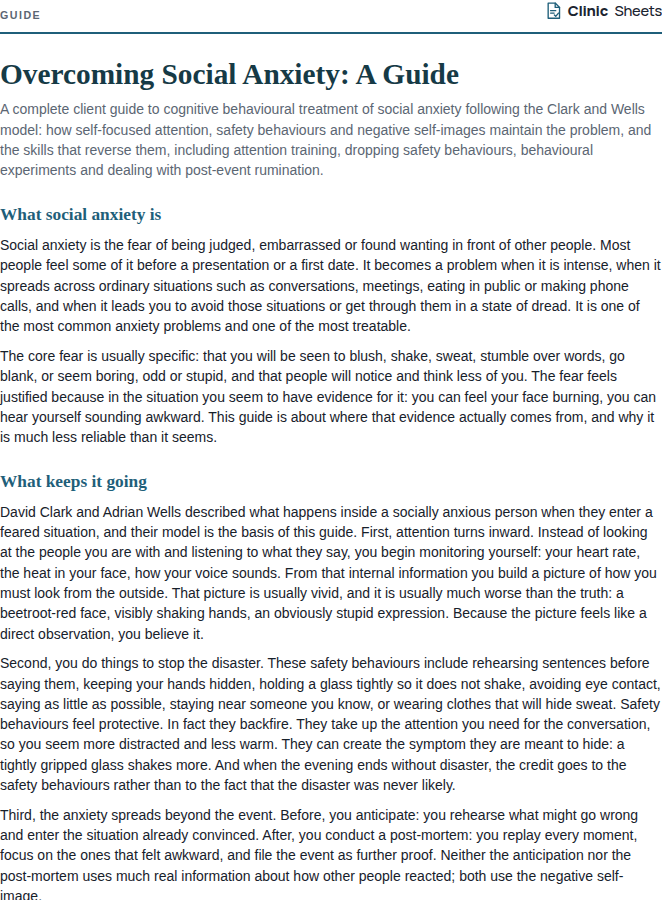
The professional version adds guidance on the two main experiment types, hypothesis-testing and discovery experiments, on using surveys and observation as alternatives to active experiments, and on the specific experiments most useful in social anxiety, such as dropping safety behaviours while shifting attention outward and testing the visibility of anxiety symptoms with video feedback.
How to use it
- Start from a belief the client rates highly and that the formulation identifies as maintaining the problem. Write it in the client's words.
- Turn the belief into a prediction that could be shown wrong: what will happen, in what situation, and how the client will know. Rate belief in the prediction as a percentage.
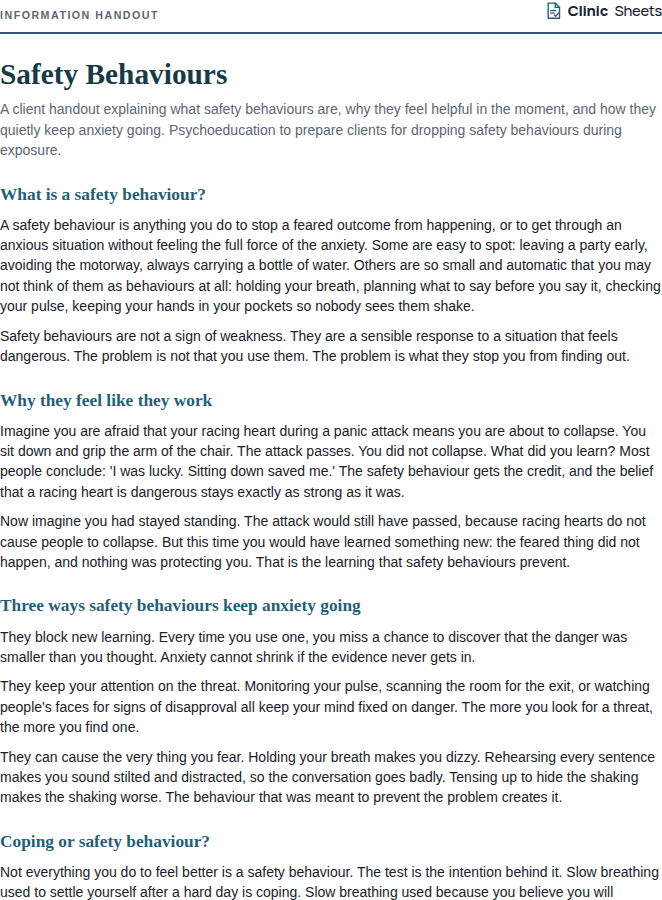
- Design the experiment with the client. Ask what would need to be true of the experiment for the client to accept its result. Build in the removal of safety behaviours and decide in advance what will be observed.
- Where possible, run the experiment in session first, so the review is immediate. Plan a between-session repetition for the same belief in a different situation.
- Review in the next session before anything else. Compare the outcome with the prediction, re-rate belief, and ask what the client makes of the difference. Record the conclusion in a form the client can keep.
- If the outcome confirmed the prediction, treat this as information about the design or about the belief, and plan the next experiment accordingly rather than dropping the method.
References
- Bennett-Levy, J., Butler, G., Fennell, M., Hackmann, A., Mueller, M., & Westbrook, D. (Eds.). (2004). Oxford Guide to Behavioural Experiments in Cognitive Therapy. Oxford University Press.
- Clark, D. M., & Wells, A. (1995). A cognitive model of social phobia. In R. G. Heimberg, M. R. Liebowitz, D. A. Hope, & F. R. Schneier (Eds.), Social Phobia: Diagnosis, Assessment, and Treatment (pp. 69-93). Guilford Press.
- Salkovskis, P. M. (1991). The importance of behaviour in the maintenance of anxiety and panic: A cognitive account. Behavioural Psychotherapy, 19(1), 6-19.