Dating Anxiety
A behavioural experiment worksheet for people whose anxiety about dating leads to avoidance or to heavy safety behaviours on dates. Plans a specific dating situation, identifies the safety behaviours to drop, predicts the outcome, and records what actually happened.
About this resource
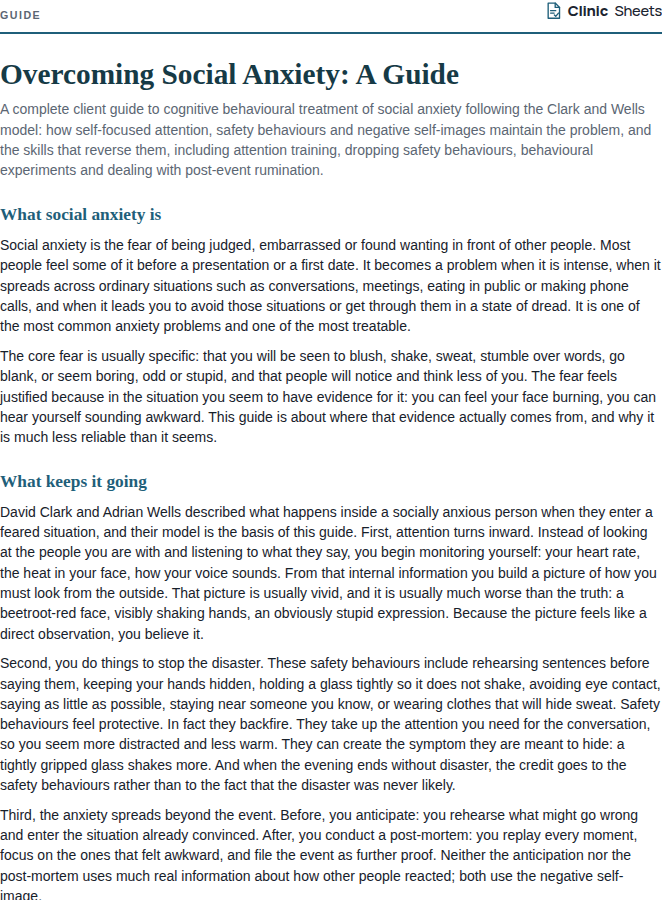
Dating is one of the situations in which social anxiety is most disabling, because it combines evaluation, uncertainty, and the possibility of rejection in a single encounter. The Clark and Wells model of social anxiety explains why the usual coping strategies backfire. Anticipating the date, the person predicts humiliation. During it, attention turns inward to monitor for signs of anxiety and to construct an image of how they must look. Safety behaviours (rehearsing lines, avoiding eye contact, over-talking or under-talking, drinking beforehand, keeping the date short, deflecting personal questions) reduce the felt risk in the moment but prevent the person from discovering that they could cope, and often produce exactly the flat, distant impression they fear. Afterwards, a post-mortem replays the evening and confirms the negative belief.
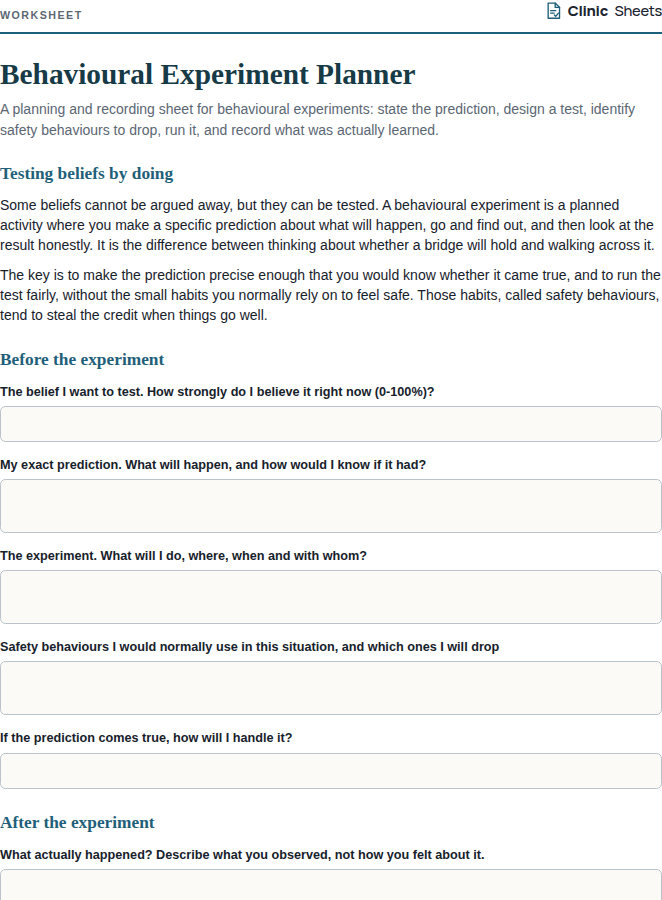
This worksheet applies behavioural experiments to dating. The client picks a specific upcoming situation (a first date, a message exchange, asking someone out), identifies their prediction and the safety behaviours they would normally use, drops one or more of them on purpose, shifts attention outward onto the other person, and records what actually happened. The comparison between prediction and outcome is where the learning lives. Repeated experiments across several dating situations gradually undermine the belief that anxiety must be hidden and that exposure of it leads to rejection.
The professional version notes that the aim is not to secure a second date, which the client cannot control, but to test a prediction about themselves; that rejection does occur in dating and needs to be framed as ordinary rather than as confirmation of the core belief; and that where the client has never dated at all, graded steps (messaging, a short coffee, a longer meeting) may be needed before a full experiment.
How to use it
- Elicit the client's dating-related predictions and safety behaviours in detail, including subtle ones (checking their appearance repeatedly, planning an exit, drinking beforehand, keeping conversation on safe topics).
- Choose a specific, achievable situation for the first experiment. If the client has been avoiding dating entirely, start with a lower step such as replying to a message or a short daytime coffee.
- Write the prediction precisely and rate belief in it. Vague predictions ('it will go badly') cannot be tested; specific ones ('there will be a silence and they will look bored') can.
- Agree which safety behaviours will be dropped and what outward-focused attention will replace them. Rehearse this in session, including a role-play if useful.
- Debrief soon after the experiment. Compare prediction with outcome, draw out what was learned about anxiety and about the client, and plan the next experiment. Address any post-mortem rumination directly.
References
- Clark, D. M., & Wells, A. (1995). A cognitive model of social phobia. In R. G. Heimberg, M. R. Liebowitz, D. A. Hope, & F. R. Schneier (Eds.), Social Phobia: Diagnosis, Assessment, and Treatment (pp. 69-93). Guilford Press.
- Bennett-Levy, J., Butler, G., Fennell, M., Hackmann, A., Mueller, M., & Westbrook, D. (Eds.). (2004). Oxford Guide to Behavioural Experiments in Cognitive Therapy. Oxford University Press.
- Butler, G. (2016). Overcoming Social Anxiety and Shyness (2nd ed.). Robinson.